Michael Clements - Böcker
Visar alla böcker från författaren Michael Clements. Handla med fri frakt och snabb leverans.
3 produkter
3 produkter
218 kr
Skickas inom 7-10 vardagar
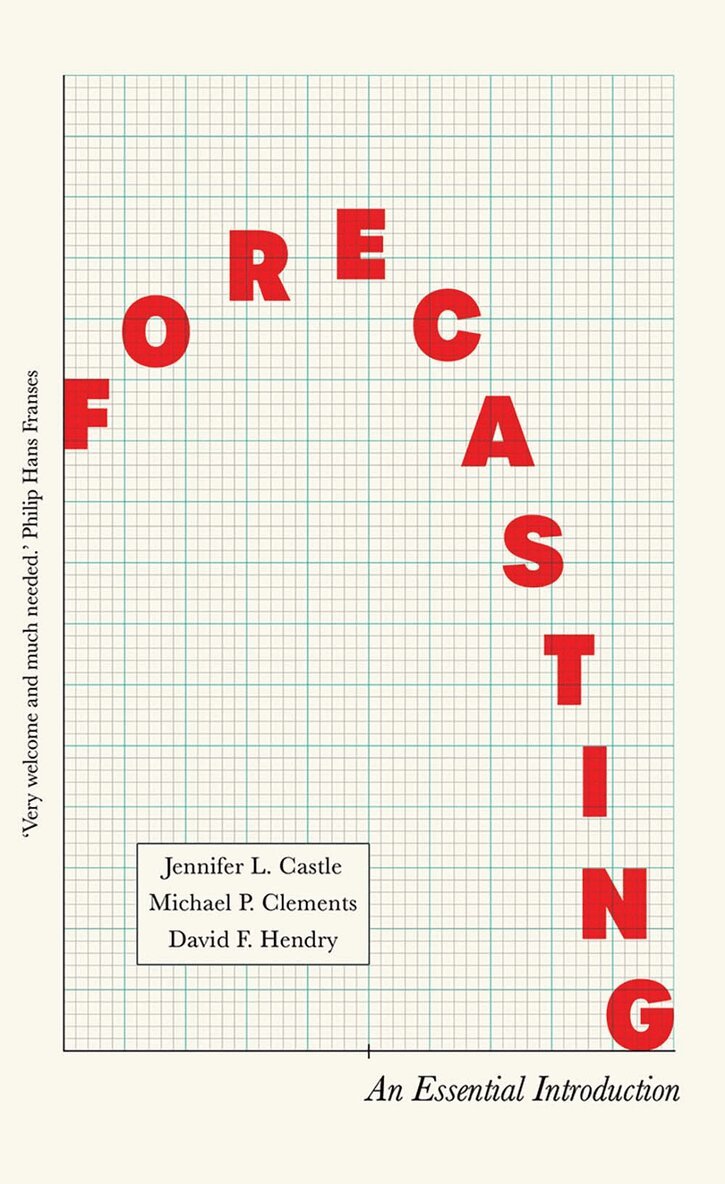
Concise, engaging, and highly intuitive—this accessible guide equips you with an understanding of all the basic principles of forecastingMaking accurate predictions about the economy has always been difficult, as F. A. Hayek noted when accepting his Nobel Prize in economics, but today forecasters have to contend with increasing complexity and unpredictable feedback loops. In this accessible and engaging guide, David Hendry, Michael Clements, and Jennifer Castle provide a concise and highly intuitive overview of the process and problems of forecasting. They explain forecasting concepts including how to evaluate forecasts, how to respond to forecast failures, and the challenges of forecasting accurately in a rapidly changing world. Topics covered include: What is a forecast? How are forecasts judged? And how can forecast failure be avoided? Concepts are illustrated using real-world examples including financial crises, the uncertainty of Brexit, and the Federal Reserve’s record on forecasting. This is an ideal introduction for university students studying forecasting, practitioners new to the field and for general readers interested in how economists forecast.
1 553 kr
Skickas inom 7-10 vardagar
This book provides a formal analysis of the models, procedures, and measures of economic forecasting with a view to improving forecasting practice. David Hendry and Michael Clements base the analyses on assumptions pertinent to the economies to be forecast, viz. a non-constant, evolving economic system, and econometric models whose form and structure are unknown a priori. The authors find that conclusions which can be established formally for constant-parameter stationary processes and correctly-specified models often do not hold when unrealistic assumptions are relaxed. Despite the difficulty of proceeding formally when models are mis-specified in unknown ways for non-stationary processes that are subject to structural breaks, Hendry and Clements show that significant insights can be gleaned. For example, a formal taxonomy of forecasting errors can be developed, the role of causal information clarified, intercept corrections re-established as a method for achieving robustness against forms of structural change, and measures of forecast accuracy re-interpreted.
645 kr
Skickas inom 7-10 vardagar
This book provides a formal analysis of the models, procedures, and measures of economic forecasting with a view to improving forecasting practice. David Hendry and Michael Clements base the analyses on assumptions pertinent to the economies to be forecast, viz. a non-constant, evolving economic system, and econometric models whose form and structure are unknown a priori. The authors find that conclusions which can be established formally for constant-parameter stationary processes and correctly-specified models often do not hold when unrealistic assumptions are relaxed. Despite the difficulty of proceeding formally when models are mis-specified in unknown ways for non-stationary processes that are subject to structural breaks, Hendry and Clements show that significant insights can be gleaned. For example, a formal taxonomy of forecasting errors can be developed, the role of causal information clarified, intercept corrections re-established as a method for achieving robustness against forms of structural change, and measures of forecast accuracy re-interpreted.