Michael G. Hinchey – författare
Visar alla böcker från författaren Michael G. Hinchey. Handla med fri frakt och snabb leverans.
18 produkter
18 produkter
E-bok
PDF, Engelska, 20122 036 kr
Läs direkt efter köp
Industrial Strength Formal Methods in Practice provides hands-on experience and guidance for anyone who needs to apply formal methods successfully in an industrial context. Each chapter is written by an expert in software engineering or formal methods, and contains background information, introductions to the techniques being used, actual fragments of formalised components, details of results and an analysis of the overall approach. It provides specific details on how to produce high-quality software that comes in on-time and within budget. Aimed mainly at practitioners in software engineering and formal methods, this book will also be of interest to the following groups; academic researchers working in formal methods who are interested in evidence of their success and in how they can be applied on an industrial scale, and students on advanced software engineering courses who need real-life specifications and examples on which to base their work.
E-bok
PDF, Engelska, 2012708 kr
Läs direkt efter köp
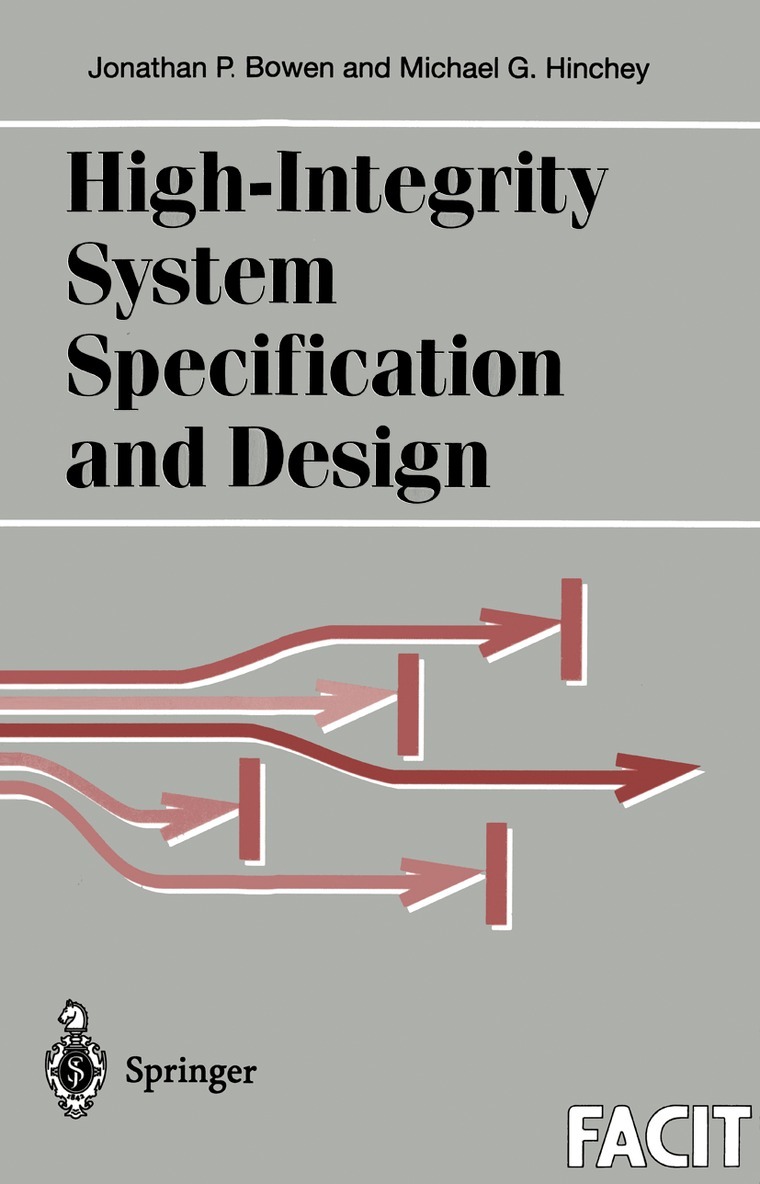
Errata, detected in Taylor''s Logarithms. London: 4to, 1792. [sic] 14.18.3 6 Kk Co-sine of 3398 3298 - Nautical Almanac (1832) In the list of ERRATA detected in Taylor''s Logarithms, for cos. 4° 18''3", read cos. 14° 18''2". - Nautical Almanac (1833) ERRATUM ofthe ERRATUM ofthe ERRATA of TAYLOR''S Logarithms. For cos. 4° 18''3", read cos. 14° 18'' 3". - Nautical Almanac (1836) In the 1820s, an Englishman named Charles Babbage designed and partly built a calculating machine originally intended for use in deriving and printing logarithmic and other tables used in the shipping industry. At that time, such tables were often inaccurate, copied carelessly, and had been instrumental in causing a number of maritime disasters. Babbage''s machine, called a ''Difference Engine'' because it performed its cal culations using the principle of partial differences, was intended to substantially reduce the number of errors made by humans calculating the tables. Babbage had also designed (but never built) a forerunner of the modern printer, which would also reduce the number of errors admitted during the transcription of the results. Nowadays, a system implemented to perform the function of Babbage''s engine would be classed as safety-critical. That is, the failure of the system to produce correct results could result in the loss of human life, mass destruction of property (in the form of ships and cargo) as well as financial losses and loss of competitive advantage for the shipping firm.
Häftad, Engelska, 1999
1 681 kr
Skickas inom 10-15 vardagar
Industrial Strength Formal Methods in Practice provides hands-on experience and guidance for anyone who needs to apply formal methods successfully in an industrial context. Each chapter is written by an expert in software engineering or formal methods, and contains background information, introductions to the techniques being used, actual fragments of formalised components, details of results and an analysis of the overall approach. It provides specific details on how to produce high-quality software that comes in on-time and within budget. Aimed mainly at practitioners in software engineering and formal methods, this book will also be of interest to the following groups; academic researchers working in formal methods who are interested in evidence of their success and in how they can be applied on an industrial scale, and students on advanced software engineering courses who need real-life specifications and examples on which to base their work.
Häftad, Engelska, 2005
565 kr
Skickas inom 10-15 vardagar
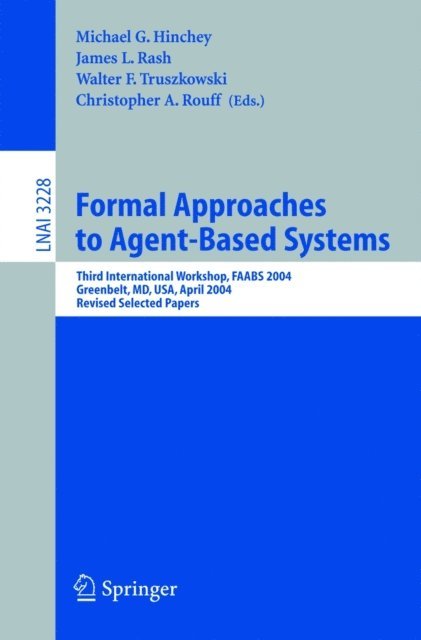
The 3rd Workshop on Formal Approaches to Agent-Based Systems (FAABS-III) was held at the Greenbelt Marriott Hotel (near NASA Goddard Space Flight Center) in April 2004 in conjunction with the IEEE Computer Society. The first FAABS workshop was help in April 2000 and the second in October 2002. Interest in agent-based systems continues to grow and this is seen in the wide range of conferences and journals that are addressing the research in this area as well as the prototype and developmental systems that are coming into use. Our third workshop, FAABS-III, was held in April, 2004. This volume contains the revised papers and posters presented at that workshop. The Organizing Committee was fortunate in having significant support in the planning and organization of these events, and were privileged to have wor- renowned keynote speakers Prof. J Moore (FAABS-I), Prof. Sir Roger Penrose (FAABS-II), and Prof. John McCarthy (FAABS-III), who spoke on the topic of se- aware computing systems, auguring perhaps a greater interest in autonomic computing as part of future FAABS events. We are grateful to all who attended the workshop, presented papers or posters, and participated in panel sessions and both formal and informal discussions to make the workshop a great success. Our thanks go to the NASA Goddard Space Flight Center, Codes 588 and 581 (Software Engineering Laboratory) for their financial support and to the IEEE Computer Society (Technical Committee on Complexity in Computing) for their sponsorship and organizational assistance.
E-bok
PDF, Engelska, 2005687 kr
Läs direkt efter köp
The 3rd Workshop on Formal Approaches to Agent-Based Systems (FAABS-III) was held at the Greenbelt Marriott Hotel (near NASA Goddard Space Flight Center) in April 2004 in conjunction with the IEEE Computer Society. The first FAABS workshop was help in April 2000 and the second in October 2002. Interest in agent-based systems continues to grow and this is seen in the wide range of conferences and journals that are addressing the research in this area as well as the prototype and developmental systems that are coming into use. Our third workshop, FAABS-III, was held in April, 2004. This volume contains the revised papers and posters presented at that workshop. The Organizing Committee was fortunate in having significant support in the planning and organization of these events, and were privileged to have wor- renowned keynote speakers Prof. J Moore (FAABS-I), Prof. Sir Roger Penrose (FAABS-II), and Prof. John McCarthy (FAABS-III), who spoke on the topic of se- aware computing systems, auguring perhaps a greater interest in autonomic computing as part of future FAABS events. We are grateful to all who attended the workshop, presented papers or posters, and participated in panel sessions and both formal and informal discussions to make the workshop a great success. Our thanks go to the NASA Goddard Space Flight Center, Codes 588 and 581 (Software Engineering Laboratory) for their financial support and to the IEEE Computer Society (Technical Committee on Complexity in Computing) for their sponsorship and organizational assistance.
Häftad, Engelska, 2003
550 kr
Skickas inom 10-15 vardagar
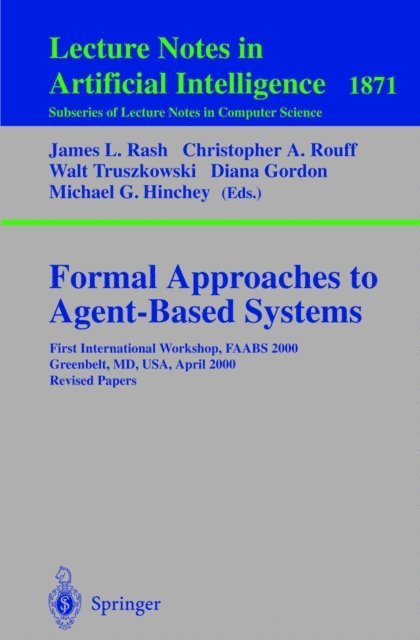
The idea of a FAABS workshop was first conceived in 1998 at the NASA Goddard Space Flight Center, while the Agent Technology Development Group in the Advanced Architectures and Automation Branch (Code 588) was developing a prototype agent community to automate satellite ground operations. While developing this system, several race conditions arose within and between agents. Due to the complexity of the agents and the communications between them, it was decided that a formal approach was needed to specify the agents and the communications between them, so that the system could be checked for additional errors. A formal model of the inter-agent communications was developed, with the expectation that this would enable us to find more errors. Success in this convinced us of the importance of using formal methods to model agent-based systems. To share our own experiences and to learn how others were approaching these issues, we decided to hold a workshop on formal methods and agent-based systems. The response was overwhelming. The result was the first FAABS workshop, which was held at the NASA Goddard Space Flight Center. Posters, paper presentations, panels, and an invited talk by J Moore stimulated much discussion and subsequent collaboration.
Häftad, Engelska, 2001
565 kr
Skickas inom 10-15 vardagar
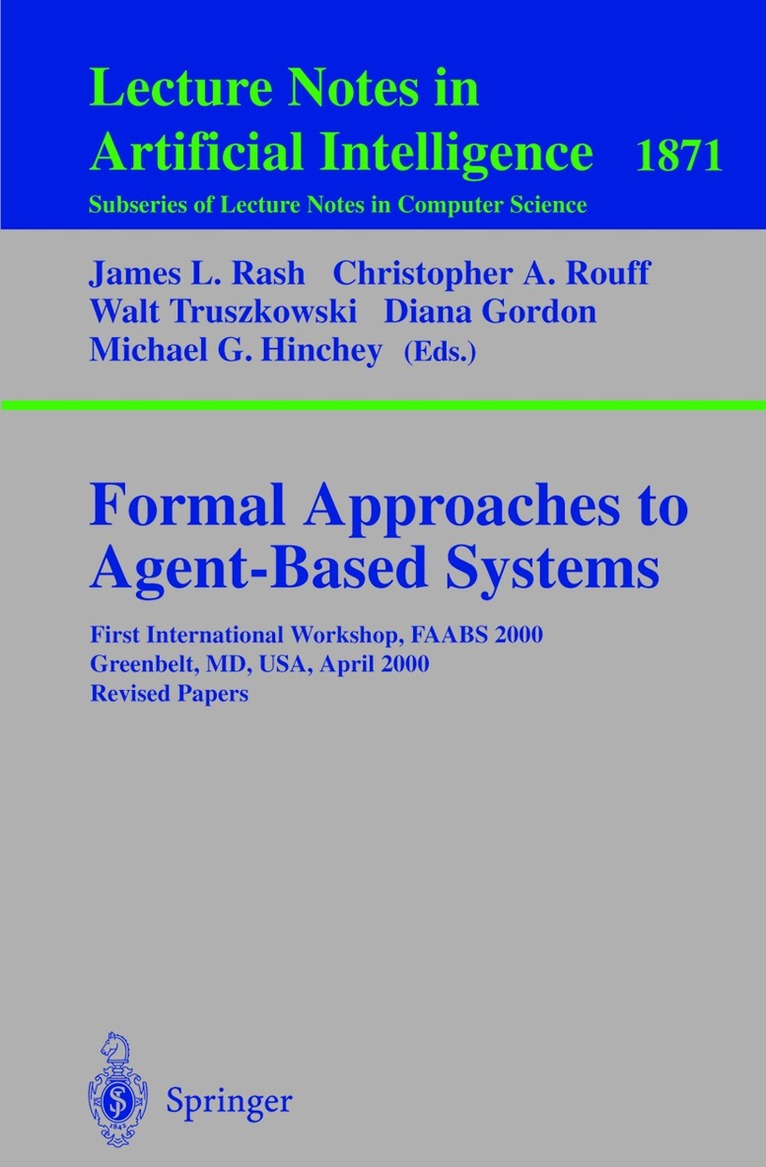
This book constitutes the thoroughly refereed post-proceedings of the First International Workshop on Formal Approaches to Agent-Based Systems, FAABS 2000, held in Greenbelt, MD, USA, in April 2000.The 22 revised full papers presented together with 13 posters and two panel discussion reports were carefully reviewed and improved for inclusion in the book. The papers are organized in topical sections on verifying agents' mental states, synthesizing agents initially, frameworks and formalizations, modeling and execution, inter-agent communication, and adaptive agents.
E-bok
PDF, Engelska, 2003708 kr
Läs direkt efter köp
The idea of a FAABS workshop was first conceived in 1998 at the NASA Goddard Space Flight Center, while the Agent Technology Development Group in the Advanced Architectures and Automation Branch (Code 588) was developing a prototype agent community to automate satellite ground operations. While developing this system, several race conditions arose within and between agents. Due to the complexity of the agents and the communications between them, it was decided that a formal approach was needed to specify the agents and the communications between them, so that the system could be checked for additional errors. A formal model of the inter-agent communications was developed, with the expectation that this would enable us to find more errors. Success in this convinced us of the importance of using formal methods to model agent-based systems. To share our own experiences and to learn how others were approaching these issues, we decided to hold a workshop on formal methods and agent-based systems. The response was overwhelming. The result was the first FAABS workshop, which was held at the NASA Goddard Space Flight Center. Posters, paper presentations, panels, and an invited talk by J Moore stimulated much discussion and subsequent collaboration.
E-bok
PDF, Engelska, 2003734 kr
Läs direkt efter köp
This book constitutes the thoroughly refereed post-proceedings of the First International Workshop on Formal Approaches to Agent-Based Systems, FAABS 2000, held in Greenbelt, MD, USA, in April 2000.The 22 revised full papers presented together with 13 posters and two panel discussion reports were carefully reviewed and improved for inclusion in the book. The papers are organized in topical sections on verifying agents'' mental states, synthesizing agents initially, frameworks and formalizations, modeling and execution, inter-agent communication, and adaptive agents.
E-bok
PDF, Engelska, 2011708 kr
Läs direkt efter köp
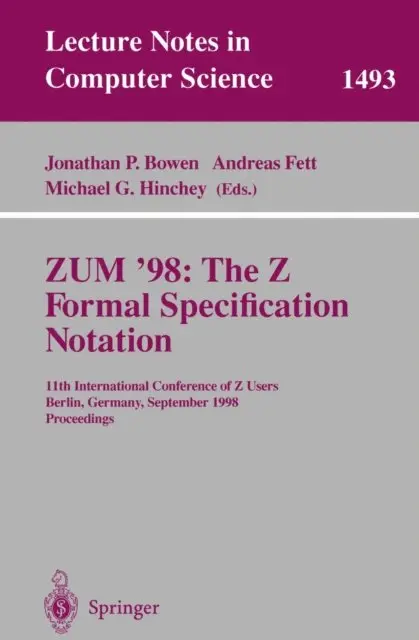
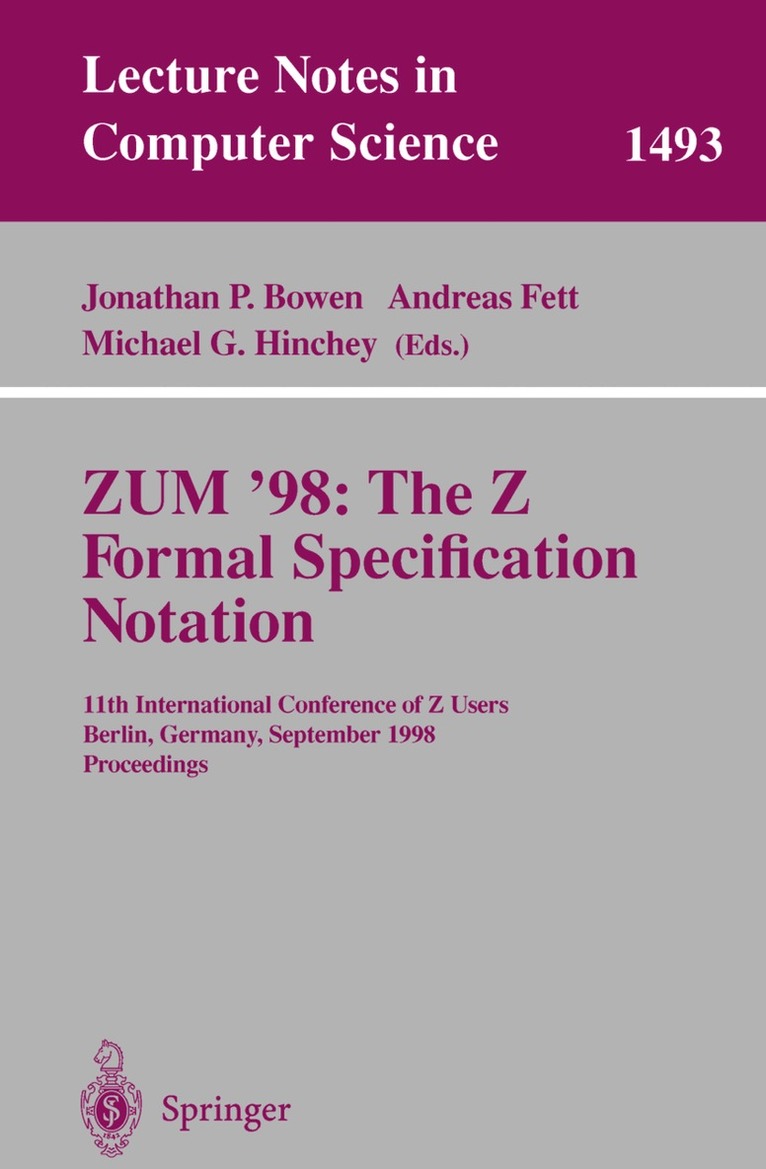
1 In a number of recent presentations – most notably at FME’96 –oneofthe foremost scientists in the ?eld of formal methods, C.A.R. Hoare,has highlighted the fact that formal methods are not the only technique for producing reliable software. This seems to have caused some controversy,not least amongst formal methods practitioners. How can one of the founding fathers of formal methods seemingly denounce the ?eld of research after over a quarter of a century of support? This is a question that has been posed recently by some formal methods skeptics. However, Prof. Hoare has not abandoned formal methods. He is reiterating, 2 albeitmoreradically,his1987view thatmorethanonetoolandnotationwillbe requiredinthepractical,industrialdevelopmentoflarge-scalecomplexcomputer systems; and not all of these tools and notations will be, or even need be, formal in nature. Formalmethods arenotasolution,butratheroneofaselectionoftechniques that have proven to be useful in the development of reliable complex systems, and to result in hardware and software systems that can be produced on-time and within a budget, while satisfying the stated requirements. After almostthree decades,the time has come to view formalmethods in the context of overall industrial-scale system development, and their relationship to othertechniquesandmethods.Weshouldnolongerconsidertheissueofwhether we are “pro-formal” or “anti-formal”, but rather the degree of formality (if any) that we need to support in system development. This is a goal of ZUM’98, the 11th International Conference of Z Users, held for the ?rst time within continental Europe in the city of Berlin, Germany.
Häftad, Engelska, 1995
1 125 kr
Skickas inom 10-15 vardagar
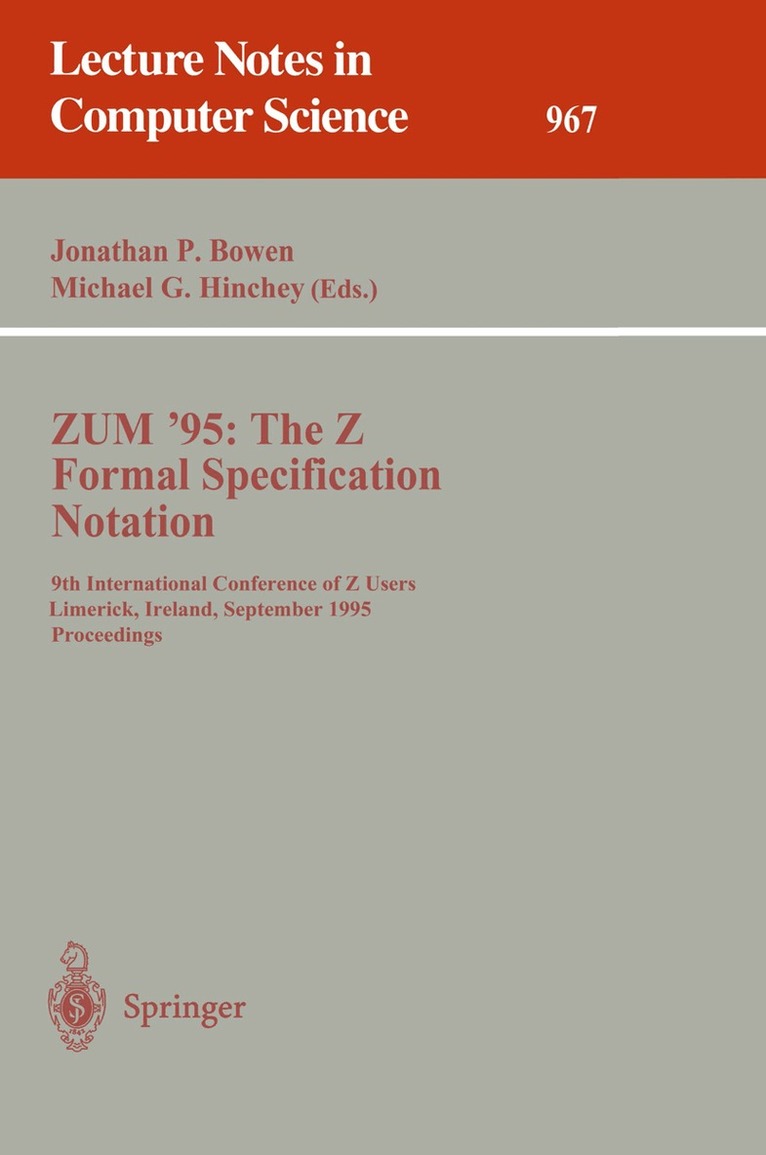
This book presents the proceedings of the 9th International Conference of Z Users, ZUM '95, held in Limerick, Ireland in September 1995.The book contains 34 carefully selected papers on Z, using Z, applications of Z, proof, testing, industrial usage, object orientation, animation of specification, method integration, and teaching formal methods. Of particular interest is the inclusion of an annotated Z bibliography listing 544 entries. While focussing on Z, by far the most commonly used "formal method" both in industry and application, the volume is of high relevance for the whole formal methods community.
Häftad, Engelska, 1997
566 kr
Skickas inom 10-15 vardagar
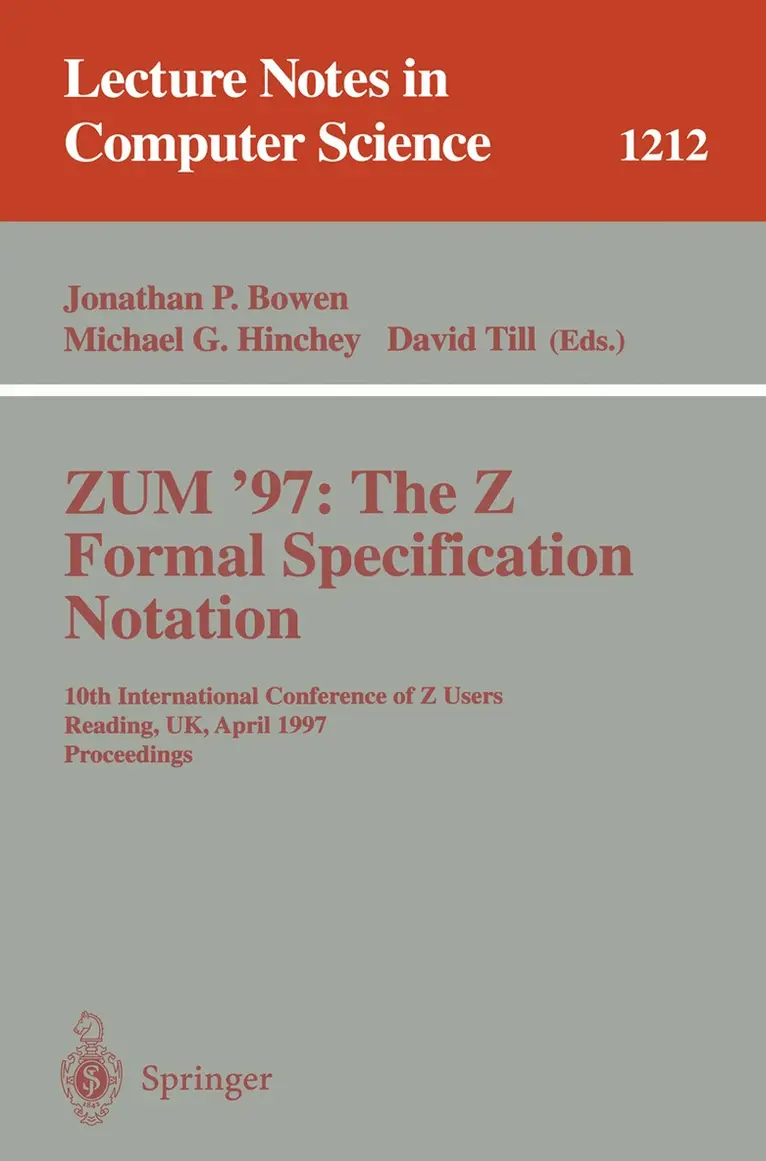
This book constitutes the refereed proceedings of the 10th International Conference of Z Users, ZUM'97, held in Reading, UK, in April 1997.The volume presents 18 revised full papers together with three invited presentations by internationally leading experts. The papers are organized into topical sections on real-time systems, tools, logic, system development, reactive systems, refinement, and applications. Also a select Z bibliography by Jonathan Bowen is added. All in all, the book competently reports the state-of-the-art in research and advanced applications of the Z notation.
Häftad, Engelska, 1998
565 kr
Skickas inom 10-15 vardagar
1 In a number of recent presentations – most notably at FME’96 –oneofthe foremost scientists in the ?eld of formal methods, C.A.R. Hoare,has highlighted the fact that formal methods are not the only technique for producing reliable software. This seems to have caused some controversy,not least amongst formal methods practitioners. How can one of the founding fathers of formal methods seemingly denounce the ?eld of research after over a quarter of a century of support? This is a question that has been posed recently by some formal methods skeptics. However, Prof. Hoare has not abandoned formal methods. He is reiterating, 2 albeitmoreradically,his1987view thatmorethanonetoolandnotationwillbe requiredinthepractical,industrialdevelopmentoflarge-scalecomplexcomputer systems; and not all of these tools and notations will be, or even need be, formal in nature. Formalmethods arenotasolution,butratheroneofaselectionoftechniques that have proven to be useful in the development of reliable complex systems, and to result in hardware and software systems that can be produced on-time and within a budget, while satisfying the stated requirements. After almostthree decades,the time has come to view formalmethods in the context of overall industrial-scale system development, and their relationship to othertechniquesandmethods.Weshouldnolongerconsidertheissueofwhether we are “pro-formal” or “anti-formal”, but rather the degree of formality (if any) that we need to support in system development. This is a goal of ZUM’98, the 11th International Conference of Z Users, held for the ?rst time within continental Europe in the city of Berlin, Germany.
Häftad, Engelska, 2006
566 kr
Skickas inom 10-15 vardagar
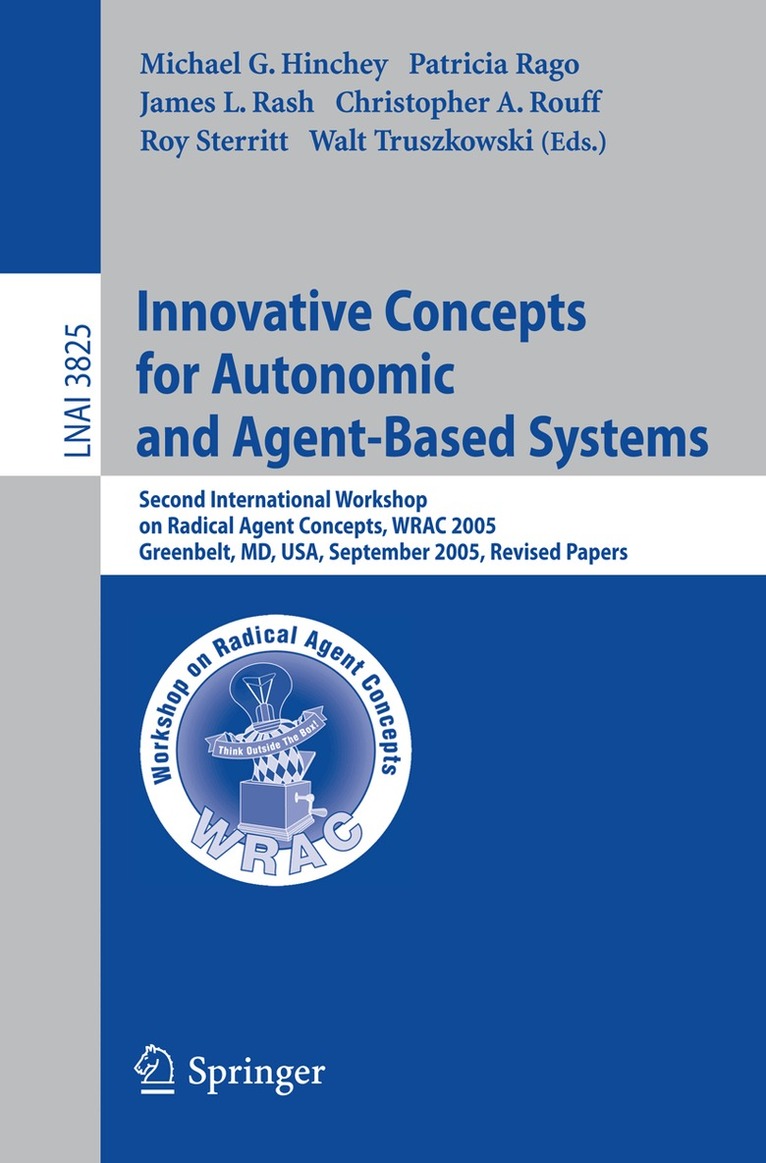
The second WRAC, NASA/IEEE Workshop on Radical Agent Concepts, was held at NASA Goddard Space Flight Center, Greenbelt, MD, September 20–22, 2005. The workshop was sponsored by the Information Systems Division of NASA Goddard and IEEE Computer Society Technical Committee on Complexity in Computing and IEEE Task Force on Autonomous and Autonomic Systems. The workshop also received generous financial support from IBM, without which the workshop would not have been possible. Agent technology, along with autonomous and autonomic computing, has emerged as a major field in computing, and will greatly influence the future development of complex computer-based systems. The area of research is strongly influenced by the autonomic computing initiative as well as by developments in biologically inspired computing, and involves interdisciplinary interaction from those involved in research in social intelligence, psychology, arts, biology, computer science, computer communications and philosophy. This volume includes revised versions of papers presented at the workshop. The workshop was structured so as to allow adequate time for discussion and interaction, to exchange ideas and reflect on the motivations, scientific grounds and practical consequences of the concepts presented. Many of the ideas are truly “radical”, and so authors were given time to revise their papers to reflect further thoughts on the ideas presented and to reflect feedback received at the workshop. We are grateful to Jeff Kephart for a very interesting keynote speech describing IBM’s current and future work in this field, which fit very well with the aims and scope of the workshop.
E-bok
PDF, Engelska, 2006712 kr
Läs direkt efter köp
The second WRAC, NASA/IEEE Workshop on Radical Agent Concepts, was held at NASA Goddard Space Flight Center, Greenbelt, MD, September 20–22, 2005. The workshop was sponsored by the Information Systems Division of NASA Goddard and IEEE Computer Society Technical Committee on Complexity in Computing and IEEE Task Force on Autonomous and Autonomic Systems. The workshop also received generous financial support from IBM, without which the workshop would not have been possible. Agent technology, along with autonomous and autonomic computing, has emerged as a major field in computing, and will greatly influence the future development of complex computer-based systems. The area of research is strongly influenced by the autonomic computing initiative as well as by developments in biologically inspired computing, and involves interdisciplinary interaction from those involved in research in social intelligence, psychology, arts, biology, computer science, computer communications and philosophy. This volume includes revised versions of papers presented at the workshop. The workshop was structured so as to allow adequate time for discussion and interaction, to exchange ideas and reflect on the motivations, scientific grounds and practical consequences of the concepts presented. Many of the ideas are truly “radical”, and so authors were given time to revise their papers to reflect further thoughts on the ideas presented and to reflect feedback received at the workshop. We are grateful to Jeff Kephart for a very interesting keynote speech describing IBM’s current and future work in this field, which fit very well with the aims and scope of the workshop.
Häftad, Engelska, 1999
565 kr
Skickas inom 10-15 vardagar
Errata, detected in Taylor's Logarithms. London: 4to, 1792. [sic] 14.18.3 6 Kk Co-sine of 3398 3298 - Nautical Almanac (1832) In the list of ERRATA detected in Taylor's Logarithms, for cos. 4° 18'3", read cos. 14° 18'2". - Nautical Almanac (1833) ERRATUM ofthe ERRATUM ofthe ERRATA of TAYLOR'S Logarithms. For cos. 4° 18'3", read cos. 14° 18' 3". - Nautical Almanac (1836) In the 1820s, an Englishman named Charles Babbage designed and partly built a calculating machine originally intended for use in deriving and printing logarithmic and other tables used in the shipping industry. At that time, such tables were often inaccurate, copied carelessly, and had been instrumental in causing a number of maritime disasters. Babbage's machine, called a 'Difference Engine' because it performed its cal culations using the principle of partial differences, was intended to substantially reduce the number of errors made by humans calculating the tables. Babbage had also designed (but never built) a forerunner of the modern printer, which would also reduce the number of errors admitted during the transcription of the results. Nowadays, a system implemented to perform the function of Babbage's engine would be classed as safety-critical. That is, the failure of the system to produce correct results could result in the loss of human life, mass destruction of property (in the form of ships and cargo) as well as financial losses and loss of competitive advantage for the shipping firm.
Häftad, Engelska, 2007
565 kr
Skickas inom 10-15 vardagar
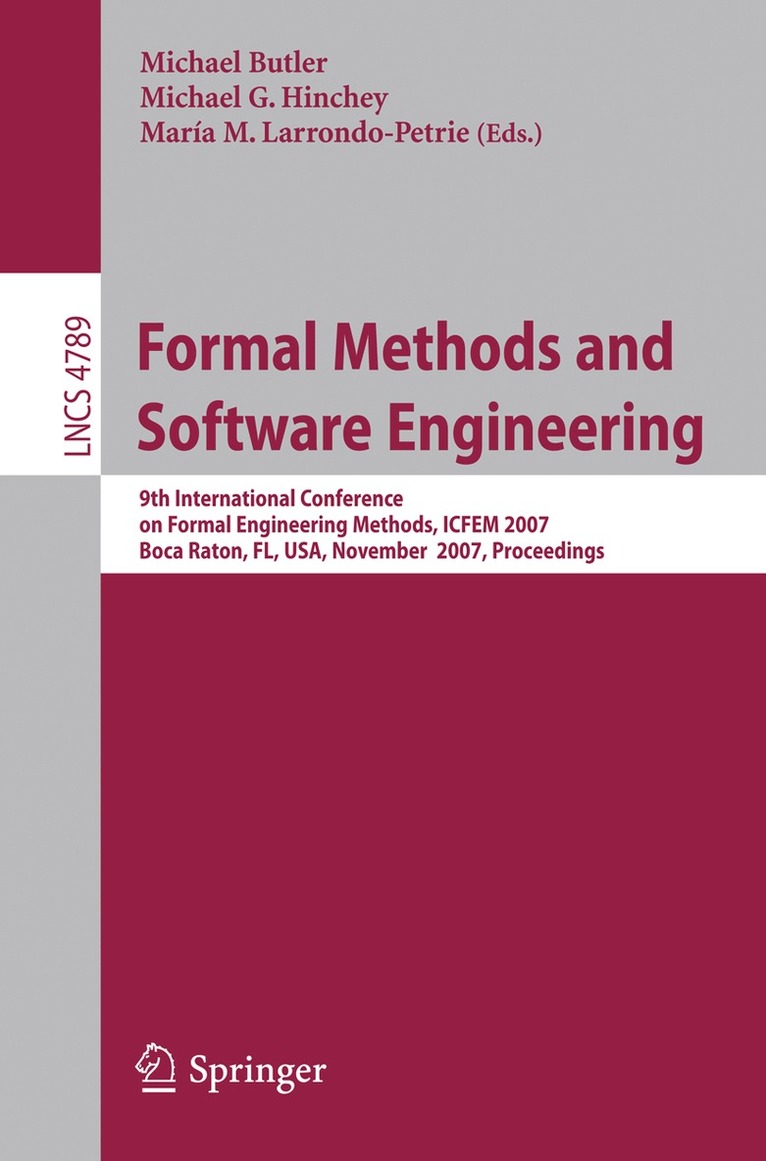
This book constitutes the refereed proceedings of the 9th International Conference on Formal Engineering Methods, ICFEM 2007, held in Boca Raton, Florida, USA, November 14-15, 2007. The 19 revised full papers together with two invited talks presented were carefully reviewed and selected from 38 submissions. The papers address all current issues in formal methods and their applications in software engineering. The papers are organized in topical sections.
E-bok
PDF, Engelska, 2007734 kr
Läs direkt efter köp