Michael Garman - Böcker
Visar alla böcker från författaren Michael Garman. Handla med fri frakt och snabb leverans.
2 produkter
2 produkter
785 kr
Skickas inom 7-10 vardagar
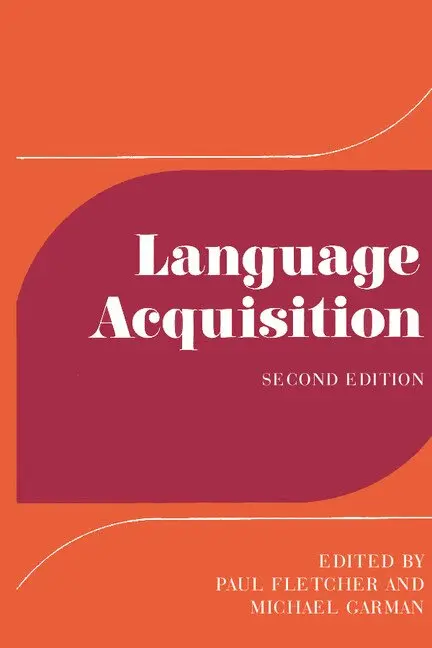
The aim of the first edition of Language Acquisition was to provide as comprehensive a description and explanation as possible of the changes in the child's language as he or she grows older. In this second edition Paul Fletcher and Michael Garman have the same fundamental aim. Six years later the field has not changed dramatically, but there have been fruitful theoretical developments - the learnability hypothesis, in particular, has been influentially expounded - and empirical work seeking evidence of specific language capacities in children has made notable advances. Equally significant are shifts in emphasis: the growing interest in cross-linguistic studies, for example, or accounts of language development of reading and writing. All these changes are reflected in the second edition. About half the chapters are entirely new, having been specially commissioned for this edition. The remainder of the book consists of substantially revised versions of chapters from the first edition. Like its predecessor, this collection is the work of distinguished specialists from many countries and will provide an invaluable resource for students and professionals alike who have an interest in the field of child language acquisition.
796 kr
Skickas inom 7-10 vardagar
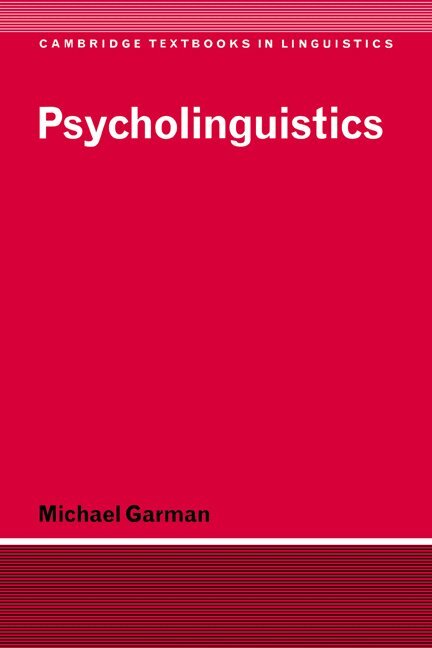
This book is an introduction to psycholinguistics, the study of human language processing. It deals with the central area of this field, the language abilities of the linguistically mature, monolingual adult. It aims to be comprehensive in its coverage, dealing with both written and spoken language, and their comprehension and production, and the nature of linguistic systems and models of processing. The book is divided into two parts. Part I identifies and investigates the main contributory areas of study, concerning the nature of the language signal, the biological foundations of language (including auditory and visual systems, the organisation of language in the brain, and articulatory and manual systems), and the sources of evidence on the abstract language system. Part II reviews a number of processing models and issues, covering perception and production of speech and writing, lexical storage and retrieval, and the comprehension and production of multiword utterances. The final chapter examines the issues that arise in the context of brain damage and the consequent impairment of language processing (in aphasia and related disorders), an additional important source of evidence and area of process modelling. Psycholinguistics provides an overview of the major contemporary issues surrounding the psychological foundations of language, most of which have roots in the last decade of research. It assumes a basic grounding in linguistic theory, but it is drawn from the author's considerable experience of teaching this subject, and has thus been designed to be accessible to students of linguistics and psychology, as well as for any reader with an interest in the psychological foundations of human language. It will be an essential work for students and specialists alike.