Michael J. Hyde - Böcker
Visar alla böcker från författaren Michael J. Hyde. Handla med fri frakt och snabb leverans.
9 produkter
9 produkter
956 kr
Skickas inom 5-8 vardagar
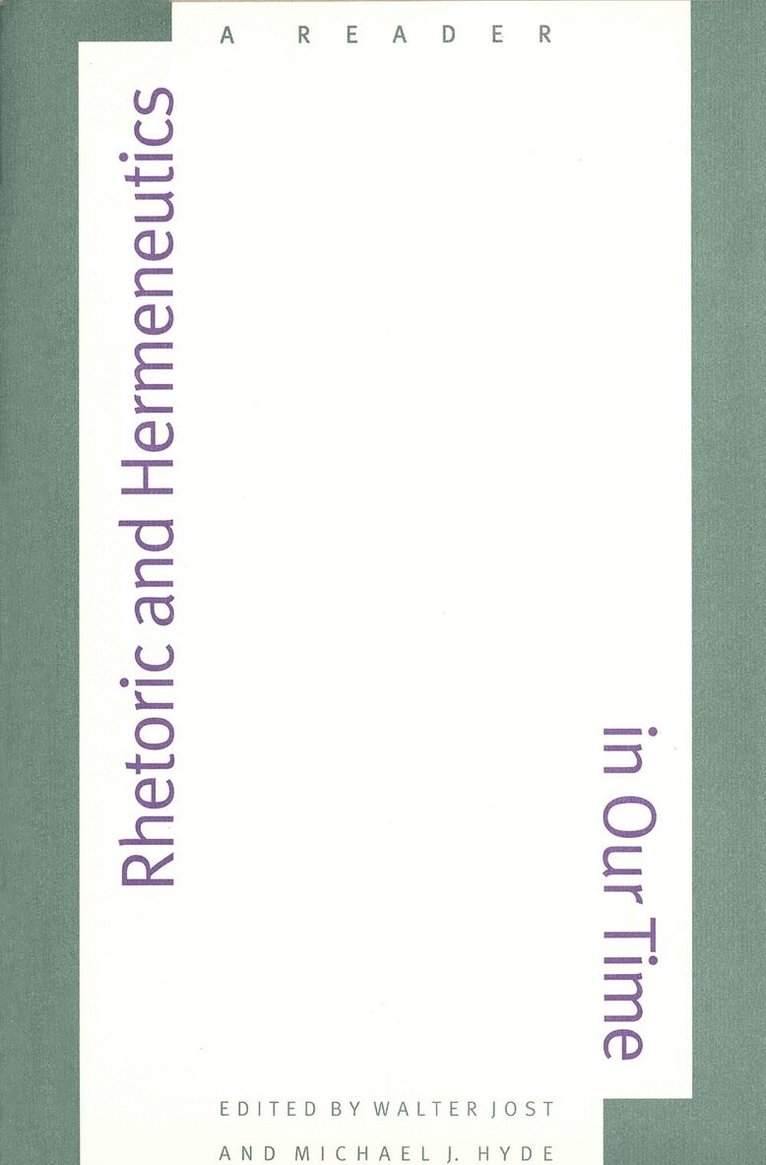
This thought-provoking book initiates a dialogue among scholars in rhetoric and hermeneutics in many areas of the humanities. Twenty leading thinkers explore the ways these two powerful disciplines inform each other and influence a wide variety of intellectual fields. Walter Jost and Michael J. Hyde organize pivotal topics in rhetoric and hermeneutics with originality and coherence, dividing their book into four sections: Locating the Disciplines; Inventions and Applications; Arguments and Narratives; and Civic Discourse and Critical Theory.Contributors to this volume include Hans-Georg Gadamer (one of whose pieces is here translated into English for the first time), Paul Ricoeur, Gerald L. Bruns, Charles Altieri, Richard E. Palmer, Calvin O. Schrag,.Victoria Kahn, Eugene Garver, Michael Leff, Nancy S. Streuver, Wendy Olmsted, David Tracy, Donald G. Marshall, Allen Scult, Rita Copeland, William Rehg, and Steven Mailloux. For readers across the humanities, the book demonstrates the usefulness of rhetorical and hermeneutic approaches in literary, philosophical, legal, religious, and political thinking. With its stimulating new perspectives on the revival and interrelation of both rhetoric and hermeneutics, this collection is sure to serve as a benchmark for years to come.
2 300 kr
Skickas inom 10-15 vardagar
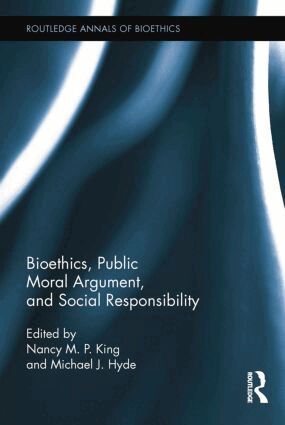
Bioethics, Public Moral Argument, and Social Responsibility explores the role of democratically oriented argument in promoting public understanding and discussion of the benefits and burdens of biotechnological progress.The contributors examine moral and policy controversies surrounding biomedical technologies and their place in American society, beginning with an examination of discourse and moral authority in democracy, and addressing a set of issues that include: dignity in health care; the social responsibilities of scientists, journalists, and scholars; and the language of genetics and moral responsibility.
824 kr
Skickas inom 10-15 vardagar
Bioethics, Public Moral Argument, and Social Responsibility explores the role of democratically oriented argument in promoting public understanding and discussion of the benefits and burdens of biotechnological progress.The contributors examine moral and policy controversies surrounding biomedical technologies and their place in American society, beginning with an examination of discourse and moral authority in democracy, and addressing a set of issues that include: dignity in health care; the social responsibilities of scientists, journalists, and scholars; and the language of genetics and moral responsibility.
369 kr
Skickas inom 10-15 vardagar
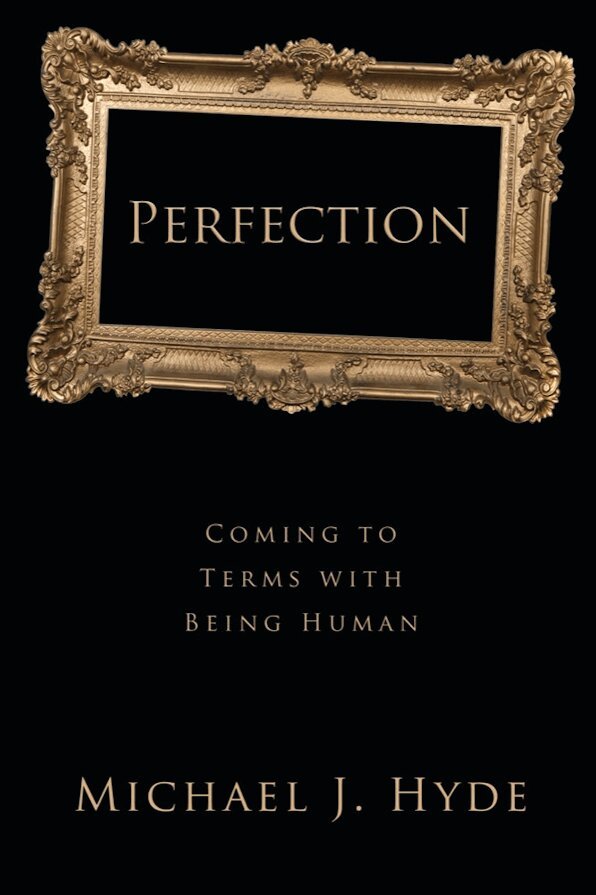
In a masterful survey of the history of the idea of human perfection, prize-winning author and noted rhetorician Michael J. Hyde leads a fascinating excursion through Western philosophy, religion, science, and art. Eloquently and engagingly he delves into the canon of Western thought, drawing on figures from St. Augustine and John Rawls to Leonardo da Vinci and David Hume to Kenneth Burke and Mary Shelley. On the journey, Hyde expounds on the very notion and ""Otherness"" of God, the empirical and ontological workings of daily existence, the development of reason, and the bounds of beauty. In the end, he ponders the consequences of the perfection-driven impulse of medical science and considers the implications of the bourgeoning rhetoric of ""our posthuman future."" It is nothing short of a triumphant examination of why we humans are challenged to live a life of significant insignificance.
369 kr
Skickas inom 10-15 vardagar
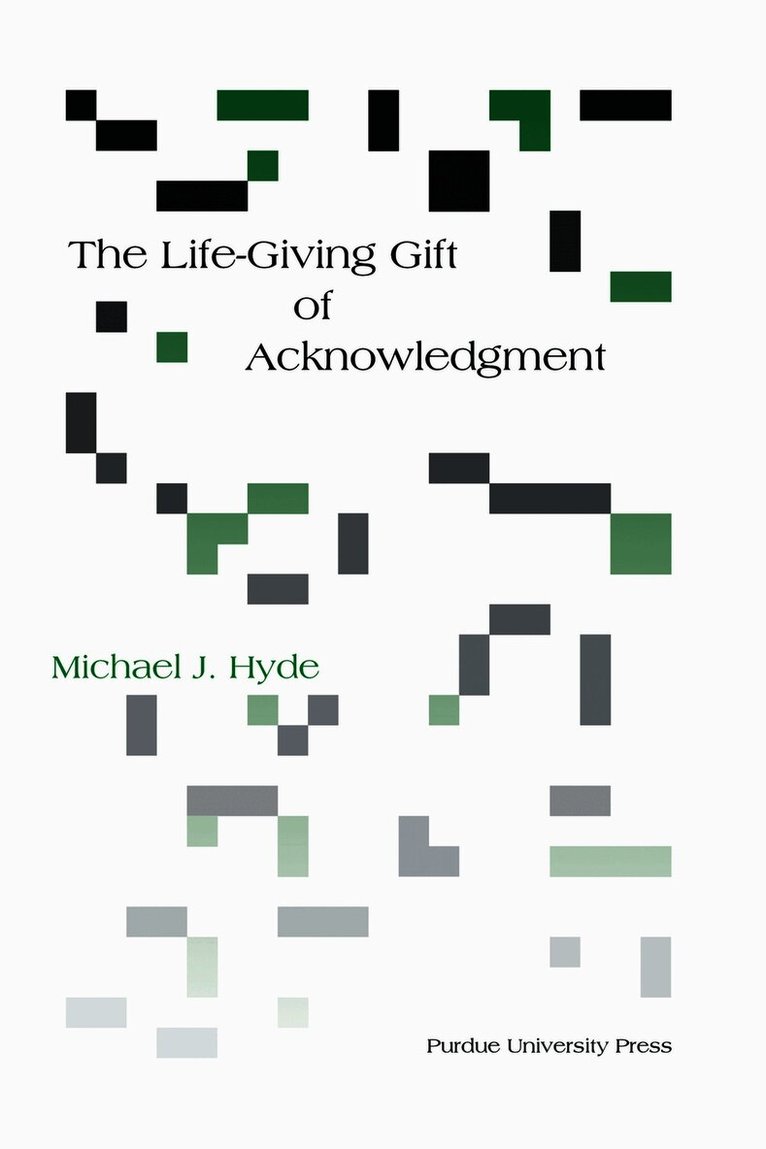
What would life be like if no one acknowledged your existence? The question confronts one with the possibility of being isolated, marginalized, ignored, and forgotten by others. The unacknowledged find themselves in an out-of-the-way place where it is hard or human beings, given their social instinct, to feel at home. The suffering that can accompany this way of being-in-the-world is known to bring about fear, anxiety, sadness, anger, and sometimes even death in the form of suicide or retaliation against those who are rightly or wrongly accused of making one's life so lonely, miserable, and unbearable. Acknowledgment provides an opening out of such a distressful situation, for the act of acknowledging is a communicative and rhetorical behavior that grants attention to others and thereby makes room for them in our lives. With this added living space comes the opportunity for a new beginning, a second chance whereby one might improve his or her lot in life. There is hope to be found with this transformation space and time as people of conscience opt to go out of their way to make us feel wanted and needed, to praise our presence and actions, and thus to acknowledge the worthiness of our existence. Offering positive acknowledgement is a moral thing to do.
315 kr
Skickas inom 10-15 vardagar
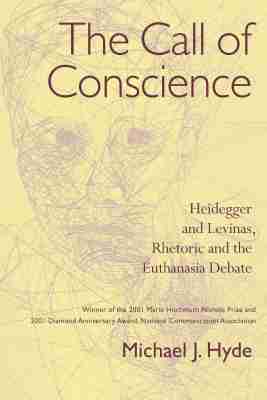
This book offers a provocative rhetorical approach to one of the defining medical debates of our time.Michael J. Hyde's pathbreaking study considers the relationship between the phenomenon of conscience and the practice of rhetoric as it relates to the controversial issues of euthanasia. Hyde investigates how the practice of rhetoric becomes a voice of conscience and influences the moral standards of individuals and communities. In doing so, he offers the first extensive treatment of Martin Heidegger's and Emmanuel Levinas' philosophical investigations of conscience and an in-depth analysis of the justifiability and social acceptability of euthanasia.Hyde establishes the theoretical basis of his study by discussing and critically assessing the phenomenological theories of conscience set forth in the works of the two philosophers. To illustrate how the relationship between the call of conscience and the practice of rhetoric shows itself in everyday existence, Hyde surveys the moral discourse that informs ongoing debates over euthanasia and physician-assisted suicide. He focuses on a cluster of related topics that emerge from his discussion of the work of Heidegger and Levinas, including the phenomena of deconstruction and acknowledgment, emotion and the reconstructive power of language, and the discursive creation of heroes.
476 kr
Skickas inom 10-15 vardagar
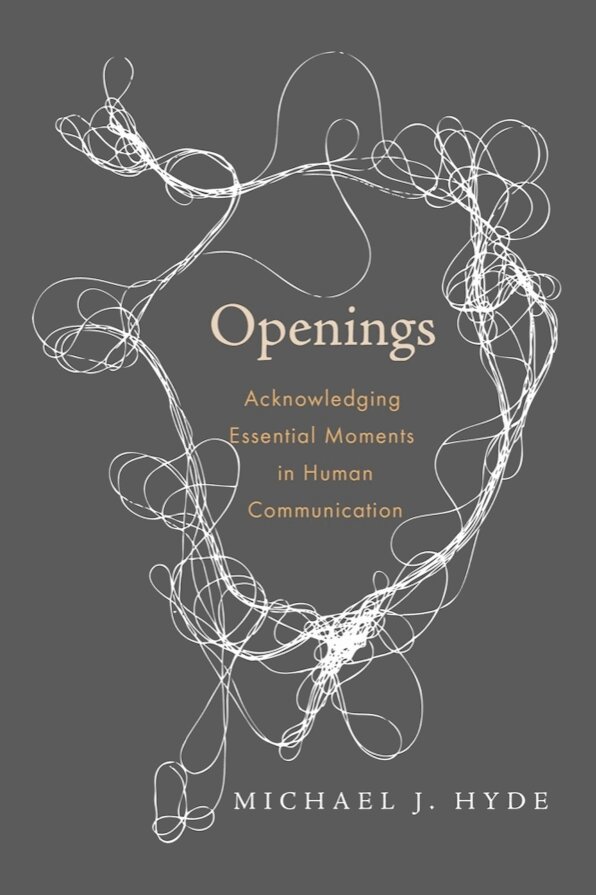
In Openings, award-winning author Michael Hyde provides a fascinating meditation on the ethical dimensions of human communication. With the breadth and depth of learning for which Hyde has become renowned, Openings engages philosophy, science, the arts, theology, and popular culture, all to demonstrate the profound importance of the possibility of openness to the human experience. In every situation, Hyde contends, this posture of conscious openness to the individuals, events, and places that surround us has noticeable effects on the way we--and others--experience the reality of existence. Hyde skillfully illustrates this way of being through abundant references to the larger culture and persuasively shows that by living with intention, and elevating practices such as acknowledgment and confession while rejecting seclusion and neglect, we human beings are enabled to engage fully and fruitfully the world in which we live.
387 kr
Skickas inom 11-20 vardagar
Biotechnological advancements during the last half-century have forced humanity to come to grips with the possibility of a post-human future. The ever-evolving opinions about how society should anticipate this biotechnological frontier demand a language that will describe our new future and discuss its ethics. After the Genome brings together expert voices from the realms of ethics, rhetoric, religion, and science to help lead complex conversations about end-of-life care, the relationship between sin and medicine, and the protection of human rights in a post-human world. With chapters on the past and future of the science-warfare narrative, the rhetoric of care and its effect on those suffering, black rhetoric and biotechnology, planning for the end of life, regenerative medicine, and more, After the Genome yields great insight into the human condition and moves us forward toward a genuinely humane approach to who we are and who we are becoming.
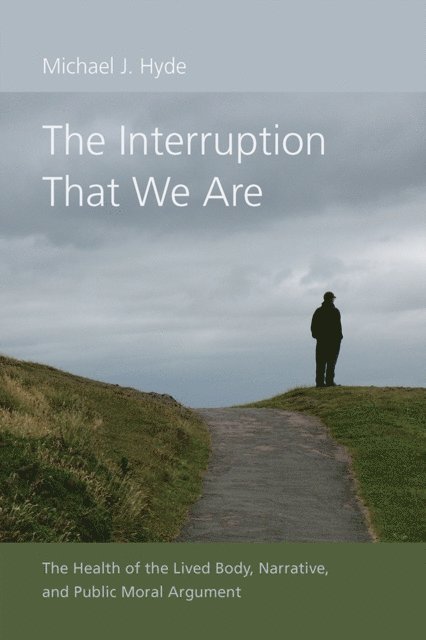
Interruption That We Are
The Health of the Lived Body, Narrative, and Public Moral Argument
Inbunden, Engelska, 2018
588 kr
Skickas inom 7-10 vardagar
In this provocative and interdisciplinary work, Michael J. Hyde develops a philosophy of communication ethics in which the practice of rhetoric plays a fundamental role in promoting and maintaining the health of our personal and communal existence. He examines how the force of interruption—the universal human capacity to challenge our complacent understanding of existence—is a catalyst for moral reflection and moral behavior.Hyde begins by reviewing the role of interruption in the history of the West, from the Big Bang to biblical figures to classical Greek and contemporary philosophers and rhetoricians to three modern thinkers: Søren Kierkegaard, Martin Heidegger, and Emmanuel Levinas. These thinkers demonstrate in various ways that interruption is not simply a heuristic tool, but constitutive of being human. After developing a critical assessment of these thinkers, Hyde offers four case studies in public moral argument that illustrate the applicability of his findings regarding our interruptive nature. These studies feature a patient suffering from heart disease, a disability rights activist defending her personhood, a young woman dying from brain cancer who must justify her decision, against staunch opposition, to opt for medical aid in dying, and the benefits and burdens of what is termed our “posthuman future” with its accelerating achievements in medical science and technology. These improvements are changing the nature of the interruption that we are, yet the wisdom of such progress has yet to be determined. Much more public moral argument is required.Hyde’s philosophy of communication ethics not only calls for the cultivation of wisdom but also promotes the fight for truth, which is essential to the livelihood of democracy.