Michael P. Farrell - Böcker
Visar alla böcker från författaren Michael P. Farrell. Handla med fri frakt och snabb leverans.
4 produkter
4 produkter
691 kr
Tillfälligt slut
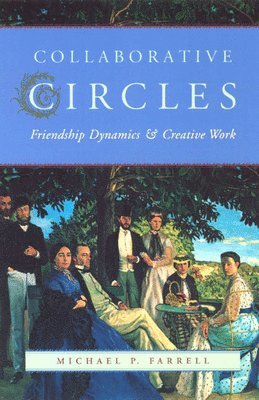
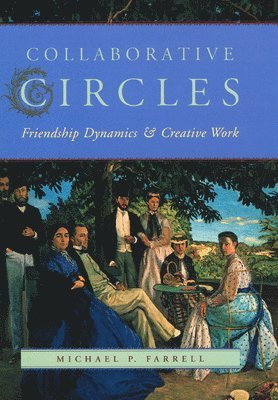
Many artists, writers, and other creative people do their best work when collaborating within a circle of likeminded friends. Experimenting together and challenging one another, they develop the courage to rebel against the established traditions in their field. Out of their discussions they develop a new, shared vision that guides their work even when they work alone. In a unique study that will become a rich source of ideas for professionals and anyone interested in fostering creative work in the arts and sciences, Michael P. Farrell looks at the group dynamics in six collaborative circles: the French Impressionists; Sigmund Freud and his friends; C. S. Lewis, J. R. R. Tolkien, and the Inklings; social reformers Elizabeth Cady Stanton and Susan B. Anthony; the Fugitive poets; and the writers Joseph Conrad and Ford Maddox Ford. He demonstrates how the unusual interactions in these collaborative circles drew out the creativity in each member. Farrell also presents vivid narrative accounts of the roles played by the members of each circle. He considers how working in such circles sustains the motivation of each member to do creative work; how collaborative circles shape the individual styles of the persons within them; how leadership roles and interpersonal relationships change as circles develop; and why some circles flourish while others flounder.
491 kr
Skickas inom 7-10 vardagar
Many artists, writers, and other creative people do their best work when collaborating within a circle of likeminded friends. Experimenting together and challenging one another, they develop the courage to rebel against the established traditions in their field. Out of their discussions they develop a new, shared vision that guides their work even when they work alone. In a unique study that will become a rich source of ideas for professionals and anyone interested in fostering creative work in the arts and sciences, Michael P. Farrell looks at the group dynamics in six collaborative circles: the French Impressionists; Sigmund Freud and his friends; C. S. Lewis, J. R. R. Tolkien, and the Inklings; social reformers Elizabeth Cady Stanton and Susan B. Anthony; the Fugitive poets; and the writers Joseph Conrad and Ford Maddox Ford. He demonstrates how the unusual interactions in these collaborative circles drew out the creativity in each member. Farrell also presents vivid narrative accounts of the roles played by the members of each circle.He considers how working in such circles sustains the motivation of each member to do creative work; how collaborative circles shape the individual styles of the persons within them; how leadership roles and interpersonal relationships change as circles develop; and why some circles flourish while others flounder.
1 703 kr
Skickas inom 10-15 vardagar
Contributions to Illuminations: A Scarecrow Press Series of Guides to Research in Religion provide students and scholars, lay readers and clergy, with a road map to research in key areas of religious study. All commonly constructed with introductions to the topic and reviews of key thinkers, concepts, and events, each volume includes surveys of the primary and secondary sources, with critical evaluations of their places in the canon of thought and research on the topic. Focusing primarily on the knowledge required by today’s students and scholars, each guide is a must-have for any student of religion.The twentieth century saw an explosion of wars and an accompanying explosion of literature on the morality of war. Thinking among Christian clerics and scholars on the idea of “just war” shifted with developments on the battlefield. Alternatives to just war theory, such as pacifism and realism, found new proponents in the published work of the neo-Anabaptists and Niebhurians. Meanwhile, proponents of Christian just war theory had to address challenges from competing ideologies as well as ththose presented by the changing nature of warfare.Modern Just War Theory: A Guide to Research, by scholar and librarian Michael Farrell, serves as a manual for students and scholars studying Christian just war theory, helping them navigate the wealth of just war literature produced in the twentieth and twenty-first centuries. Farrell’s guide provides an introduction to the major developments of just war theory in the twentieth century, including sections on how to research just war theory, an overview of some of the most important theorists and developments of the twentieth century, and discussions of key search terms and related topics. Farrell then surveys and evaluates key primary and secondary sources for researchers on just war theory, as well as related sources on Christian realism and the responses of just war theorists to proponents of pacifism and secular just war theories. Modern Just War Theory will appeal to students and scholars of theology, military history, international law, and Christian ethics.
489 kr
Skickas inom 10-15 vardagar