Michael R. Barnes - Böcker
Visar alla böcker från författaren Michael R. Barnes. Handla med fri frakt och snabb leverans.
7 produkter
7 produkter
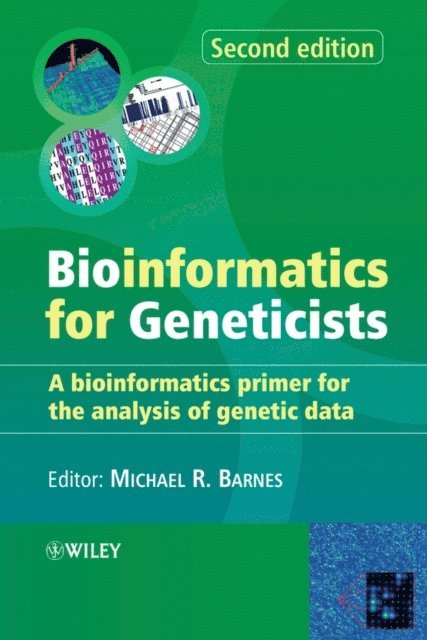
Bioinformatics for Geneticists
A Bioinformatics Primer for the Analysis of Genetic Data
Inbunden, Engelska, 2007
2 498 kr
Skickas inom 7-10 vardagar
Praise from the reviews: "Without reservation, I endorse this text as the best resource I've encountered that neatly introduces and summarizes many points I've learned through years of experience. The gems of truth found in this book will serve well those who wish to apply bioinformatics in their daily work, as well as help them advise others in this capacity." CIRCGENETICS"This book may really help to get geneticists and bioinformaticians on 'speaking-terms'... contains some essential reading for almost any person working in the field of molecular genetics." EUROPEAN JOURNAL OF HUMAN GENETICS "... an excellent resource... this book should ensure that any researcher's skill base is maintained." GENETICAL RESEARCH“… one of the best available and most accessible texts on bioinformatics and genetics in the postgenome age… The writing is clear, with succinct subsections within each chapter….Without reservation, I endorse this text as the best resource I’ve encountered that neatly introduces and summarizes many points I’ve learned through years of experience. The gems of truth found in this book will serve well those who wish to apply bioinformatics in their daily work, as well as help them advise others in this capacity.” CIRCULATION: CARDIOVASCULAR GENETICSA fully revised version of the successful First Edition, this one-stop reference book enables all geneticists to improve the efficiency of their research.The study of human genetics is moving into a challenging new era. New technologies and data resources such as the HapMap are enabling genome-wide studies, which could potentially identify most common genetic determinants of human health, disease and drug response. With these tremendous new data resources at hand, more than ever care is required in their use. Faced with the sheer volume of genetics and genomic data, bioinformatics is essential to avoid drowning true signal in noise. Considering these challenges, Bioinformatics for Geneticists, Second Edition works at multiple levels: firstly, for the occasional user who simply wants to extract or analyse specific data; secondly, at the level of the advanced user providing explanations of how and why a tool works and how it can be used to greatest effect. Finally experts from fields allied to genetics give insight into the best genomics tools and data to enhance a genetic experiment.Hallmark Features of the Second Edition: Illustrates the value of bioinformatics as a constantly evolving avenue into novel approaches to study geneticsThe only book specifically addressing the bioinformatics needs of geneticistsMore than 50% of chapters are completely new contributionsDramatically revised content in core areas of gene and genomic characterisation, pathway analysis, SNP functional analysis and statistical geneticsFocused on freely available tools and web-based approaches to bioinformatics analysis, suitable for novices and experienced researchers alikeBioinformatics for Geneticists, Second Edition describes the key bioinformatics and genetic analysis processes that are needed to identify human genetic determinants. The book is based upon the combined practical experience of domain experts from academic and industrial research environments and is of interest to a broad audience, including students, researchers and clinicians working in the human genetics domain.
Bioinformatics for Geneticists
A Bioinformatics Primer for the Analysis of Genetic Data
Häftad, Engelska, 2007
1 035 kr
Skickas inom 7-10 vardagar
Praise from the reviews: "Without reservation, I endorse this text as the best resource I've encountered that neatly introduces and summarizes many points I've learned through years of experience. The gems of truth found in this book will serve well those who wish to apply bioinformatics in their daily work, as well as help them advise others in this capacity." CIRCGENETICS"This book may really help to get geneticists and bioinformaticians on 'speaking-terms'... contains some essential reading for almost any person working in the field of molecular genetics." EUROPEAN JOURNAL OF HUMAN GENETICS "... an excellent resource... this book should ensure that any researcher's skill base is maintained." GENETICAL RESEARCH“… one of the best available and most accessible texts on bioinformatics and genetics in the postgenome age… The writing is clear, with succinct subsections within each chapter….Without reservation, I endorse this text as the best resource I’ve encountered that neatly introduces and summarizes many points I’ve learned through years of experience. The gems of truth found in this book will serve well those who wish to apply bioinformatics in their daily work, as well as help them advise others in this capacity.” CIRCULATION: CARDIOVASCULAR GENETICSA fully revised version of the successful First Edition, this one-stop reference book enables all geneticists to improve the efficiency of their research.The study of human genetics is moving into a challenging new era. New technologies and data resources such as the HapMap are enabling genome-wide studies, which could potentially identify most common genetic determinants of human health, disease and drug response. With these tremendous new data resources at hand, more than ever care is required in their use. Faced with the sheer volume of genetics and genomic data, bioinformatics is essential to avoid drowning true signal in noise. Considering these challenges, Bioinformatics for Geneticists, Second Edition works at multiple levels: firstly, for the occasional user who simply wants to extract or analyse specific data; secondly, at the level of the advanced user providing explanations of how and why a tool works and how it can be used to greatest effect. Finally experts from fields allied to genetics give insight into the best genomics tools and data to enhance a genetic experiment.Hallmark Features of the Second Edition: Illustrates the value of bioinformatics as a constantly evolving avenue into novel approaches to study geneticsThe only book specifically addressing the bioinformatics needs of geneticistsMore than 50% of chapters are completely new contributionsDramatically revised content in core areas of gene and genomic characterisation, pathway analysis, SNP functional analysis and statistical geneticsFocused on freely available tools and web-based approaches to bioinformatics analysis, suitable for novices and experienced researchers alikeBioinformatics for Geneticists, Second Edition describes the key bioinformatics and genetic analysis processes that are needed to identify human genetic determinants. The book is based upon the combined practical experience of domain experts from academic and industrial research environments and is of interest to a broad audience, including students, researchers and clinicians working in the human genetics domain.
2 407 kr
Skickas inom 11-20 vardagar
Evidence-based, peer reviewed, best practice management guidelines for neurologists Diagnosis is only part of the puzzle. Effective treatment is what your patients really want. The European Federation of Neurological Societies has been publishing management guidelines in the European Journal of Neurology for many years. Developed by a consensus approach, using graded evidence, and then fully peer reviewed, these guidelines provide gold-standard, best-practice guidance to the treatment of neurological disorders. They help bridge the gap between what is done and what should be done for patients with neurological disorders.The basic guidelines have been expanded with ‘Recommendations’ based on strong evidence and ‘Good Practice Points’ where only weaker evidence is available. The Guidelines in this volume cover:InvestigationMajor neurological diseasesNeuromuscular diseasesInfectionsNeurological problemsSleep disordersRehabilitationThe European Handbook of Neurological Management provides a thoroughly rounded and grounded approach to best-practice neurological management using evidence-based principles.
1 780 kr
Tillfälligt slut
Evidence-based, peer reviewed, best practice management guidelines for neurologists Diagnosis is only part of the puzzle. Effective treatment is what your patients really want. The European Federation of Neurological Societies has been publishing management guidelines in the European Journal of Neurology for many years. Developed by a consensus approach, using graded evidence, and then fully peer reviewed, these guidelines provide gold-standard, best-practice guidance to the treatment of neurological disorders. They help bridge the gap between what is done and what should be done for patients with neurological disorders.The basic guidelines have been expanded with 'Recommendations' based on strong evidence and 'Good Practice Points' where only weaker evidence is available. The Guidelines in this volume include, amongst others: Neurostimulation therapy for neuropathic painMolecular diagnosis for a range of neurological conditionsIntravenous immunoglobulin in the treatment of neurological diseasesSleep disorders in neurodegenerative disorders and strokeManagement of low-grade gliomasTreatment of miscellaneous idiopathic headache disordersThe European Handbook of Neurological Management provides a thoroughly rounded and grounded approach to best-practice neurological management using evidence-based principles.Titles of related interestCerebrovascular Ultrasound in Stroke Prevention, 2eAlexandrov (ed); ISBN 9781405195768Parkinsons's Disease: Non-Motor and Non-Dopaminergic FeaturesOlanow, Stocchi and Lang (eds); ISBN 9781405191852Hyperkinetic Movement Disorders: Differential Diagnosis and TreatmentAlbanese and Jankovic (eds); ISBN 9781444333527
2 661 kr
Tillfälligt slut
A bundled resource on the treatment and management of neurological diseaseThe challenge of managing neurological diseases is addressed in the EFNS Handbook, Volumes 1 and 2. This publication bundle features peer-reviewed guidelines for the treatment and management of neurological disease. The handbook looks at symptom control and treatment responses in patients. It also examines the effectiveness of specific treatment approaches. The handbook is published in association with the European Federation of Neurological Societies.
1 589 kr
Skickas inom 10-15 vardagar
“Your genome is an email attachment” What a difference a few years can make? In 2001, to a global fanfare, the completion of the frst draft sequence of the human genome was announced. This had been a Herculean effort, involving thousands of researchers and millions of dollars. Today, a project to re-sequence 1,000 genomes is well underway, and within a year or two, your own “personal genome” is likely to be available for a few thousand pounds, a price that will undoubtedly decrease further. We are fast approaching the day when your genome will be available as an email attachment (about 4 Mb). The key to this feat is the fact that any two human genomes are more than 99% identical, so rather than representing every base, there is really only a requirement to store the 1% of variable sequence judged against a common reference genome. This brings us directly to the focus of this edition of Methods in Molecular Biology, Genetic Variation. The human genome was once the focus of biology, but now individual genome var- tion is taking the center stage. This new focus on individual variation ultimately democ- tizes biology, offering individuals insight into their own phenotype. But these advances also raise huge concerns of data misuse, misinterpretation, and misunderstanding. The immediacy of individual genomes also serves to highlight our relative ignorance of human genetic variation, underlining the need for more studies of the nature and impact of genetic variation on human phenotypes.
1 202 kr
Skickas inom 10-15 vardagar
“Your genome is an email attachment” What a difference a few years can make? In 2001, to a global fanfare, the completion of the frst draft sequence of the human genome was announced. This had been a Herculean effort, involving thousands of researchers and millions of dollars. Today, a project to re-sequence 1,000 genomes is well underway, and within a year or two, your own “personal genome” is likely to be available for a few thousand pounds, a price that will undoubtedly decrease further. We are fast approaching the day when your genome will be available as an email attachment (about 4 Mb). The key to this feat is the fact that any two human genomes are more than 99% identical, so rather than representing every base, there is really only a requirement to store the 1% of variable sequence judged against a common reference genome. This brings us directly to the focus of this edition of Methods in Molecular Biology, Genetic Variation. The human genome was once the focus of biology, but now individual genome var- tion is taking the center stage. This new focus on individual variation ultimately democ- tizes biology, offering individuals insight into their own phenotype. But these advances also raise huge concerns of data misuse, misinterpretation, and misunderstanding. The immediacy of individual genomes also serves to highlight our relative ignorance of human genetic variation, underlining the need for more studies of the nature and impact of genetic variation on human phenotypes.