Michael Suk-Young Chwe – författare
Visar alla böcker från författaren Michael Suk-Young Chwe. Handla med fri frakt och snabb leverans.
3 produkter
3 produkter
554 kr
Skickas inom 7-10 vardagar
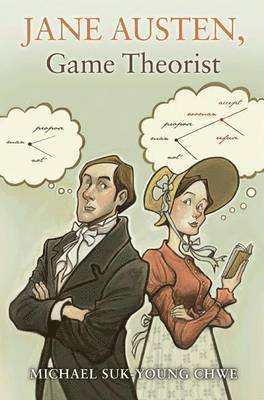
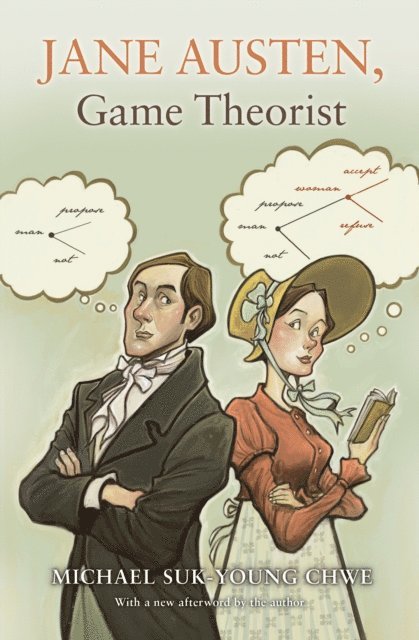
Game theory--the study of how people make choices while interacting with others--is one of the most popular technical approaches in social science today. But as Michael Chwe reveals in his insightful new book, Jane Austen explored game theory's core ideas in her six novels roughly two hundred years ago. Jane Austen, Game Theorist shows how this beloved writer theorized choice and preferences, prized strategic thinking, argued that jointly strategizing with a partner is the surest foundation for intimacy, and analyzed why superiors are often strategically clueless about inferiors. With a diverse range of literature and folktales, this book illustrates the wide relevance of game theory and how, fundamentally, we are all strategic thinkers. Although game theory's mathematical development began in the Cold War 1950s, Chwe finds that game theory has earlier subversive historical roots in Austen's novels and in "folk game theory" traditions, including African American folktales. Chwe makes the case that these literary forebears are game theory's true scientific predecessors.He considers how Austen in particular analyzed "cluelessness"--the conspicuous absence of strategic thinking--and how her sharp observations apply to a variety of situations, including U.S. military blunders in Iraq and Vietnam. Jane Austen, Game Theorist brings together the study of literature and social science in an original and surprising way.
244 kr
Skickas inom 7-10 vardagar
Why do Internet, financial service, and beer commercials dominate Super Bowl advertising? How do political ceremonies establish authority? Why does repetition characterize anthems and ritual speech? Why were circular forms favored for public festivals during the French Revolution? This book answers these questions using a single concept: common knowledge. Game theory shows that in order to coordinate its actions, a group of people must form "common knowledge." Each person wants to participate only if others also participate. Members must have knowledge of each other, knowledge of that knowledge, knowledge of the knowledge of that knowledge, and so on. Michael Chwe applies this insight, with striking erudition, to analyze a range of rituals across history and cultures. He shows that public ceremonies are powerful not simply because they transmit meaning from a central source to each audience member but because they let audience members know what other members know. For instance, people watching the Super Bowl know that many others are seeing precisely what they see and that those people know in turn that many others are also watching.This creates common knowledge, and advertisers selling products that depend on consensus are willing to pay large sums to gain access to it. Remarkably, a great variety of rituals and ceremonies, such as formal inaugurations, work in much the same way. By using a rational-choice argument to explain diverse cultural practices, Chwe argues for a close reciprocal relationship between the perspectives of rationality and culture. He illustrates how game theory can be applied to an unexpectedly broad spectrum of problems, while showing in an admirably clear way what game theory might hold for scholars in the social sciences and humanities who are not yet acquainted with it. In a new afterword, Chwe delves into new applications of common knowledge, both in the real world and in experiments, and considers how generating common knowledge has become easier in the digital age.
495 kr
Skickas inom 3-6 vardagar
Game theory--the study of how people make choices while interacting with others--is one of the most popular technical approaches in social science today. But as Michael Chwe reveals in his insightful new book, Jane Austen explored game theory's core ideas in her six novels roughly two hundred years ago--over a century before its mathematical development during the Cold War. Jane Austen, Game Theorist shows how this beloved writer theorized choice and preferences, prized strategic thinking, and analyzed why superiors are often strategically clueless about inferiors. Exploring a diverse range of literature and folktales, this book illustrates the wide relevance of game theory and how, fundamentally, we are all strategic thinkers.