Michael T. Gibbons - Böcker
Visar alla böcker från författaren Michael T. Gibbons. Handla med fri frakt och snabb leverans.
3 produkter
3 produkter
809 kr
Skickas inom 10-15 vardagar
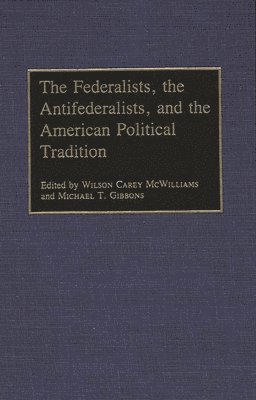
In analyzing the debates between the Federalists and the Antifederalists, McWilliams, Gibbons, and their contributors break sharply with those who interpret the founding of America as either the work of pure pragmatists or as the institutionalization of class interests. This study of the very nature of modern representative democracy explains past and present dilemmas and contradictions in terms of differing Federalist and Antifederalist views. Students and scholars interested in political theory and American government and history will find this discussion of our political traditions a fascinating one that provokes thought about possible opportunities for political renewal and democratic change.This examination of the political theory of the American founding deals with often-opposing beliefs about pluralist interests and political compromise, human nature, what constitutes the public good and the public sphere, the relationship between polity and economy, the role of religion in politics, and our political tradition in general. The study presents different points of view held by America's founders and considers other interpretations and ideas of Machiavelli, Spinoza, Hobbes, Montesquieu, James Wilson, and Woodrow Wilson, among others.
944 kr
Skickas inom 5-8 vardagar
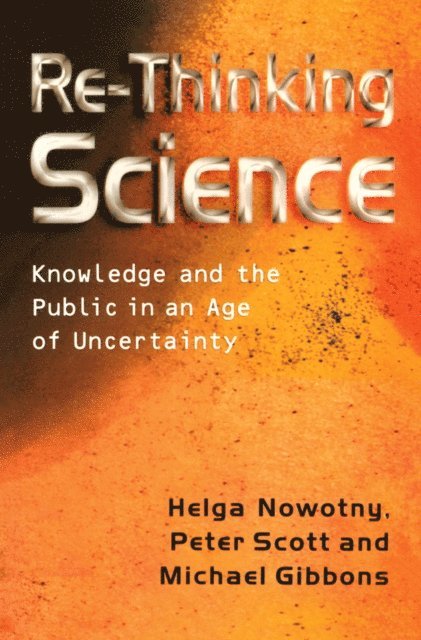
Re-Thinking Science presents an account of the dynamic relationship between society and science. Despite the mounting evidence of a much closer, interactive relationship between society and science, current debate still seems to turn on the need to maintain a 'line' to demarcate them. The view persists that there is a one-way communication flow from science to society - with scant attention given to the ways in which society communicates with science. The authors argue that changes in society now make such communications both more likely and more numerous, and that this is transforming science not only in its research practices and the institutions that support it but also deep in its epistemological core. To explain these changes, Nowotny, Scott and Gibbons have developed an open, dynamic framework for re-thinking science. The authors conclude that the line which formerly demarcated society from science is regularly transgressed and that the resulting closer interaction of science and society signals the emergence of a new kind of science: contextualized or context-sensitive science. The co-evolution between society and science requires a more or less complete re-thinking of the basis on which a new social contract between science and society might be constructed. In their discussion the authors present some of the elements that would comprise this new social contract.
309 kr
Skickas inom 5-8 vardagar
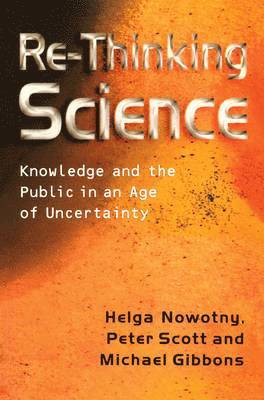
Re-Thinking Science presents an account of the dynamic relationship between society and science. Despite the mounting evidence of a much closer, interactive relationship between society and science, current debate still seems to turn on the need to maintain a 'line' to demarcate them. The view persists that there is a one-way communication flow from science to society - with scant attention given to the ways in which society communicates with science. The authors argue that changes in society now make such communications both more likely and more numerous, and that this is transforming science not only in its research practices and the institutions that support it but also deep in its epistemological core. To explain these changes, Nowotny, Scott and Gibbons have developed an open, dynamic framework for re-thinking science. The authors conclude that the line which formerly demarcated society from science is regularly transgressed and that the resulting closer interaction of science and society signals the emergence of a new kind of science: contextualized or context-sensitive science. The co-evolution between society and science requires a more or less complete re-thinking of the basis on which a new social contract between science and society might be constructed. In their discussion the authors present some of the elements that would comprise this new social contract.