Michel Fayol - Böcker
Visar alla böcker från författaren Michel Fayol. Handla med fri frakt och snabb leverans.
6 produkter
6 produkter
Processing interclausal Relationships
Studies in the Production and Comprehension of Text
Inbunden, Engelska, 1996
2 793 kr
Skickas inom 3-6 vardagar
During the last 10 years, more and more linguistic and psycholinguistic research has been devoted to the study of discourse and written texts. Much of this research deals with the markers that underline the connections and the breaks between clauses and sentences plus the use of these markers -- by adults and children -- in the production and comprehension of oral and written material. In this volume, major observations and theoretical views from both sides of the Atlantic are brought together to appeal to a wide range of linguists, psychologists, and speech therapists.The volume presents contributions from researchers interested specifically in adult language and from others concerned with developmental aspects of language. Some contributors deal primarily with production, whereas others concentrate on comprehension. Some direct their attention to oral discourse while others focus on written texts. To preserve overall coherence, however, the contributors were given the following recommendations:* With regard to the level of linguistic analysis, the emphasis should be on the clause level -- more particularly, on the relationships between clauses.* Special emphasis should also be placed on linguistic markers (e.g., connectives, markers of segmentation, punctuation). * An overview of a given field of research should be offered, and current research should be put into perspective.* For contributors in the developmental field, attention should be paid to the fact that an account of the acquisition of some language functions throughout childhood should be included only if general principles of interclause relations that might be masked by the exclusive examination of adult evidence could be derived from it.
Processing interclausal Relationships
Studies in the Production and Comprehension of Text
Häftad, Engelska, 1996
747 kr
Skickas inom 10-15 vardagar
During the last 10 years, more and more linguistic and psycholinguistic research has been devoted to the study of discourse and written texts. Much of this research deals with the markers that underline the connections and the breaks between clauses and sentences plus the use of these markers -- by adults and children -- in the production and comprehension of oral and written material. In this volume, major observations and theoretical views from both sides of the Atlantic are brought together to appeal to a wide range of linguists, psychologists, and speech therapists.The volume presents contributions from researchers interested specifically in adult language and from others concerned with developmental aspects of language. Some contributors deal primarily with production, whereas others concentrate on comprehension. Some direct their attention to oral discourse while others focus on written texts. To preserve overall coherence, however, the contributors were given the following recommendations:* With regard to the level of linguistic analysis, the emphasis should be on the clause level -- more particularly, on the relationships between clauses.* Special emphasis should also be placed on linguistic markers (e.g., connectives, markers of segmentation, punctuation). * An overview of a given field of research should be offered, and current research should be put into perspective.* For contributors in the developmental field, attention should be paid to the fact that an account of the acquisition of some language functions throughout childhood should be included only if general principles of interclause relations that might be masked by the exclusive examination of adult evidence could be derived from it.
1 899 kr
Skickas inom 10-15 vardagar
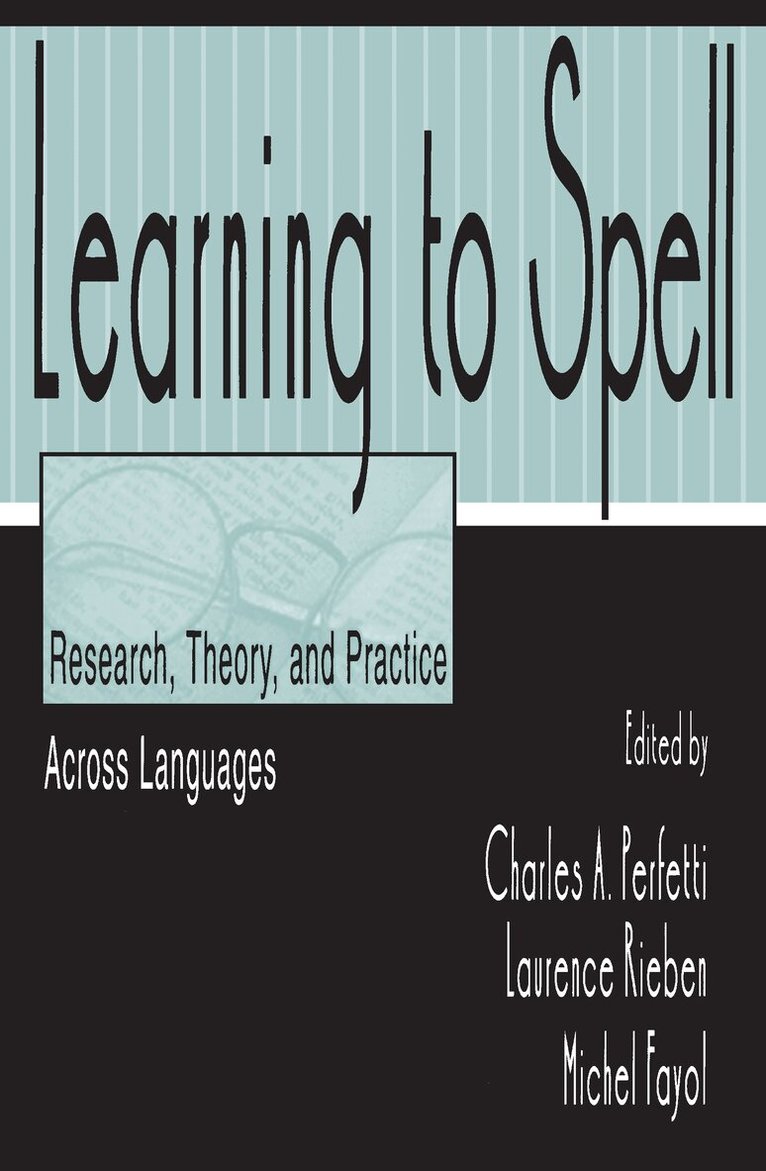
This distinctive cross-linguistic examination of spelling examines the cognitive processes that underlie spelling and the process of learning how to spell. The chapters report and summarize recent research in English, German, Hebrew, and French.Framing the specific research on spelling are chapters that place spelling in braod theoretical perspectives provided by cognitive neuroscience, psycholinguistic, and writing system-linguistic frameworks. Of special interest is the focus on two major interrelated issues: how spelling is acquired and the relationship between reading and spelling. An important dimension of the book is the interweaving of these basic questions about the nature of spelling with practical questions about how children learn to spell in classrooms. A motivating factor in this work was to demonstrate that spelling research has become a central challenging topic in the study of cognitive processes, rather than an isolated skill learned in school. It thus brings together schooling and learning issues with modern cognitive research in a unique way. testing, children writing strings of letters as a teacher pronounces words ever so clearly. In parts of the United States it can also bring an image of specialized wizardry and school room competition, the "spelling bee." And for countless adults who confess with self-deprecation to being "terrible spellers," it is a reminder of a mysterious but minor affliction that the fates have visited on them. Beneath these popular images, spelling is a human literacy ability that reflects language and nonlanguage cognitive processes. This collection of papers presents a sample of contemporary research across different languages that addresses this ability. To understand spelling as an interesting scientific problem, there are several important perspectives. First, spelling is the use of conventionalized writing systems that encode languages. A second asks how children learn to spell. Finally, from a literacy point of view, another asks the extent to which spelling and reading are related. In collecting some of the interesting research on spelling, the editors have adopted each of these perspectives. Many of the papers themselves reflect more than one perspective, and the reader will find important observations about orthographies, the relationship between spelling and reading, and issues of learning and teaching throughout the collection.
824 kr
Skickas inom 10-15 vardagar
This distinctive cross-linguistic examination of spelling examines the cognitive processes that underlie spelling and the process of learning how to spell. The chapters report and summarize recent research in English, German, Hebrew, and French.Framing the specific research on spelling are chapters that place spelling in braod theoretical perspectives provided by cognitive neuroscience, psycholinguistic, and writing system-linguistic frameworks. Of special interest is the focus on two major interrelated issues: how spelling is acquired and the relationship between reading and spelling. An important dimension of the book is the interweaving of these basic questions about the nature of spelling with practical questions about how children learn to spell in classrooms. A motivating factor in this work was to demonstrate that spelling research has become a central challenging topic in the study of cognitive processes, rather than an isolated skill learned in school. It thus brings together schooling and learning issues with modern cognitive research in a unique way. testing, children writing strings of letters as a teacher pronounces words ever so clearly. In parts of the United States it can also bring an image of specialized wizardry and school room competition, the "spelling bee." And for countless adults who confess with self-deprecation to being "terrible spellers," it is a reminder of a mysterious but minor affliction that the fates have visited on them. Beneath these popular images, spelling is a human literacy ability that reflects language and nonlanguage cognitive processes. This collection of papers presents a sample of contemporary research across different languages that addresses this ability. To understand spelling as an interesting scientific problem, there are several important perspectives. First, spelling is the use of conventionalized writing systems that encode languages. A second asks how children learn to spell. Finally, from a literacy point of view, another asks the extent to which spelling and reading are related. In collecting some of the interesting research on spelling, the editors have adopted each of these perspectives. Many of the papers themselves reflect more than one perspective, and the reader will find important observations about orthographies, the relationship between spelling and reading, and issues of learning and teaching throughout the collection.
Translation of Thought to Written Text While Composing
Advancing Theory, Knowledge, Research Methods, Tools, and Applications
Häftad, Engelska, 2017
652 kr
Skickas inom 10-15 vardagar
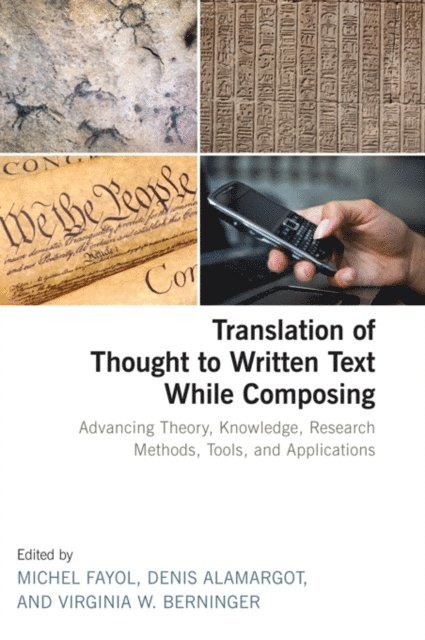
Translation of cognitive representations into written language is one of the most important processes in writing. This volume provides a long-awaited updated overview of the field.The contributors discuss each of the commonly used research methods for studying translation; theorize about the nature of the cognitive and language representations and cognitive/linguistic transformation mechanisms involved in translation during writing; and make the case that translation is a higher-order executive function that is fundamental to the writing process.The book also reviews the application of research to practice -- that is, the translation of the research findings in education and the work-world for individuals who interact with others using written language to communicate ideas.This volume provides a rich resource for student, theorists, and empirical researchers in cognitive psychology, linguistics, and education; and teachers and clinicians who can use the research in their work.
Translation of Thought to Written Text While Composing
Advancing Theory, Knowledge, Research Methods, Tools, and Applications
Inbunden, Engelska, 2012
2 030 kr
Skickas inom 10-15 vardagar
Translation of cognitive representations into written language is one of the most important processes in writing. This volume provides a long-awaited updated overview of the field.The contributors discuss each of the commonly used research methods for studying translation; theorize about the nature of the cognitive and language representations and cognitive/linguistic transformation mechanisms involved in translation during writing; and make the case that translation is a higher-order executive function that is fundamental to the writing process.The book also reviews the application of research to practice -- that is, the translation of the research findings in education and the work-world for individuals who interact with others using written language to communicate ideas.This volume provides a rich resource for student, theorists, and empirical researchers in cognitive psychology, linguistics, and education; and teachers and clinicians who can use the research in their work.