Mike Oaksford - Böcker
Visar alla böcker från författaren Mike Oaksford. Handla med fri frakt och snabb leverans.
6 produkter
6 produkter
1 147 kr
Skickas inom 5-8 vardagar
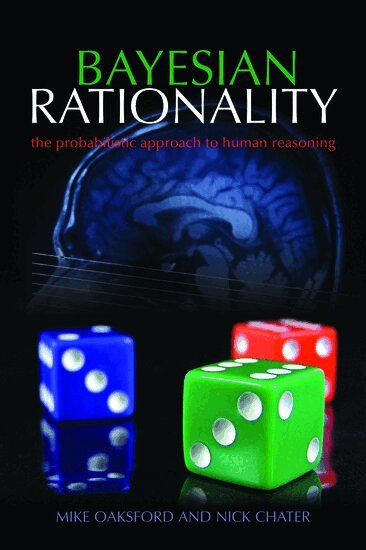
Are people rational? This question was central to Greek thought and has been at the heart of psychology and philosophy for millennia. This book provides a radical and controversial reappraisal of conventional wisdom in the psychology of reasoning, proposing that the Western conception of the mind as a logical system is flawed at the very outset. It argues that cognition should be understood in terms of probability theory, the calculus of uncertain reasoning, rather than in terms of logic, the calculus of certain reasoning.
2 498 kr
Skickas inom 5-8 vardagar
Are people rational? This question was central to Greek thought; and has been at the heart of psychology and philosophy for millennia. This book provides a radical and controversial reappraisal of conventional wisdom in the psychology of reasoning, proposing that the Western conception of the mind as a logical system is flawed at the very outset. It argues that cognition should be understood in terms of probability theory, the calculus of uncertain reasoning, rather than in terms of logic, the calculus of certain reasoning.
991 kr
Skickas inom 5-8 vardagar
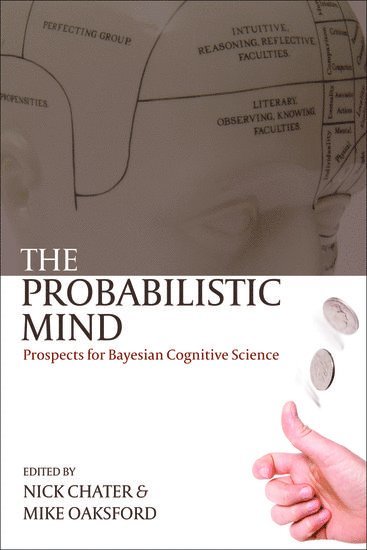
The rational analysis method, first proposed by John R. Anderson, has been enormously influential in helping us understand high-level cognitive processes.'The Probabilistic Mind' is a follow-up to the influential and highly cited 'Rational Models of Cognition' (OUP, 1998). It brings together developments in understanding how, and how far, high-level cognitive processes can be understood in rational terms, and particularly using probabilistic Bayesian methods. It synthesizes and evaluates the progress in the past decade, taking into account developments in Bayesian statistics, statistical analysis of the cognitive 'environment' and a variety of theoretical and experimental lines of research. The scope of the book is broad, covering important recent work in reasoning, decision making, categorization, and memory. Including chapters from many of the leading figures in this field, 'The Probabilistic Mind' will be valuable for psychologists and philosophers interested in cognition.
1 025 kr
Skickas inom 5-8 vardagar
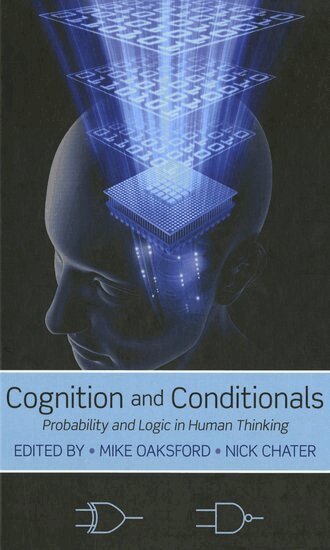
The conditional, if...then, is probably the most important term in natural language and forms the core of systems of logic and mental representation. It occurs in all human languages and allows people to express their knowledge of the causal or law-like structure of the world and of others' behaviour, e.g., if you turn the key the car starts, if John walks the dog he stops for a pint of beer; to make promises, e.g., if you cook tonight, I'll wash up all week; to regulate behaviour, e.g., if you are drinking beer, you must be over 18 years of age; to suggest what would have happened had things been different, e.g., if the match had been dry it would have lit, among many other possible uses. The way in which the conditional is modelled also determines the core of most logical systems. Unsurprisingly, it is also the most researched expression in the psychology of human reasoning.Cognition and Conditionals is the first volume for over 20 years (On Conditionals, 1986, CUP) that brings together recent developments in the cognitive science and psychology of conditional reasoning. Over the last 10 to 15 years, research on conditionals has come to dominate the psychology of reasoning providing a rich seam of results that have created new theoretical possibilities. This book shows how these developments have led researchers to view people's conditional reasoning behaviour more as succesful probabilistic reasoning rather than as errorful logical reasoning. It shows how the multifarious, and apparently competing, theoretical positions developed over the last 50 years in this area - mental logics, mental models, heuristic approaches, dual process theory, and probabilistic approaches-have responded to these insights. Its organisation reflects the view that an integrative approach is emerging that may need to exploit aspects of all these theoretical positions to explain the rich and complex phenomenon of reasoning with conditionals. It includes an introductory chapter relating the development of the psychology of reasoning to developments in the logic and semantics of the conditional. It also includes chapters by many of the leading figures in this field.Cognition and Conditionals will be a valuable resource for cognitive scientists, psychologists and philosophers interested how people actually reason with conditionals.
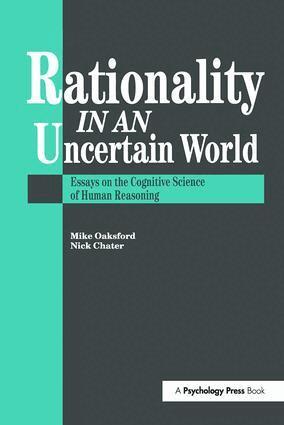
Rationality In An Uncertain World
Essays In The Cognitive Science Of Human Understanding
Inbunden, Engelska, 1998
2 088 kr
Skickas inom 10-15 vardagar
This book brings together an influential sequence of papers that argue for a radical re-conceptualisation of the psychology of inference, and of cognitive science more generally. The papers demonstrate that the thesis that logic provides the basis of human inference is central to much cognitive science, although the commitment to this view is often implicit. They then note that almost all human inference is uncertain, whereas logic is the calculus of certain inference. This mismatch means that logic is not the appropriate model for human thought.Oaksford and Chater's argument draws on research in computer science, artificial intelligence and philosophy of science, in addition to experimental psychology. The authors propose that probability theory, the calculus of uncertain inference, provides a more appropriate model for human thought. They show how a probabilistic account can provide detailed explanations of experimental data on Wason's selection task, which many have viewed as providing a paradigmatic demonstration of human irrationality. Oaksford and Chater show that people's behaviour appears irrational only from a logical point of view, whereas it is entirely rational from a probabilistic perspective. The shift to a probabilistic framework for human inference has significant implications for the psychology of reasoning, cognitive science more generally, and forour picture of ourselves as rational agents.
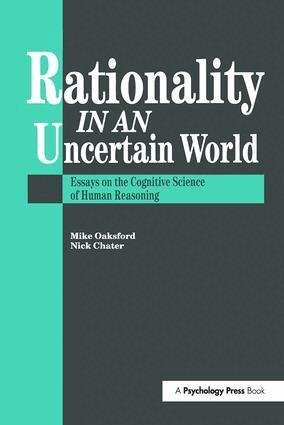
Rationality In An Uncertain World
Essays In The Cognitive Science Of Human Understanding
Häftad, Engelska, 2019
644 kr
Skickas inom 10-15 vardagar
This book brings together an influential sequence of papers that argue for a radical re-conceptualisation of the psychology of inference, and of cognitive science more generally. The papers demonstrate that the thesis that logic provides the basis of human inference is central to much cognitive science, although the commitment to this view is often implicit. They then note that almost all human inference is uncertain, whereas logic is the calculus of certain inference. This mismatch means that logic is not the appropriate model for human thought.Oaksford and Chater's argument draws on research in computer science, artificial intelligence and philosophy of science, in addition to experimental psychology. The authors propose that probability theory, the calculus of uncertain inference, provides a more appropriate model for human thought. They show how a probabilistic account can provide detailed explanations of experimental data on Wason's selection task, which many have viewed as providing a paradigmatic demonstration of human irrationality. Oaksford and Chater show that people's behaviour appears irrational only from a logical point of view, whereas it is entirely rational from a probabilistic perspective. The shift to a probabilistic framework for human inference has significant implications for the psychology of reasoning, cognitive science more generally, and forour picture of ourselves as rational agents.