Mikiyasu Nakayama - Böcker
Visar alla böcker från författaren Mikiyasu Nakayama. Handla med fri frakt och snabb leverans.
7 produkter
7 produkter
2 171 kr
Skickas inom 10-15 vardagar
The rapid economic expansion and population growth of developing countries in Asia has led to increasing demands for water and energy. To meet these demands, large dam development projects have been completed, which has inevitably caused involuntary resettlement. In order to support these projects, dam developers must find appropriate ways to ensure adequate livelihood reconstruction for resettled individuals. Resettlement causes both short-term and long-term effects (both positive and negative) for the relocated populations, meaning that in order to evaluate the larger impact of such projects long-term post-project evaluations must be carried out. However, post-project evaluations by international donors have typically been conducted within a few years after completion; the long-term impact of such projects is seldom evaluated.This book aims to fill this gap. A study team composed of researchers from Indonesia, Japan, Lao PDR, Sri Lanka, and Turkey has conducted ten case studies focusing on resettled individuals’ satisfaction, opportunities offered, and income generation. The volume provides an overview of the ten case studies, which were carried out across five countries. It also discusses how a compensation programme should be designed and what sort of options should be presented to resettled individuals for their maximum benefit.This book was originally published as a special issue of the International Journal of Water Resources Development.
1 359 kr
Skickas inom 10-15 vardagar
Hydropower generation by construction of large dams attracts considerable attention as a feasible renewable energy source to meet the power demand in Asian cities. However, large development projects cause involuntary resettlement. Of the world’s forty to eighty million resettlers, many resettlers have been unable to rebuild their livelihood after relocation and have become impoverished. This book uniquely explores the long-term impacts of displacement and resettlement. It shows that long-term post-project evaluation is necessary to assess the rehabilitation and livelihood reconstruction of resettlers after relocation. It focuses on large dam projects in a number of Asian countries, including Indonesia, Japan, Laos, Turkey, Sri Lanka and Vietnam, which are often ignored in Displacement studies in favour of China or India. Drawing on a wealth of empirical data over ten years, it presents crucial factors for successful resettlement by analysing lessons learned. The range of countries allow for a diverse and complex set of factors and outcomes to be analysed. Many of the factors for successful resettlement recur despite the cases being different in implementation period and location. The book presents highly original findings gathered by local researchers in the field directly talking to resettlers who were relocated more than a decade ago. This original book is a unique resource for researchers and postgraduate students of development studies, environment, geography, sociology and anthropology. It also makes policy recommendations for future resettlement programs that are of great value to development policy makers, planners, water resources engineers and civil society protest groups.
2 495 kr
Skickas inom 10-15 vardagar
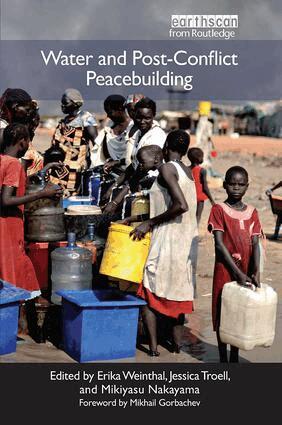
Water is a basic human need, and despite predictions of "water wars," shared waters have proven to be the natural resource with the greatest potential for interstate cooperation and local confidence building. Indeed, water management plays a singularly important role in rebuilding trust after conflict and in preventing a return to conflict. Featuring nineteen case studies and analyses of experiences from twenty eight countries and territories in Africa, Asia, Europe, the Americas, and the Middle East, and drawing on the experiences of thirty-five researchers and practitioners from around the world, this book creates a framework for understanding how decisions governing water resources in post-conflict settings can facilitate or undermine peacebuilding. The lessons will be of value to practitioners in international development and humanitarian initiatives, policy makers, students, and others interested in post-conflict peacebuilding and the nexus between water management and conflict. Water and Post-Conflict Peacebuilding is part of a global initiative to identify and analyze lessons in post-conflict peacebuilding and natural resource management. The project has generated six edited books of case studies and analyses, with contributions from practitioners, policy makers, and researchers. Other books in this series address high-value resources, land, livelihoods, assessing and restoring natural resources, and governance.
440 kr
Skickas inom 10-15 vardagar
Hydropower generation by construction of large dams attracts considerable attention as a feasible renewable energy source to meet the power demand in Asian cities. However, large development projects cause involuntary resettlement. Of the world’s forty to eighty million resettlers, many resettlers have been unable to rebuild their livelihood after relocation and have become impoverished. This book uniquely explores the long-term impacts of displacement and resettlement. It shows that long-term post-project evaluation is necessary to assess the rehabilitation and livelihood reconstruction of resettlers after relocation. It focuses on large dam projects in a number of Asian countries, including Indonesia, Japan, Laos, Turkey, Sri Lanka and Vietnam, which are often ignored in Displacement studies in favour of China or India. Drawing on a wealth of empirical data over ten years, it presents crucial factors for successful resettlement by analysing lessons learned. The range of countries allow for a diverse and complex set of factors and outcomes to be analysed. Many of the factors for successful resettlement recur despite the cases being different in implementation period and location. The book presents highly original findings gathered by local researchers in the field directly talking to resettlers who were relocated more than a decade ago. This original book is a unique resource for researchers and postgraduate students of development studies, environment, geography, sociology and anthropology. It also makes policy recommendations for future resettlement programs that are of great value to development policy makers, planners, water resources engineers and civil society protest groups.
697 kr
Skickas inom 10-15 vardagar
The rapid economic expansion and population growth of developing countries in Asia has led to increasing demands for water and energy. To meet these demands, large dam development projects have been completed, which has inevitably caused involuntary resettlement. In order to support these projects, dam developers must find appropriate ways to ensure adequate livelihood reconstruction for resettled individuals. Resettlement causes both short-term and long-term effects (both positive and negative) for the relocated populations, meaning that in order to evaluate the larger impact of such projects long-term post-project evaluations must be carried out. However, post-project evaluations by international donors have typically been conducted within a few years after completion; the long-term impact of such projects is seldom evaluated.This book aims to fill this gap. A study team composed of researchers from Indonesia, Japan, Lao PDR, Sri Lanka, and Turkey has conducted ten case studies focusing on resettled individuals’ satisfaction, opportunities offered, and income generation. The volume provides an overview of the ten case studies, which were carried out across five countries. It also discusses how a compensation programme should be designed and what sort of options should be presented to resettled individuals for their maximum benefit.This book was originally published as a special issue of the International Journal of Water Resources Development.
989 kr
Skickas inom 10-15 vardagar
Water is a basic human need, and despite predictions of "water wars," shared waters have proven to be the natural resource with the greatest potential for interstate cooperation and local confidence building. Indeed, water management plays a singularly important role in rebuilding trust after conflict and in preventing a return to conflict.Featuring nineteen case studies and analyses of experiences from twenty eight countries and territories in Africa, Asia, Europe, the Americas, and the Middle East, and drawing on the experiences of thirty-five researchers and practitioners from around the world, this book creates a framework for understanding how decisions governing water resources in post-conflict settings can facilitate or undermine peacebuilding. The lessons will be of value to practitioners in international development and humanitarian initiatives, policy makers, students, and others interested in post-conflict peacebuilding and the nexus between water management and conflict. Water and Post-Conflict Peacebuilding is part of a global initiative to identify and analyze lessons in post-conflict peacebuilding and natural resource management. The project has generated six edited books of case studies and analyses, with contributions from practitioners, policy makers, and researchers. Other books in this series address high-value resources, land, livelihoods, assessing and restoring natural resources, and governance.
7 695 kr
Skickas inom 10-15 vardagar
Post-conflict peacebuilding efforts can fail if they do not pay sufficient attention to natural resources. Natural resources – diamonds, oil, and minerals – are frequently at the heart of historic grievances, and have caused or funded at least eighteen conflicts since 1990. The same resources can play a central role in post-conflict peacebuilding, providing revenue for cash-starved governments, basic services for collapsed economies, and means for restoring livelihoods. To date, there is a striking gap in knowledge of what works, what does not, and how to improve peacebuilding through more effective and systematic management of natural resources. Post-Conflict Peacebuilding and Natural Resource Management addresses this gap by examining the growing literature on the topic and surveying experiences across more than forty post-conflict countries. The six-volume series includes more than 130 chapters from over 200 researchers, practitioners, and policymakers.