Milette Gaifman – författare
Visar alla böcker från författaren Milette Gaifman. Handla med fri frakt och snabb leverans.
10 produkter
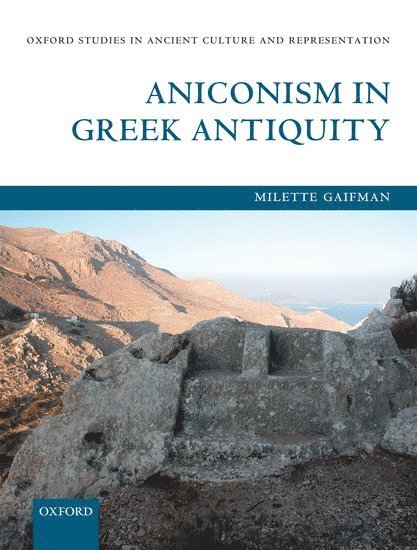
Aniconism in Greek Antiquity
Inbunden, 2012
2039 kr
Lägg i varukorg
In this volume, Milette Gaifman explores a phenomenon known as aniconism - the absence of figural images of gods in Greek practiced religion and the adoption of aniconic monuments, namely objects such as pillars and poles, to designate the presence of the divine. Shifting our attention from the …
Landmark Through Time
On Classifying Greek Art and Architecture
Inbunden, 2027
653 kr
Kommande
What representations of a monument across centuries can tell us about how we engage with, study, and understand the past.In a square in the heart of Athens, a cylindrical structure rests on a platform made up of large stone blocks. Semi-columns encircle it, and a slanted roof sits on top, with a …
Exploring Aniconism
Av Mikael Aktor, Milette Gaifman
Inbunden, 2019
2512 kr
Lägg i varukorg
This book explores the phenomenon of aniconism—the denotation of the presence of gods, saints, or spiritual forces using non-figural visual markers that do not resemble these supranatural entities. The contributors show how various types of aniconism differ in how they mediate divine presence and …
Exploring Aniconism
Av Milette Gaifman, Mikael Aktor
E-bok, 2020
814 kr
Lägg i varukorg
This book explores the phenomenon of aniconism—the denotation of the presence of gods, saints, or spiritual forces using non-figural visual markers that do not resemble these supranatural entities. The contributors show how various types of aniconism differ in how they mediate divine presence and …
Exploring Aniconism
Av Milette Gaifman, Mikael Aktor
E-bok, 2020
796 kr
Lägg i varukorg
This book explores the phenomenon of aniconism—the denotation of the presence of gods, saints, or spiritual forces using non-figural visual markers that do not resemble these supranatural entities. The contributors show how various types of aniconism differ in how they mediate divine presence and …
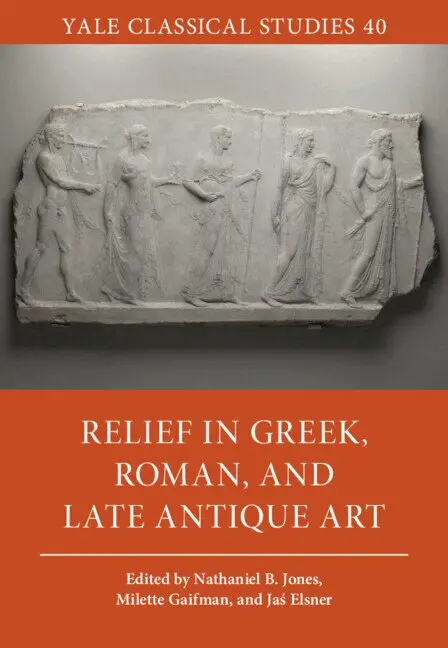
Relief in Greek, Roman, and Late Antique Art
Av Jas' Elsner, Milette Gaifman m. fl.
Inbunden, 2025
1576 kr
Lägg i varukorg
The artistic category of relief has long dominated scholarly discussions of ancient Greco-Roman art for good reason: images in relief pervaded ancient visual culture from the rise of the Greek city-state through to the Christian era. They are witnessed in public and private contexts; terracotta, …
Relief in Greek, Roman, and Late Antique Art
Av Nathaniel B. Jones, Milette Gaifman m. fl.
E-bok, 2025
1788 kr
Lägg i varukorg
Relief in Greek, Roman, and Late Antique Art
Av Nathaniel B. Jones, Milette Gaifman m. fl.
E-bok, 2025
1846 kr
Lägg i varukorg
Exploring Aniconism
Av Mikael Aktor, Milette Gaifman
Häftad, 2021
691 kr
Lägg i varukorg
This book explores the phenomenon of aniconism—the denotation of the presence of gods, saints, or spiritual forces using non-figural visual markers that do not resemble these supranatural entities. The contributors show how various types of aniconism differ in how they mediate divine presence and …