Mingya Liu – författare
Visar alla böcker från författaren Mingya Liu. Handla med fri frakt och snabb leverans.
5 produkter
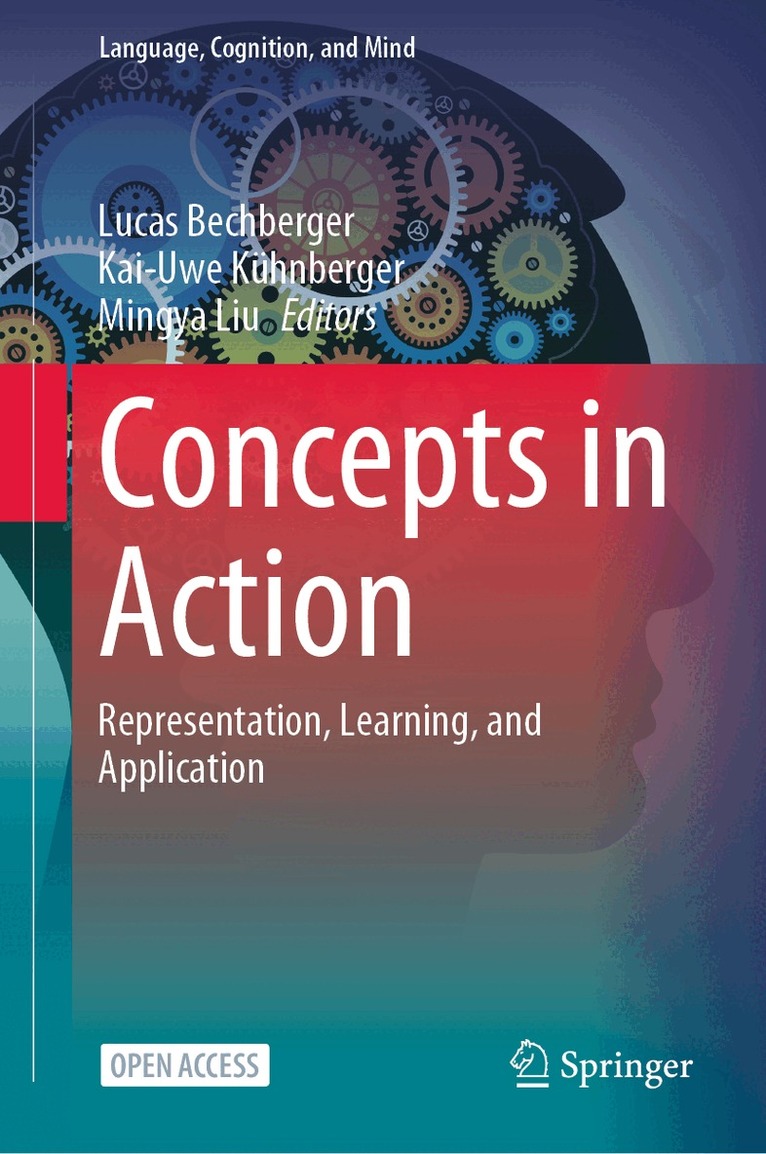
Concepts in Action
Representation, Learning, and Application
Av Lucas Bechberger, Kai-Uwe Kühnberger m. fl.
Inbunden, 2021
552 kr
Lägg i varukorg
This open access book is a timely contribution in presenting recent issues, approaches, and results that are not only central to the highly interdisciplinary field of concept research but also particularly important to newly emergent paradigms and challenges. The contributors present a unique, …
Concepts in Action
Representation, Learning, and Application
Av Lucas Bechberger, Kai-Uwe Kühnberger m. fl.
Häftad, 2021
443 kr
Lägg i varukorg
This open access book is a timely contribution in presenting recent issues, approaches, and results that are not only central to the highly interdisciplinary field of concept research but also particularly important to newly emergent paradigms and challenges. The contributors present a unique, …
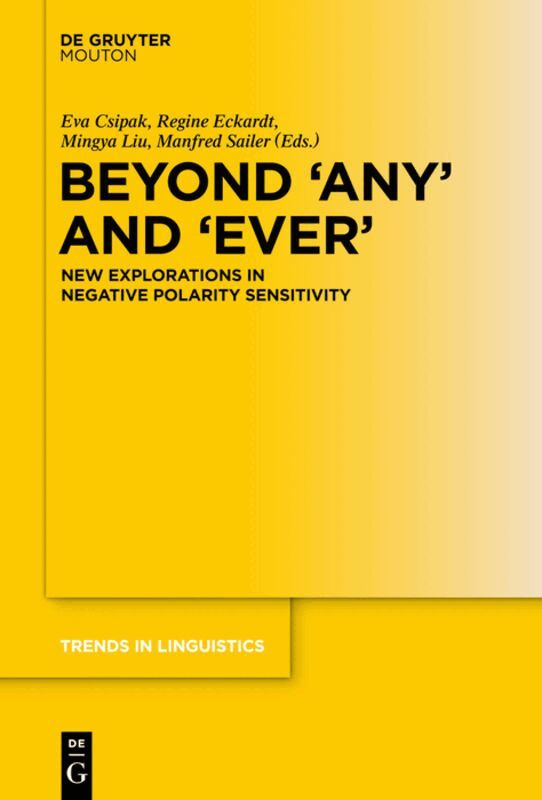
Beyond 'Any' and 'Ever'
New Explorations in Negative Polarity Sensitivity
Av Eva Csipak, Regine Eckardt m. fl.
Inbunden, 2013
2390 kr
Lägg i varukorg
The grammar of negative polarity items is one of the challenges for linguistic theory. NPIs cross-cut all traditional categories in grammar and semantics, yet their distribution is by no means arbitrary. Theories of NPI licensing have been proposed in terms of syntax, semantics, and pragmatics - …
Beyond 'Any' and 'Ever'
New Explorations in Negative Polarity Sensitivity
Av Manfred Sailer, Mingya Liu m. fl.
E-bok, 2013
2416 kr
Lägg i varukorg
The grammar of negative polarity items is one of the challenges for linguistic theory. NPIs cross-cut all traditional categories in grammar and semantics, yet their distribution is by no means arbitrary. Theories of NPI licensing have been proposed in terms of syntax, semantics, and pragmatics - …
Projective Meaning in Mandarin Chinese
A Case Study Approach
Av Mingya Liu
Inbunden, 2024
1793 kr
Kommande
Multidimensional semantic theory has greatly influenced the semantic and pragmatic research of natural languages in the past few decades, but Chinese-based research in this direction has been very scarce so far.This monograph, through five case studies, investigates the distributional, semantic and …