Mogens Mueller – författare
Visar alla böcker från författaren Mogens Mueller. Handla med fri frakt och snabb leverans.
4 produkter
4 produkter
Expression Son of Man and the Development of Christology
A History of Interpretation
Inbunden, Engelska, 2011
2 113 kr
Skickas inom 10-15 vardagar
'Son of Man' is practically the only self-designation employed by Jesus himself in the gospels, but is used in such a way that no hint is left of any particular theological significance. Still, during the first many centuries of the church, the expression as it was reused was given content, first literally as signifying Christ's human nature. Later 'Son of Man' was thought to be a christological title in its own right. Today, many scholars are inclined to think that, in an original Aramaic of an historical Jesus, it was little more than a rhetorical circumlocution, referring to the one speaking. Mogens Müller's 'The Expression 'Son of Man' and the Development of Christology: A History of Interpretation' is the first study of the 'Son of Man' trope, which traces the history of interpretation from the Apostolic Fathers to the present, concluding that the various interpretations of this phrase reflect little more than the various doctrinal assumptions held by its interpreters over centuries.
Expression Son of Man and the Development of Christology
A History of Interpretation
Häftad, Engelska, 2013
632 kr
Skickas inom 10-15 vardagar
'Son of Man' is practically the only self-designation employed by Jesus himself in the gospels, but is used in such a way that no hint is left of any particular theological significance. Still, during the first many centuries of the church, the expression as it was reused was given content, first literally as signifying Christ's human nature. Later 'Son of Man' was thought to be a christological title in its own right. Today, many scholars are inclined to think that, in an original Aramaic of an historical Jesus, it was little more than a rhetorical circumlocution, referring to the one speaking. Mogens Müller's 'The Expression 'Son of Man' and the Development of Christology: A History of Interpretation' is the first study of the 'Son of Man' trope, which traces the history of interpretation from the Apostolic Fathers to the present, concluding that the various interpretations of this phrase reflect little more than the various doctrinal assumptions held by its interpreters over centuries.
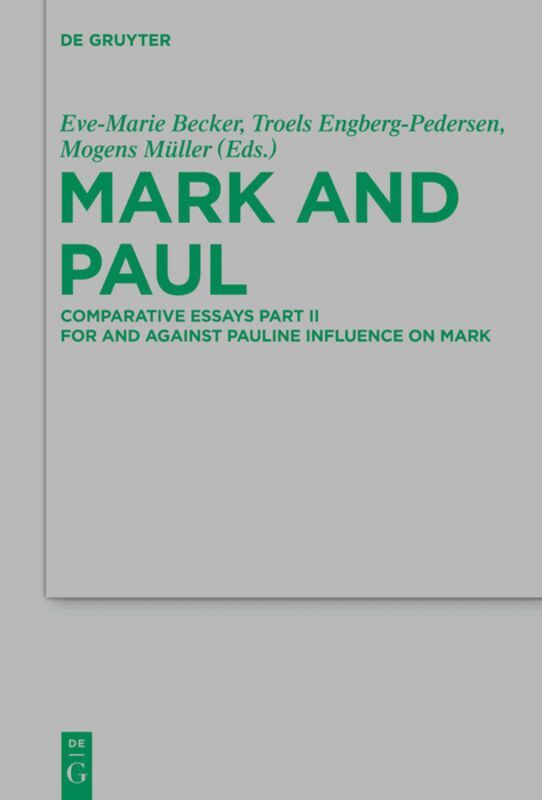
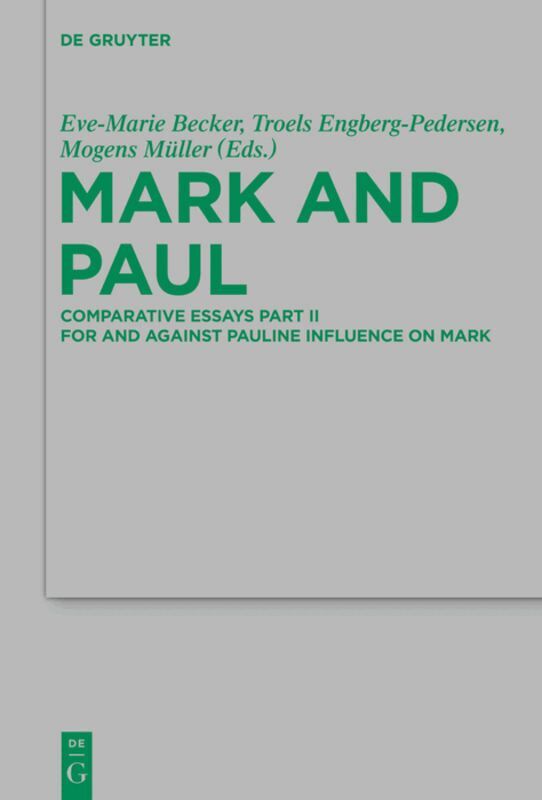
Mark and Paul
Comparative Essays Part II. For and Against Pauline Influence on Mark
Inbunden, Engelska, 2014
1 866 kr
Skickas inom 5-8 vardagar
This volume brings together an international group of scholars on Mark and Paul, respectively, who reopen the question whether Paul was a direct influence on Mark. On the basis of the latest methods in New Testament scholarship, the battle over Yes and No to this question of literary and theological influence is waged within these pages. In the end, no agreement is reached, but the basic issues stand out with much greater clarity than before. How may one relate two rather different literary genres, the apostolic letter and the narrative gospel? How may the theologies of two such different types of writing be compared? Are there sufficient indications that Paul lies directly behind Mark for us to conclude that through Paul himself and Mark the New Testament as a whole reflects specifically Pauline ideas? What would the literary and theological consequences of either assuming or denying a direct influence be for our reconstruction of 1st century Christianity? And what would the consequences be for either understanding Mark or Paul as literary authors and theologians? How far should we give Paul an exalted a position in the literary creativity of the first Christians? Addressing these questions are scholars who have already written seminally on the issue or have marked positions on it, like Joel Marcus, Margaret Mitchell, Gerd Theissen and Oda Wischmeyer, together with a group of up-coming and senior Danish scholars from Aarhus and Copenhagen Universities who have collaborated on the issue for some years. The present volume leads the discussion further that has been taken up in: “Paul and Mark” (ed. by O. Wischmeyer, D. Sim, and I. Elmer), BZNW 191, 2013.
Del 199 - Beihefte zur Zeitschrift fur die Neutestamentliche Wissenschaft
Mark and Paul
Comparative Essays Part II. For and Against Pauline Influence on Mark
Häftad, Engelska, 2017
275 kr
Skickas inom 5-8 vardagar
This volume brings together an international group of scholars on Mark and Paul, respectively, who reopen the question whether Paul was a direct influence on Mark. On the basis of the latest methods in New Testament scholarship, the battle over Yes and No to this question of literary and theological influence is waged within these pages. In the end, no agreement is reached, but the basic issues stand out with much greater clarity than before. How may one relate two rather different literary genres, the apostolic letter and the narrative gospel? How may the theologies of two such different types of writing be compared? Are there sufficient indications that Paul lies directly behind Mark for us to conclude that through Paul himself and Mark the New Testament as a whole reflects specifically Pauline ideas? What would the literary and theological consequences of either assuming or denying a direct influence be for our reconstruction of 1st century Christianity? And what would the consequences be for either understanding Mark or Paul as literary authors and theologians? How far should we give Paul an exalted a position in the literary creativity of the first Christians? Addressing these questions are scholars who have already written seminally on the issue or have marked positions on it, like Joel Marcus, Margaret Mitchell, Gerd Theissen and Oda Wischmeyer, together with a group of up-coming and senior Danish scholars from Aarhus and Copenhagen Universities who have collaborated on the issue for some years. The present volume leads the discussion further that has been taken up in: “Paul and Mark” (ed. by O. Wischmeyer, D. Sim, and I. Elmer), BZNW 191, 2013.