N. J. Demerath – författare
Visar alla böcker från författaren N. J. Demerath. Handla med fri frakt och snabb leverans.
4 produkter
4 produkter
Inbunden, Engelska, 1998
2 284 kr
Skickas inom 5-8 vardagar
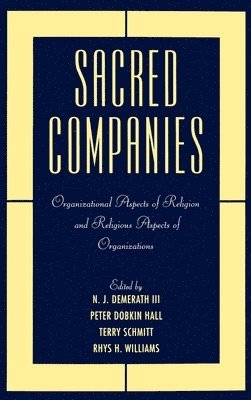
Religion is intrinsically social, and hence irretrievably organizational. Religion and organizations have separately been the objects of frequent study but their confluence has rarely been considered. This interdisciplinary collection of mostly unpublished papers is the first volume to tackle this neglected subject. The result of a three-year research project at Yale sponsored by the Lilly Endowment, the volume looks at such topics as the historical sources and patterns of U.S. religious institutions, contemporary patterns of denominational authority, the congregation as organization, and the interface between religious and secular institutions.
Häftad, Engelska, 2014
585 kr
Skickas inom 5-8 vardagar
Homelessness, black neighborhood development, problems of abortion and sex education--how does religion affect the politics of an American city confronting these and other concerns? And what differences have "church and state" issues made in these struggles? In answering such questions, A Bridging of Faiths conveys a feeling of the urgent social theater of Springfield, Massachusetts, and provides both a contemporary and historical sense of how power shapes and is shaped by the civic culture. Recalling the immediacy and provocativeness of classic community studies like Middletown and Yankee City, the work draws on the voices of Springfielders themselves, while it exposes tendencies that prevail throughout contemporary America. This is a tale of two establishments: Protestant for three centuries, Springfield has been for the last fifty years a Catholic city. In looking at its emerging demographic, political, and economic patterns, the book shows how church and state interact at the local level, where lives are actually lived, as opposed to how the law and public opinion say they ought to interact at the more abstract federal level.While religion is more politically influential than some social scientists might have expected, it does not possess the kind of power feared by many constitutionalists. Politicians are seeking to redefine themselves in relation to religion and in other ways, and religion as a whole faces subtle crises of mobility, authority, and secularization. From these complexities, new patterns of cultural and political authority have emerged in Springfield, similar to those now affecting other American communities and the nation. Originally published in 1992. The Princeton Legacy Library uses the latest print-on-demand technology to again make available previously out-of-print books from the distinguished backlist of Princeton University Press. These editions preserve the original texts of these important books while presenting them in durable paperback and hardcover editions. The goal of the Princeton Legacy Library is to vastly increase access to the rich scholarly heritage found in the thousands of books published by Princeton University Press since its founding in 1905.
Inbunden, Engelska, 2016
2 624 kr
Skickas inom 3-6 vardagar
Homelessness, black neighborhood development, problems of abortion and sex education--how does religion affect the politics of an American city confronting these and other concerns? And what differences have "church and state" issues made in these struggles? In answering such questions, A Bridging of Faiths conveys a feeling of the urgent social theater of Springfield, Massachusetts, and provides both a contemporary and historical sense of how power shapes and is shaped by the civic culture. Recalling the immediacy and provocativeness of classic community studies like Middletown and Yankee City, the work draws on the voices of Springfielders themselves, while it exposes tendencies that prevail throughout contemporary America. This is a tale of two establishments: Protestant for three centuries, Springfield has been for the last fifty years a Catholic city. In looking at its emerging demographic, political, and economic patterns, the book shows how church and state interact at the local level, where lives are actually lived, as opposed to how the law and public opinion say they ought to interact at the more abstract federal level.While religion is more politically influential than some social scientists might have expected, it does not possess the kind of power feared by many constitutionalists. Politicians are seeking to redefine themselves in relation to religion and in other ways, and religion as a whole faces subtle crises of mobility, authority, and secularization. From these complexities, new patterns of cultural and political authority have emerged in Springfield, similar to those now affecting other American communities and the nation. Originally published in 1992. The Princeton Legacy Library uses the latest print-on-demand technology to again make available previously out-of-print books from the distinguished backlist of Princeton University Press. These editions preserve the original texts of these important books while presenting them in durable paperback and hardcover editions. The goal of the Princeton Legacy Library is to vastly increase access to the rich scholarly heritage found in the thousands of books published by Princeton University Press since its founding in 1905.
E-bok
PDF, Engelska, 2013783 kr
Läs direkt efter köp
Social Policy and Sociology explores the relationship between social policy and sociology and covers topics such as social inequities and individual stress in the family cycle. America''s youth and their problems are also given attention, along with the relationship between graduate training and federal funding. Comprised of 24 chapters, this book begins with an assessment of the proper relationship between sociology and public policy, and whether sociologists should become actively engaged in social engineering. Methods of training graduate students for doing policy research are also discussed. Subsequent chapters explore community planning and poverty; policy implications of race relations; formal models as a guide to social policy; and the interrelationships between governmental policy, social structure, and public values. Social problems such as alcoholism and drug addiction are also considered, together with the changing relationship between government support and graduate training. Finally, the what and why of policy research in sociology are examined, and possible changes in graduate training and professional practice in sociology are evaluated. This monograph will be of interest to sociologists as well as social and public policymakers.