Nadine Ehlers - Böcker
Visar alla böcker från författaren Nadine Ehlers. Handla med fri frakt och snabb leverans.
7 produkter
7 produkter
Racial Imperatives
Discipline, Performativity, and Struggles Against Subjection
Häftad, Engelska, 2012
257 kr
Skickas inom 7-10 vardagar
Nadine Ehlers examines the constructions of blackness and whiteness cultivated in the U.S. imaginary and asks, how do individuals become racial subjects? She analyzes anti-miscegenation law, statutory definitions of race, and the rhetoric surrounding the phenomenon of racial passing to provide critical accounts of racial categorization and norms, the policing of racial behavior, and the regulation of racial bodies as they are underpinned by demarcations of sexuality, gender, and class. Ehlers places the work of Michel Foucault, Judith Butler's account of performativity, and theories of race into conversation to show how race is a form of discipline, that race is performative, and that all racial identity can be seen as performative racial passing. She tests these claims through an excavation of the 1925 "racial fraud" case of Rhinelander v. Rhinelander and concludes by considering the possibilities for racial agency, extending Foucault's later work on ethics and "technologies of the self" to explore the potential for racial transformation.
Racial Imperatives
Discipline, Performativity, and Struggles Against Subjection
Inbunden, Engelska, 2012
743 kr
Skickas inom 7-10 vardagar
Nadine Ehlers examines the constructions of blackness and whiteness cultivated in the U.S. imaginary and asks, how do individuals become racial subjects? She analyzes anti-miscegenation law, statutory definitions of race, and the rhetoric surrounding the phenomenon of racial passing to provide critical accounts of racial categorization and norms, the policing of racial behavior, and the regulation of racial bodies as they are underpinned by demarcations of sexuality, gender, and class. Ehlers places the work of Michel Foucault, Judith Butler's account of performativity, and theories of race into conversation to show how race is a form of discipline, that race is performative, and that all racial identity can be seen as performative racial passing. She tests these claims through an excavation of the 1925 "racial fraud" case of Rhinelander v. Rhinelander and concludes by considering the possibilities for racial agency, extending Foucault's later work on ethics and "technologies of the self" to explore the potential for racial transformation.
1 167 kr
Skickas inom 10-15 vardagar
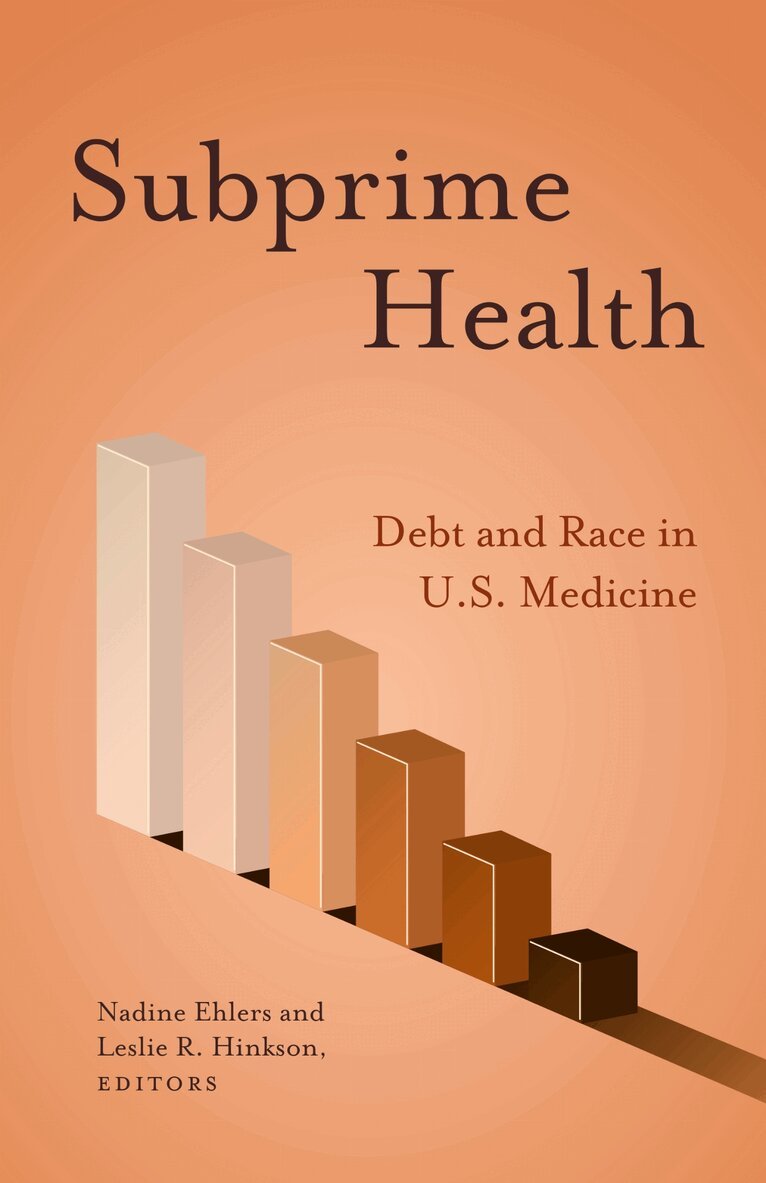
From race-based pharmaceutical prescriptions and marketing, to race-targeted medical hot spottingand the Affordable Care Act, to stem-cell trial recruitment discourse, Subprime Health is a timely examination of race-based medicine as it intersects with the concept of debt. The contributors to this volume propose that race-based medicine is inextricable from debt in two key senses. They first demonstrate how the financial costs related to race-based medicine disproportionately burden minorities, as well as how monetary debt and race are conditioned by broader relations of power. Second, the contributors investigate how race-based medicine is related to the concept of indebtedness and is often positioned as a way to pay back the debt that the medical establishment-and society at large-owes for the past and present neglect and abuses of many communities of color. By approaching the subject of race-based medicine from an interdisciplinary perspective-critical race studies, science and technology studies, public health, sociology, geography, and law-this volume moves the discussion beyond narrow and familiar debates over racial genomics and suggests fruitful new directions for future research. Contributors: Ruha Benjamin, Princeton U; Catherine Bliss, U of California, San Francisco; Khiara M. Bridges, Boston U; Shiloh Krupar, Georgetown U; Jenna M. Loyd, U of Wisconsin Milwaukee; Anne Pollock, Georgia Tech.
287 kr
Skickas inom 10-15 vardagar
From race-based pharmaceutical prescriptions and marketing, to race-targeted medical hot spottingand the Affordable Care Act, to stem-cell trial recruitment discourse, Subprime Health is a timely examination of race-based medicine as it intersects with the concept of debt. The contributors to this volume propose that race-based medicine is inextricable from debt in two key senses. They first demonstrate how the financial costs related to race-based medicine disproportionately burden minorities, as well as how monetary debt and race are conditioned by broader relations of power. Second, the contributors investigate how race-based medicine is related to the concept of indebtedness and is often positioned as a way to pay back the debt that the medical establishment-and society at large-owes for the past and present neglect and abuses of many communities of color. By approaching the subject of race-based medicine from an interdisciplinary perspective-critical race studies, science and technology studies, public health, sociology, geography, and law-this volume moves the discussion beyond narrow and familiar debates over racial genomics and suggests fruitful new directions for future research. Contributors: Ruha Benjamin, Princeton U; Catherine Bliss, U of California, San Francisco; Khiara M. Bridges, Boston U; Shiloh Krupar, Georgetown U; Jenna M. Loyd, U of Wisconsin Milwaukee; Anne Pollock, Georgia Tech.
1 167 kr
Skickas inom 10-15 vardagar
A trenchant analysis of the dark side of regulatory life-making todayIn their seemingly relentless pursuit of life, do contemporary U.S. “biocultures”-where biomedicine extends beyond the formal institutions of the clinic, hospital, and lab to everyday cultural practices-also engage in a deadly endeavor? Challenging us to question their implications, Deadly Biocultures shows that efforts to “make live” are accompanied by the twin operation of “let die”: they validate and enhance lives seen as economically viable, self-sustaining, productive, and oriented toward the future and optimism while reinforcing inequitable distributions of life based on race, class, gender, and dis/ability. Affirming life can obscure death, create deadly conditions, and even kill.Deadly Biocultures examines the affirmation to hope, target, thrive, secure, and green in the respective biocultures of cancer, race-based health, fatness, aging, and the afterlife. Its chapters focus on specific practices, technologies, or techniques that ostensibly affirm life and suggest life’s inextricable links to capital but that also engender a politics of death and erasure. The authors ultimately ask: what alternative social forms and individual practices might be mapped onto or intersect with biomedicine for more equitable biofutures?
296 kr
Skickas inom 10-15 vardagar
A trenchant analysis of the dark side of regulatory life-making todayIn their seemingly relentless pursuit of life, do contemporary U.S. “biocultures”-where biomedicine extends beyond the formal institutions of the clinic, hospital, and lab to everyday cultural practices-also engage in a deadly endeavor? Challenging us to question their implications, Deadly Biocultures shows that efforts to “make live” are accompanied by the twin operation of “let die”: they validate and enhance lives seen as economically viable, self-sustaining, productive, and oriented toward the future and optimism while reinforcing inequitable distributions of life based on race, class, gender, and dis/ability. Affirming life can obscure death, create deadly conditions, and even kill.Deadly Biocultures examines the affirmation to hope, target, thrive, secure, and green in the respective biocultures of cancer, race-based health, fatness, aging, and the afterlife. Its chapters focus on specific practices, technologies, or techniques that ostensibly affirm life and suggest life’s inextricable links to capital but that also engender a politics of death and erasure. The authors ultimately ask: what alternative social forms and individual practices might be mapped onto or intersect with biomedicine for more equitable biofutures?
125 kr
Skickas inom 7-10 vardagar
The potential of biohumanities as a foundation for antiracist critique of the humanThe Racial Cage delivers a spirited and polyvocal analysis of how race is materialized through both metaphorical and literal cages. It theorizes the cage, fence, dragnet, and tube as material–semiotic sites for racialization and for iteratively redefining the human–animal boundary. A collaborative conversation across continents, this work examines the racial cage as an important part of the practice of social division and bodily containment. The deeply considered result is an empirical and theoretical approach to biohumanities that productively interrogates its linkages to critical theories of race and racism.