Nancy Folbre - Böcker
Visar alla böcker från författaren Nancy Folbre. Handla med fri frakt och snabb leverans.
13 produkter
13 produkter
300 kr
Skickas
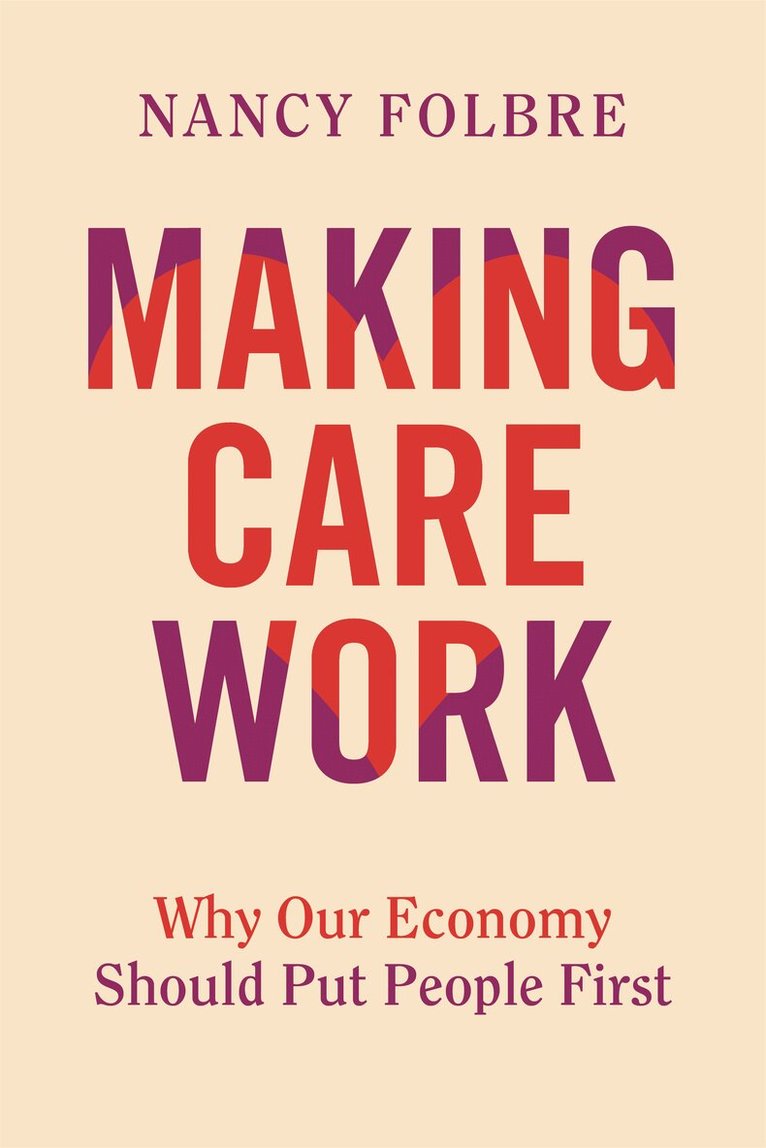
A bold critique of conventional economics that reveals why the time and money we devote to care work is vital to our economic future.Our economy is much bigger than the dollar value of things we buy and sell. It depends on us—our health, our creativity, and our moral commitments. These capabilities don't have price tags but are crucial to a sustainable future. We need to acknowledge and reward the value of caring for ourselves and others, especially our children, our elderly, and those experiencing illness or disability. From leading feminist economist Nancy Folbre, Making Care Work provides a compelling historical and economic account of care provision in the United States. Folbre traces the long and colorful history of resistance to bogus claims that only paid work "counts" and that employees in care services are always paid what they deserve. Explaining why care providers remain economically vulnerable today, she argues that more attention to the public benefits of care provision could help build the political coalitions needed to implement policies that put people first. In this comprehensive and bold book, Folbre upends conventional economic thinking and maps a hopeful path toward a more equitable and sustainable economy.
973 kr
When does the pursuit of self-interest go too far, lapsing into morally unacceptable behaviour? Until the unprecedented events of the recent global financial crisis economists often seemed unconcerned with this question, even suggesting that "greed is good." A closer look, however, suggests that greed and lust are generally considered good only for men, and then only outside the realm of family life. The history of Western economic ideas shows that men have given themselves more cultural permission than women for the pursuit of both economic and sexual self-interest. Feminists have long contested the boundaries of this permission, demanding more than mere freedom to act more like men. Women have gradually gained the power to revise our conceptual and moral maps and to insist on a better-and less gendered-balance between self interest and care for others. This book brings women's work, their sexuality, and their ideas into the center of the dialectic between economic history and the history of economic ideas. It describes a spiralling process of economic and cultural change in Great Britain, France, and the United States since the 18th century that shaped the evolution of patriarchal capitalism and the larger relationship between production and reproduction. This feminist reinterpretation of our past holds profound implications for today's efforts to develop a more humane and sustainable form of capitalism.
2 290 kr
Skickas inom 10-15 vardagar
Three paradoxes surround the division of the costs of social reproduction:* Women have entered the paid labour force in growing numbers, but they continue to perform most of the unpaid labour of housework and childcare.* Birth rates have fallen but more and more mothers are supporting children on their own, with little or no assistance from fathers.* The growth of state spending is often blamed on malfunctioning markets, or runaway bureaucracies. But a large percentage of social spending provides substitutes for income transfers that once took place within families.Who Pays for the Kids? explains how this paradoxical situation has arisen. The costs of social reproduction are largely paid by women: men have remained extremely reluctant to pay their share of the costs of raising the next generation. Traditional theories - neo-classical, Marxist and Feminist - can only provide an incomplete account of this, and this book offers an alternative analysis, based on individual choices but within interlocking structures of constraint based on gender, age, sex, nation, race and class.
820 kr
Skickas inom 10-15 vardagar
Three paradoxes surround the division of the costs of social reproduction:* Women have entered the paid labour force in growing numbers, but they continue to perform most of the unpaid labour of housework and childcare.* Birth rates have fallen but more and more mothers are supporting children on their own, with little or no assistance from fathers.* The growth of state spending is often blamed on malfunctioning markets, or runaway bureaucracies. But a large percentage of social spending provides substitutes for income transfers that once took place within families.Who Pays for the Kids? explains how this paradoxical situation has arisen. The costs of social reproduction are largely paid by women: men have remained extremely reluctant to pay their share of the costs of raising the next generation. Traditional theories - neo-classical, Marxist and Feminist - can only provide an incomplete account of this, and this book offers an alternative analysis, based on individual choices but within interlocking structures of constraint based on gender, age, sex, nation, race and class.
2 290 kr
Skickas inom 10-15 vardagar
The time we have to care for one another, especially for our children and our elderly, is more precious to us than anything else in the world. Yet we have more experience accounting for money than we do for time. In this volume, leading experts in analysis of time use from across the globe explore the interface between time use and family policy. The contributors:* show how social institutions limit the choices that individuals can make about how to divide their time between paid and unpaid work* challenge conventional surveys that offer simplistic measures of time spent in childcare or elder care* summarize empirical evidence concerning trends in time devoted to the care of family members * debate ways of assigning a monetary value to this time.This informative and enlightening book is well researched, well thought through and well written. An important read for students of feminist economics, sociology and gender studies, the contributors here argue that time is not money, in fact time is more important than money.
820 kr
Skickas inom 10-15 vardagar
The time we have to care for one another, especially for our children and our elderly, is more precious to us than anything else in the world. Yet we have more experience accounting for money than we do for time. In this volume, leading experts in analysis of time use from across the globe explore the interface between time use and family policy. The contributors:* show how social institutions limit the choices that individuals can make about how to divide their time between paid and unpaid work* challenge conventional surveys that offer simplistic measures of time spent in childcare or elder care* summarize empirical evidence concerning trends in time devoted to the care of family members * debate ways of assigning a monetary value to this time.This informative and enlightening book is well researched, well thought through and well written. An important read for students of feminist economics, sociology and gender studies, the contributors here argue that time is not money, in fact time is more important than money.
576 kr
Skickas inom 10-15 vardagar
Public discussion of population aging usually focuses on the financial burden that increasingly elderly populations will impose on younger generations. Scholars give much less attention to who does the actual work of day-to-day care for those no longer able to care for themselves; and although women are the majority among the elderly, little is heard about gender differences in economic resources or the need for care. This volume is dedicated to giving gender - and a full range of social and cultural differences - their rightful place in these discussions. The authors address, amongst other issues:the worldwide dilemmas of eldercarethe structure of income and care provisions for older populationsthe role of family, marital status, and class in these provisionsthe impact of polices affecting retirement agethe role of social insurance in preventing poverty among elderly women.The essays included address these topics in a myriad of geographical contexts, including South Africa, the US, Palestine, Australia, South Korea, Spain, Germany, and Sweden. The concerns highlighted here also remind us that whether through individual families or social insurance, through family caregivers or paid help, the oldest generation will continue to depend on adults of working age for its well-being.This book was previously published as a special issue of Feminist Economics.
346 kr
Skickas inom 10-15 vardagar
Public discussion of population aging usually focuses on the financial burden that increasingly elderly populations will impose on younger generations. Scholars give much less attention to who does the actual work of day-to-day care for those no longer able to care for themselves; and although women are the majority among the elderly, little is heard about gender differences in economic resources or the need for care. This volume is dedicated to giving gender - and a full range of social and cultural differences - their rightful place in these discussions. The authors address, amongst other issues:the worldwide dilemmas of eldercarethe structure of income and care provisions for older populationsthe role of family, marital status, and class in these provisionsthe impact of polices affecting retirement agethe role of social insurance in preventing poverty among elderly women.The essays included address these topics in a myriad of geographical contexts, including South Africa, the US, Palestine, Australia, South Korea, Spain, Germany, and Sweden. The concerns highlighted here also remind us that whether through individual families or social insurance, through family caregivers or paid help, the oldest generation will continue to depend on adults of working age for its well-being.This book was previously published as a special issue of Feminist Economics.
Del 5 - Family and Public Policy
Valuing Children
Rethinking the Economics of the Family
Häftad, Engelska, 2010
258 kr
Skickas inom 7-10 vardagar
Nancy Folbre challenges the conventional economist's assumption that parents have children for the same reason that they acquire pets--primarily for the pleasure of their company. Children become the workers and taxpayers of the next generation, and "investments" in them offer a significant payback to other participants in the economy.Yet parents, especially mothers, pay most of the costs. The high price of childrearing pushes many families into poverty, often with adverse consequences for children themselves.Parents spend time as well as money on children. Yet most estimates of the "cost" of children ignore the value of this time. Folbre provides a startlingly high but entirely credible estimate of the value of parental time per child by asking what it would cost to purchase a comparable substitute for it.She also emphasizes the need for better accounting of public expenditure on children over the life cycle and describes the need to rethink the very structure and logic of the welfare state. A new institutional structure could promote more cooperative, sustainable, and efficient commitments to the next generation.
121 kr
Tillfälligt slut
180 kr
Skickas inom 5-8 vardagar
232 kr
Skickas inom 7-10 vardagar
In this groundbreaking new work, Nancy Folbre builds on a critique and reformulation of Marxian political economy, drawing on a larger body of scientific research, including neoclassical economics, sociology, psychology, and evolutionary biology, to answer the defining question of feminist political economy: why is gender inequality so pervasive? In part, because of the contradictory effects of capitalist development: on the one hand, rapid technological change has improved living standards and increased the scope for individual choice for women; on the other, increased inequality and the weakening of families and communities have reconfigured gender inequalities, leaving caregivers particularly vulnerable.The Rise and Decline of Patriarchal Systems examines why care work is generally unrewarded in a market economy, calling attention to the non-market processes of childbearing, childrearing and the care of other dependents, the inheritance of assets, and the use of force and violence to appropriate both physical and human resources. Exploring intersecting inequalities based on class, gender, age, race/ethnicity, and citizenship, and their implications for political coalitions, it sets a new feminist agenda for the twenty-first century.
Del 64 - The International Library of Critical Writings in Economics series
Economics of the Family
Inbunden, Engelska, 1996
5 454 kr
Skickas inom 7-10 vardagar
This collection of essays features debate among neoclassical, institutionalist and feminist theorists, providing an invaluable guide to the evolution of economic approaches to the family. The clash of paradigms illuminates some issues of profound concern to economics as a whole, such as the relative importance of altruism and self-interest. Both abstract mathematical models and interdisciplinary approaches are represented, and the empirical articles explore trends in developing as well as advanced industrial countries. The list of specific topics includes bargaining power models, fertility decline, intergenerational transfers, intrahousehold allocation, class inequality, and state policy. The editor's introduction provides a broad overview of the fascinating controversies that are emerging in this relatively new field of economics.