Nancy Gertner – författare
Visar alla böcker från författaren . Handla med fri frakt och snabb leverans.
4 produkter
4 produkter
Häftad, Engelska, 2012
311 kr
Skickas inom 5-8 vardagar
E-bok
Engelska, 2011222 kr
Läs direkt efter köp
From a “Human Rights Hero,” a memoir of her illustrious career litigating groundbreaking cases In the boys'' club climate of 1975, Nancy Gertner launched her career fighting a murder charge on behalf of antiwar activist Susan Saxe, one of the few women to ever make the FBI''s Most Wanted List. What followed was a storied span of groundbreaking firsts, as Gertner threw herself into criminal and civil cases focused on women''s rights and civil liberties.Gertner writes, for example, about representing Clare Dalton, the Harvard Law professor who famously sued the school after being denied tenure, and of being one of the first lawyers to introduce evidence of Battered Women''s Syndrome in a first-degree murder defense. She writes about the client who sued her psychiatrist after he had sexually preyed on her, and another who sued her employers at Merrill Lynch--she had endured strippers and penis-shaped cakes in the office, but the wildly skewed distribution of clients took professional injury too far. All of these were among the first cases of their kind.Gertner brings her extensive experience to bear on issues of long-standing importance today: the general evolution of thought regarding women and fetuses as legally separate entities, possibly at odds; the fungible definition of rape and the rights of both the accused and the victim; ever-changing workplace attitudes and policies around women and minorities; the concept of abetting crime. In Defense of Women is the one-of-a-kind memoir of an exceptional, self-proclaimed "outsider lawyer."
E-bok
PDF, Engelska, 2012734 kr
Läs direkt efter köp
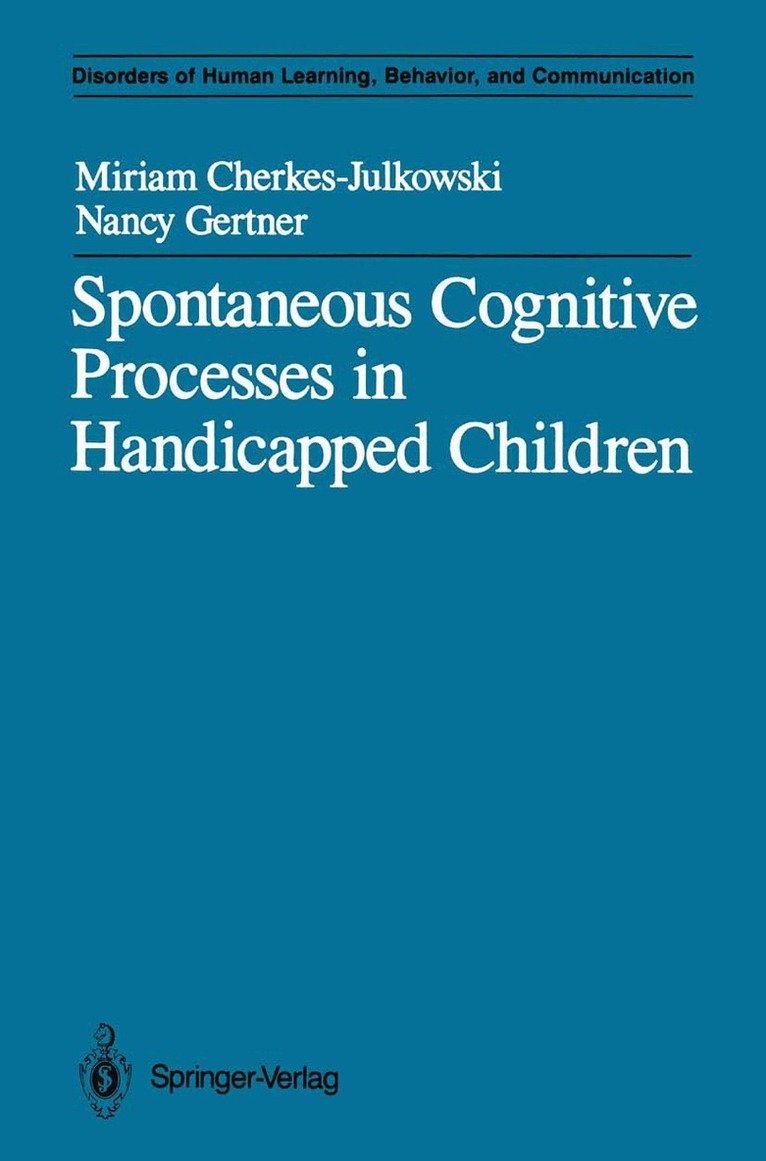
The thinking that began this book arose out of some dissatisfaction with the rela tively simplified, unidimensional model of development, which seems to have come to dominate the fields that address the needs of atypically developing chil dren. It seemed impossible to us that developmental differences could explain the range of learning and coping styles we have seen and read about in children iden tified as mentally retarded, slow learning, learning disabled, nonhandicapped, and gifted. If a typical model of development did not account for what children with handicaps to learning could do, when they would do it, and how they would accomplish it, such a model was not likely to imply anything important about how to intervene with and help them. Unfortunately, when we first began to examine this problem, turning away from a developmental model for interpreting atypical behavior meant turning toward a behaviorist one. This was not very satisfying either. Again the assumptions were bothersome. We were expected to accept that all children, this time at all ages as well as with all kinds of diagnoses, learned in essentially the same way with perhaps some variation in rate, reac tivity, reinforcement preferences, and, according to more liberal applications, expectancy. In our search for a more satisfying view of the atypical learner, we were lucky to be lost at the moment when cognitive psychology and systems theory were being found.
Häftad, Engelska, 2011
560 kr
Skickas inom 10-15 vardagar
The thinking that began this book arose out of some dissatisfaction with the rela tively simplified, unidimensional model of development, which seems to have come to dominate the fields that address the needs of atypically developing chil dren. It seemed impossible to us that developmental differences could explain the range of learning and coping styles we have seen and read about in children iden tified as mentally retarded, slow learning, learning disabled, nonhandicapped, and gifted. If a typical model of development did not account for what children with handicaps to learning could do, when they would do it, and how they would accomplish it, such a model was not likely to imply anything important about how to intervene with and help them. Unfortunately, when we first began to examine this problem, turning away from a developmental model for interpreting atypical behavior meant turning toward a behaviorist one. This was not very satisfying either. Again the assumptions were bothersome. We were expected to accept that all children, this time at all ages as well as with all kinds of diagnoses, learned in essentially the same way with perhaps some variation in rate, reac tivity, reinforcement preferences, and, according to more liberal applications, expectancy. In our search for a more satisfying view of the atypical learner, we were lucky to be lost at the moment when cognitive psychology and systems theory were being found.