Nevada Levi DeLapp – författare
Visar alla böcker från författaren Nevada Levi DeLapp. Handla med fri frakt och snabb leverans.
4 produkter
4 produkter
Reformed David(s) and the Question of Resistance to Tyranny
Reading the Bible in the 16th and 17th Centuries
Inbunden, Engelska, 2014
1 884 kr
Skickas inom 10-15 vardagar
This study centers on the question: how do particular readers read a biblical passage? What factors govern each reading? DeLapp here attempts to set up a test case for observing how both socio-historical and textual factors play a part in how a person reads a biblical text. Using a reception-historical methodology, he surveys five Reformed authors and their readings of the David and Saul story (primarily 1 Sam 24 and 26). From this survey two interrelated phenomena emerge. First, all the authors find in David an ideal model for civic praxis—a “Davidic social imaginary” (Charles Taylor). Second, despite this primary agreement, the authors display two different reading trajectories when discussing David’s relationship with Saul. Some read the story as showing a persecuted exile, who refuses to offer active resistance against a tyrannical monarch. Others read the story as exemplifying active defensive resistance against a tyrant. To account for this convergence and divergence in the readings, DeLapp argues for a two-fold conclusion. The authors are influenced both by their socio-historical contexts and by the shape of the biblical text itself. Given a Deuteronomic frame conducive to the social imaginary, the paradigmatic narratives of 1 Sam 24 and 26 offer a narrative gap never resolved. The story never makes explicit to the reader what David is doing in the wilderness in relation to King Saul. As a result, the authors fill in the “gap” in ways that accord with their own socio-historical experiences.
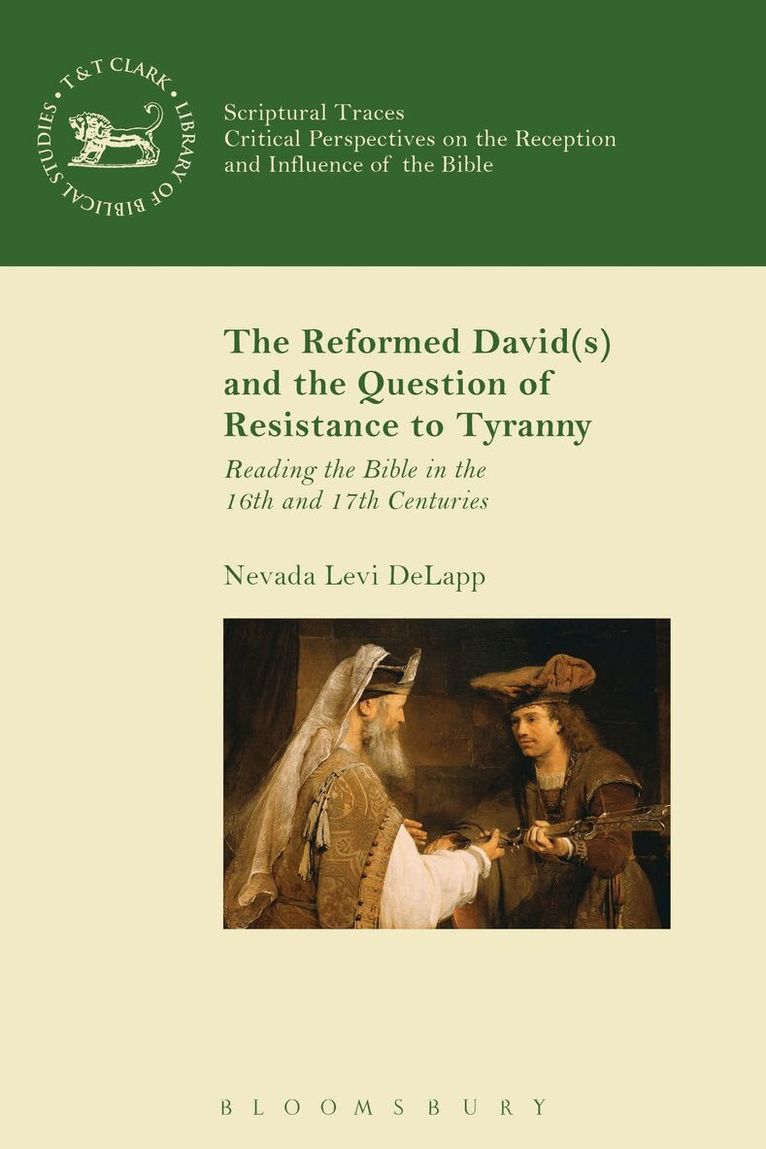
Reformed David(s) and the Question of Resistance to Tyranny
Reading the Bible in the 16th and 17th Centuries
Häftad, Engelska, 2016
530 kr
Skickas inom 10-15 vardagar
This study centers on the question: how do particular readers read a biblical passage? What factors govern each reading? DeLapp here attempts to set up a test case for observing how both socio-historical and textual factors play a part in how a person reads a biblical text. Using a reception-historical methodology, he surveys five Reformed authors and their readings of the David and Saul story (primarily 1 Sam 24 and 26). From this survey two interrelated phenomena emerge. First, all the authors find in David an ideal model for civic praxis—a “Davidic social imaginary” (Charles Taylor). Second, despite this primary agreement, the authors display two different reading trajectories when discussing David’s relationship with Saul. Some read the story as showing a persecuted exile, who refuses to offer active resistance against a tyrannical monarch. Others read the story as exemplifying active defensive resistance against a tyrant. To account for this convergence and divergence in the readings, DeLapp argues for a two-fold conclusion. The authors are influenced both by their socio-historical contexts and by the shape of the biblical text itself. Given a Deuteronomic frame conducive to the social imaginary, the paradigmatic narratives of 1 Sam 24 and 26 offer a narrative gap never resolved. The story never makes explicit to the reader what David is doing in the wilderness in relation to King Saul. As a result, the authors fill in the “gap” in ways that accord with their own socio-historical experiences.
1 750 kr
Skickas inom 10-15 vardagar
An examination of the presence of theophanic scenes in the final form of the Pentateuch, which argues that rather than there being a single, over-arching theophanic “type-scene” there are multiple such scenes which reflect the individual theological tendencies of the biblical books within which they appear. The Genesis type-scene revolves around YHWH's promises in crisis situations (i.e., YHWH only appears when there is a crisis or threat to the Abrahamic promise). The Exodus type-scene typically includes the appearance of YHWH's dangerous fiery presence (Kabod Adonai), a communal setting, and divine action constituting or preserving Israel as a people in preparation for the Abrahamic inheritance. In Leviticus the theophanies augment the Exodus type-scene with a liturgical setting where a specific priestly action brings forth a theophanic response. DeLapp then shows how Numbers recontextualizes each of the preceding type-scenes as it retells the exodus narrative post-Sinai. When read synchronically the three type-scenes build on each other and follow the developing narrative logic of Israel’s larger story. Deuteronomy then re-reads the Exodus type-scene (and indirectly the Genesis type-scene) to ensure that later readers read the theophanies appropriately (i.e., YHWH only appeared as “formless” and shrouded in “fire”).
476 kr
Skickas inom 10-15 vardagar
An examination of the presence of theophanic scenes in the final form of the Pentateuch, which argues that rather than there being a single, over-arching theophanic “type-scene” there are multiple such scenes which reflect the individual theological tendencies of the biblical books within which they appear. The Genesis type-scene revolves around YHWH's promises in crisis situations (i.e., YHWH only appears when there is a crisis or threat to the Abrahamic promise). The Exodus type-scene typically includes the appearance of YHWH's dangerous fiery presence (Kabod Adonai), a communal setting, and divine action constituting or preserving Israel as a people in preparation for the Abrahamic inheritance. In Leviticus the theophanies augment the Exodus type-scene with a liturgical setting where a specific priestly action brings forth a theophanic response. DeLapp then shows how Numbers recontextualizes each of the preceding type-scenes as it retells the exodus narrative post-Sinai. When read synchronically the three type-scenes build on each other and follow the developing narrative logic of Israel’s larger story. Deuteronomy then re-reads the Exodus type-scene (and indirectly the Genesis type-scene) to ensure that later readers read the theophanies appropriately (i.e., YHWH only appeared as “formless” and shrouded in “fire”).