Nicholas Eberstadt - Böcker
Visar alla böcker från författaren Nicholas Eberstadt. Handla med fri frakt och snabb leverans.
19 produkter
19 produkter
415 kr
Skickas inom 7-10 vardagar
The eventual reunification of the Korean Peninsula will send political and economic reverberations throughout Northeast Asia and will catalyze the struggle over a new regional order among the four great powers of the Pacific—Russia, China, Japan, and the United States. Korea's Future and the Great Powers addresses the vital issues of how to achieve a stable political order in a unified Korea, how to finance Korean economic reconstruction, and how to link Korea into a cooperative framework of international diplomatic relations.
249 kr
Tillfälligt slut
319 kr
Tillfälligt slut
Throughout the world, numbers are increasingly used to guide acts of government - but not always for the better. In this volume, the author examines the "facts and figures" that have led to measures unhelpful or injurious to their intended beneficiaries. "The Tyranny of Numbers" offers a look at problems such as world hunger, the population explosion, the Third World debt crisis, and the poverty in South Africa, in which misdiagnoses have driven action. In America, the author argues, antipoverty programmes proceed without an understanding of what the data actually show about living standards and child health. And our surprise at the collapse of communism in Eastern Europe and the crisis in the USSR may betray an equal misunderstanding of data that revealed the weakness in those systems.
215 kr
Skickas inom 5-8 vardagar
In this wide-ranging study, Nicholas Eberstadt demonstrates that some of the most basic of today's domestic and foreign policies have been buttressed or justified by what turns out to be misanalysis or misuse of available facts and figures. The Tyranny of Numbers not only warns about the ways the statistics are being misused in government policy in the United States and abroad but explains how this process can end up injuring vulnerable groups or distorting the workings of the democratic system.
200 kr
Skickas inom 5-8 vardagar
Policy and Economic Performance in Divided Korea during the Cold War Era: 1945-91
Häftad, Engelska, 2010
380 kr
Skickas inom 3-6 vardagar
The Korean peninsula during the Cold War provided a cruel but historically unparalleled real-world “experiment” in the relationship between polity and material advance: an ethnically and culturally homogenous nation was, in 1945, suddenly divided by an arbitrary boundary line and then subjected to two radically different and adversarial political economies for successive decades on end. Assessing the competition between the North and South Korean economies from partition to the end of the Soviet era, Nicholas Eberstadt argues that the storyline is not quite as simple as the now-prevailing narrative suggests (that centrally-planned economies are doomed to fail against market-oriented alternatives). Rather, he suggests, the race for material progress was just that: a race, the results of which were far from preordained at the outset. In Policy and Economic Performance in Divided Korea during the Cold War Era: 1945–91, Eberstadt presents an impressive compilation of hard-to-find comparative data on economic performance for the Democratic People’s Republic of Korea (DPRK, or North Korea) and the Republic of Korea (ROK, or South Korea) over two critical generations. By a number of indicators, Eberstadt argues, Kim Il Sung’s North Korea actually outperformed South Korea for much of this period—not only in the years immediately following partition, but perhaps also into the 1970s. To explain these surprising results, Eberstadt details the impact of government policies on the course of growth of both economies and offers some unorthodox observations about material performance under these two contending polities. He finds that prevailing economic development theory on such issues as planned-versus- market economies, military burden, and the relationship between material advance and poverty, may require reexamination in light of the experience of the two Koreas between partition and the end of the Cold War.
234 kr
Skickas inom 3-6 vardagar
180 kr
Skickas inom 5-8 vardagar
146 kr
Skickas inom 5-8 vardagar
200 kr
Skickas inom 5-8 vardagar
1 099 kr
Tillfälligt slut
One third of the world's population today lives under governments that consider themselves to be Marxist-Leninist. In many of these places, severe poverty was endemic in the years before Communist authorities came to power. Communist governments claim to have a special understanding into and effectiveness in dealing with problems of poverty. Marxist-Leninist rulers have been in power for nearly thirty years in Cuba, nearly forty years in China, and over sixty-five years in the Soviet Union. How do the poor fare in such places today?Western intellectuals often assume there is an inevitable tradeoff between bread and freedom under communism. What populations lose in the way of civil and political rights, they gain in social guarantees that protect them against material hardship. In The Poverty of Communism, Nick Eberstadt challenges this assumption and shatters it. He shows that Communist governments in a wide variety of settings have been no more successful in attending to the material needs of the most vulnerable segments of the populations they govern than non-Communist governments against which they might most readily be compared. Indeed, measured by the health, literacy, and nutrition of their people, Communist governments may today be less effective in dealing with poverty than are non-Communist governments.The Poverty of Communism is a pathbreaking investigation. In a series of separate studies, Eberstadt analyzes the performance of Communist governments in the Soviet Union, Eastern Europe, China, and Cuba. This is the first scholarly effort to assess the record of Communist governments with respect to poverty in a detailed and comprehensive fashion. Well written, carefully argued, and reflecting a sweeping range of knowledge, The Poverty of Communism will be of interest to specialists in the countries investigated as well as those concerned with comparative economic and political development. Above all, it gives testimony to the plight of voiceless populations about which all too little has been written from an objective standpoint.
332 kr
Skickas inom 10-15 vardagar
One third of the world's population today lives under governments that consider themselves to be Marxist-Leninist. In many of these places, severe poverty was endemic in the years before Communist authorities came to power. Communist governments claim to have a special understanding into and effectiveness in dealing with problems of poverty. Marxist-Leninist rulers have been in power for nearly thirty years in Cuba, nearly forty years in China, and over sixty-five years in the Soviet Union. How do the poor fare in such places today?Western intellectuals often assume there is an inevitable tradeoff between bread and freedom under communism. What populations lose in the way of civil and political rights, they gain in social guarantees that protect them against material hardship. In The Poverty of Communism, Nick Eberstadt challenges this assumption and shatters it. He shows that Communist governments in a wide variety of settings have been no more successful in attending to the material needs of the most vulnerable segments of the populations they govern than non-Communist governments against which they might most readily be compared. Indeed, measured by the health, literacy, and nutrition of their people, Communist governments may today be less effective in dealing with poverty than are non-Communist governments.The Poverty of Communism is a pathbreaking investigation. In a series of separate studies, Eberstadt analyzes the performance of Communist governments in the Soviet Union, Eastern Europe, China, and Cuba. This is the first scholarly effort to assess the record of Communist governments with respect to poverty in a detailed and comprehensive fashion. Well written, carefully argued, and reflecting a sweeping range of knowledge, The Poverty of Communism will be of interest to specialists in the countries investigated as well as those concerned with comparative economic and political development. Above all, it gives testimony to the plight of voiceless populations about which all too little has been written from an objective standpoint.
671 kr
Skickas inom 10-15 vardagar
In current intellectual and public discourse, the entire modern world-from the affluent United States to the poorest low-income regions-is beset today by a broad and alarming array of "population problems." Around the globe, leading scientists, academics, and political figures attribute poverty, hunger, social tension, and even political conflict to contemporary demographic trends. These authorities assert that the size, composition, and growth rate of population routinely pose direct and major threats to human well-being. They argue for interventions aimed specifically at altering society's demographic rhythms. In this wide-ranging and carefully reasoned book, renowned demographer and social scientist Nicholas Eberstadt challenges these ideas and exposes their glaring intellectual -shortcomings.Eberstadt makes the case that the very conception of "population problems" is inherently ambiguous and arbitrary, lending itself to faulty analysis and inappropriate diagnoses. Careless thinking about population is typically a result of inattention to, or indifference toward, the fundamental unit in all populations: the individual human being. In our time, Eberstadt writes, problems attributed to demographic trends are actually rooted in political and ethical situations. The brave new world of economic reform, far from bringing about the good society, serves only to postpone that society by a cavalier disregard of social and culture factors in human evolution. Eberstadt warns against a melodramatic approach to issues such as hunger and malnutrition. Material advances in the economy and cultural advances in the polity are safeguards against the worst outcomes of current problems in population. His reversal of cause and effect marks this as a volume apart, provocative, controversial, but surefooted in its scholarly sensibility and methods. In an academic world in which demographers are now speaking of the peaking of population rather than its infinite expansion, Eberstadt moves the discussion to family ties and common bonds. Demographers and family planners alike have much to learn from an approach that takes seriously the pitfalls as well as blessings of so-called zero-growth in the world -population.
2 150 kr
Skickas inom 10-15 vardagar
Viewed from afar, North Korea may appear bizarre, or positively irrational. But as Nicholas Eberstadt demonstrates in this meticulously researched volume, there is a grim coherence to North Korea's political economy, and a ruthless logic undergirding it--one that unreservedly subordinates economic welfare to augmentation of political power. Thus, paradoxically, even as official policies and practices consign the DPRK economy to a perilous realm between crisis and catastrophe, the country's leadership maintains unchallenged domestic control and has actually managed to increase its international influence.Through painstaking collection of hard-to-uncover data and careful analysis, Eberstadt provides a quantitative tableau of North Korea's terrible failure in its economic race against South Korea; its stubborn adherence to policies all but guaranteed to stifle growth and undermine economic performance; and the longstanding official effort to ignore, or mitigate, pressures for economic reform.Eberstadt is skeptical of optimistic accounts from South Korea and elsewhere suggesting that the North Korean leadership is interested in resolving the current nuclear impasse, and getting on with the business of reform and development. So long as Pyongyang's rulers entertain the ambition of reunifying the Korean peninsula on its own terms, Eberstadt argues, economic reforms worthy of the name will be subversive of state authority--and vigilantly resisted by Pyongyang's rulers. This authoritative volume has received widespread attention from Asian specialists, well as those concerned with nuclear proliferation and world peace, and international relations professionals in general.
2 088 kr
Skickas inom 10-15 vardagar
In current intellectual and public discourse, the entire modern world-from the affluent United States to the poorest low-income regions-is beset today by a broad and alarming array of "population problems." Around the globe, leading scientists, academics, and political figures attribute poverty, hunger, social tension, and even political conflict to contemporary demographic trends. These authorities assert that the size, composition, and growth rate of population routinely pose direct and major threats to human well-being. They argue for interventions aimed specifically at altering society's demographic rhythms. In this wide-ranging and carefully reasoned book, renowned demographer and social scientist Nicholas Eberstadt challenges these ideas and exposes their glaring intellectual -shortcomings.Eberstadt makes the case that the very conception of "population problems" is inherently ambiguous and arbitrary, lending itself to faulty analysis and inappropriate diagnoses. Careless thinking about population is typically a result of inattention to, or indifference toward, the fundamental unit in all populations: the individual human being. In our time, Eberstadt writes, problems attributed to demographic trends are actually rooted in political and ethical situations. The brave new world of economic reform, far from bringing about the good society, serves only to postpone that society by a cavalier disregard of social and culture factors in human evolution. Eberstadt warns against a melodramatic approach to issues such as hunger and malnutrition. Material advances in the economy and cultural advances in the polity are safeguards against the worst outcomes of current problems in population. His reversal of cause and effect marks this as a volume apart, provocative, controversial, but surefooted in its scholarly sensibility and methods. In an academic world in which demographers are now speaking of the peaking of population rather than its infinite expansion, Eberstadt moves the discussion to family ties and common bonds. Demographers and family planners alike have much to learn from an approach that takes seriously the pitfalls as well as blessings of so-called zero-growth in the world -population.
593 kr
Skickas inom 10-15 vardagar
This work presents a detailed picture of the divergent socio-economic trends in divided Korea since its 1945 partition. It also covers the social and political situation in the North and South today, and the domestic and international challenges to a successful Korean reunification.
356 kr
Skickas inom 10-15 vardagar
This work presents a detailed picture of the divergent socio-economic trends in divided Korea since its 1945 partition. It also covers the social and political situation in the North and South today, and the domestic and international challenges to a successful Korean reunification.
138 kr
Skickas inom 7-10 vardagar
In A Nation of Takers: America’s Entitlement Epidemic, one of our country’s foremost demographers, Nicholas Eberstadt, details the exponential growth in entitlement spending over the past fifty years. As he notes, in 1960, entitlement payments accounted for well under a third of the federal government’s total outlays. Today, entitlement spending accounts for a full two-thirds of the federal budget. Drawing on an impressive array of data and employing a range of easy-to-read, four-color charts, Eberstadt shows the unchecked spiral of spending on a range of entitlements, everything from Medicare to disability payments. But Eberstadt does not just chart the astonishing growth of entitlement spending, he also details the enormous economic and cultural costs of this epidemic. He powerfully argues that while this spending certainly drains our federal coffers, it also has a very real, long-lasting, negative impact on the character of our citizens. Also included in the book is a response from one of our leading political theorists, William Galston. In his incisive response, he questions Eberstadt’s conclusions about the corrosive effect of entitlements on character and offers his own analysis of the impact of American entitlement growth.
165 kr
Skickas inom 7-10 vardagar
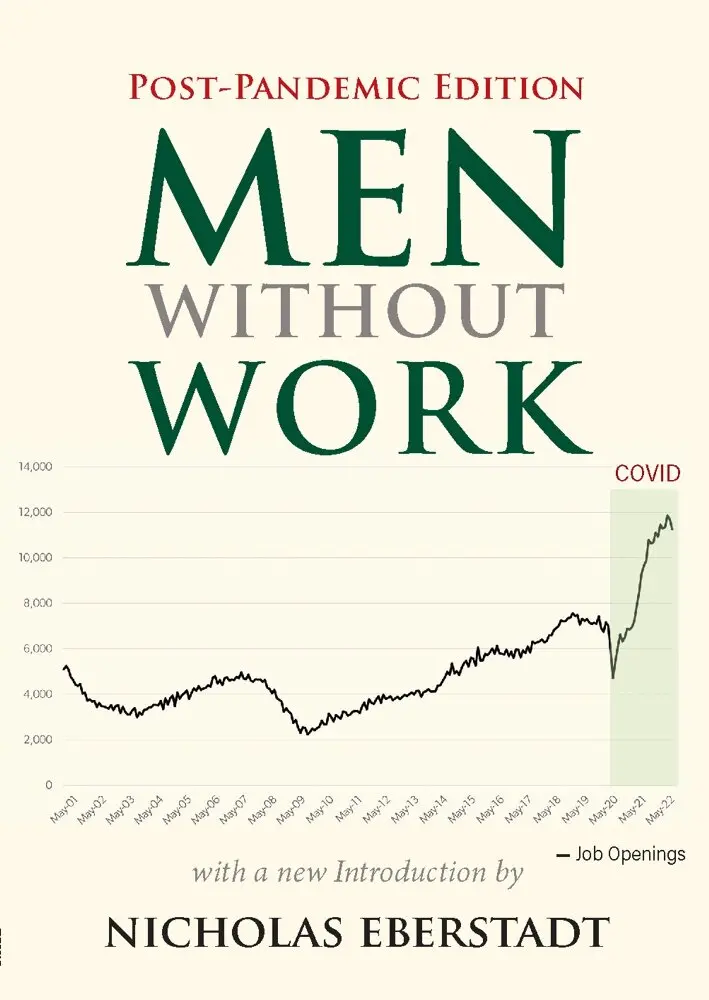
Nicholas Eberstadt’s landmark 2016 study, Men without Work, cast a spotlight on the collapse of work for men in modern America. Rosy reports of low unemployment rates and “full or near full employment” conditions, he contends, were overlooking a quiet, continuing crisis: Depression-era work rates for American men of “prime working age” (25–54).The grim truth: over six million prime-age men were neither working nor looking for work. Conventional unemployment measures ignored these labor force dropouts, but their ranks had been rising relentlessly for half a century. Eberstadt’s unflinching analysis was, in the words of The New York Times, “an unsettling portrait not just of male unemployment, but also of lives deeply alienated from civil society.”The famed American work ethic was once near universal: men of sound mind and body took pride in contributing to their communities and families. No longer, warned Eberstadt. And now-six years and one catastrophic pandemic later-the problem has not only worsened: it has seemingly been spreading among prime-age women and workers over fifty-five.In a brand new introduction, Eberstadt explains how the government’s response to Covid-19 inadvertently exacerbated the flight from work in America. From indiscriminate pandemic shutdowns to almost unconditional “unemployment” benefits, Americans were essentially paid not to work.Thus today, despite the vaccine rollouts, inexplicable numbers of working age men and women are sitting on the sidelines while over 11 million jobs go unfilled. Current low rates of unemployment, touted by pundits and politicians, are grievously misleading. The truth is that fewer prime-age American men are looking for readily available work than at any previous juncture in our history. And others may be catching the “Men Without Work” virus too.Given the devastating economic impact of the Covid calamity and the unforeseen aftershocks yet to come, this reissue of Eberstadt’s groundbreaking work is timelier than ever.