Nicholas T. Davis - Böcker
Visar alla böcker från författaren Nicholas T. Davis. Handla med fri frakt och snabb leverans.
3 produkter
3 produkter
993 kr
Skickas inom 7-10 vardagar
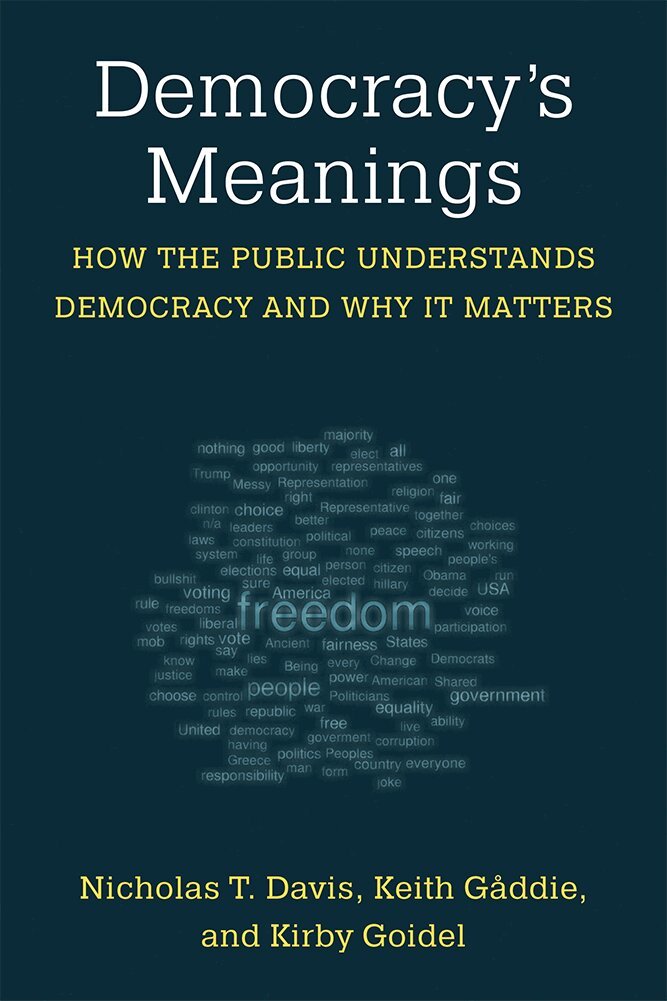
Democracy’s Meanings challenges conventional wisdom regarding how the public thinks about and evaluates democracy. Mining both political theory and more than 75 years of public opinion data, the book argues that Americans think about democracy in ways that go beyond voting or elected representation. Instead, citizens have rich and substantive views about the material conditions that democracy should produce, which draw from their beliefs about equality, fairness, and justice.The authors construct a typology of views about democracy. Procedural views of democracy take a minimalistic quality. While voting and fair treatment are important to this vision of democracy, ideas about equality are mostly limited to civil liberties. In contrast, social views of democracy incorporate both civil and economic equality; according to people with these views, democracy ought to meet the basic social and material needs of citizens. Complementing these two groups are moderate and indifferent views about democracy. While moderate views sit somewhere in between procedural and social perspectives regarding the role of democracy in producing social and economic equality, indifferent views of democracy involve disaffection toward it. For a small group of apathetic citizens, democracy is an ambiguous and ill-defined concept.
215 kr
Kommande
Although the Supreme Court has historically resisted a partisan sorting out of its public legitimacy, today, Republicans and Democrats look at the Court in very different ways. This Element assembles original survey and experimental data to unpack these changes in three ways. First, the authors illustrate the powerful role that partisanship plays in shaping judicial public opinion. Second, they validate a new three-item measure of specific support and show that it reliably predicts perceptions of Supreme Court legitimacy. Finally, they introduce a new, applied measure of support for the rule of law and connect it to specific and diffuse support. Taken as a whole, their work demonstrates that large chunks of the mass public view the Supreme Court critically. Looking ahead, it is unclear whether legitimacy will rebound when citizens perceive that the balance of judicial power within the nation's High Court has fractured along party lines.
Supremely Polarizing
How Partisanship Structures Support for the Supreme Court
Inbunden, Engelska, 2026
692 kr
Kommande
Although the Supreme Court has historically resisted a partisan sorting out of its public legitimacy, today, Republicans and Democrats look at the Court in very different ways. This Element assembles original survey and experimental data to unpack these changes in three ways. First, the authors illustrate the powerful role that partisanship plays in shaping judicial public opinion. Second, they validate a new three-item measure of specific support and show that it reliably predicts perceptions of Supreme Court legitimacy. Finally, they introduce a new, applied measure of support for the rule of law and connect it to specific and diffuse support. Taken as a whole, their work demonstrates that large chunks of the mass public view the Supreme Court critically. Looking ahead, it is unclear whether legitimacy will rebound when citizens perceive that the balance of judicial power within the nation's High Court has fractured along party lines.