Nick Seaver – författare
Visar alla böcker från författaren Nick Seaver. Handla med fri frakt och snabb leverans.
4 produkter
4 produkter
814 kr
Skickas inom 7-10 vardagar
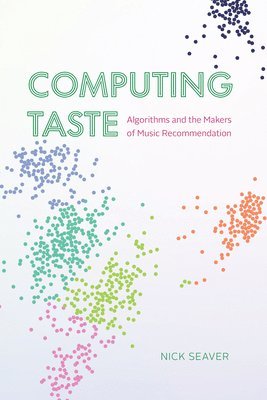
Meet the people who design the algorithms that capture our musical tastes. The people who make music recommender systems have lofty goals: they want to broaden listeners’ horizons and help obscure musicians find audiences, taking advantage of the enormous catalogs offered by companies like Spotify, Apple Music, and Pandora. But for their critics, recommender systems seem to embody all the potential harms of algorithms: they flatten culture into numbers, they normalize ever-broadening data collection, and they profile their users for commercial ends. Drawing on years of ethnographic fieldwork, anthropologist Nick Seaver describes how the makers of music recommendation navigate these tensions: how product managers understand their relationship with the users they want to help and to capture; how scientists conceive of listening itself as a kind of data processing; and how engineers imagine the geography of the world of music as a space they care for and control. Computing Taste rehumanizes the algorithmic systems that shape our world, drawing attention to the people who build and maintain them. In this vividly theorized book, Seaver brings the thinking of programmers into conversation with the discipline of anthropology, opening up the cultural world of computation in a wide-ranging exploration that travels from cosmology to calculation, myth to machine learning, and captivation to care.
170 kr
Skickas inom 7-10 vardagar
Meet the people who design the algorithms that capture our musical tastes. The people who make music recommender systems have lofty goals: they want to broaden listeners’ horizons and help obscure musicians find audiences, taking advantage of the enormous catalogs offered by companies like Spotify, Apple Music, and Pandora. But for their critics, recommender systems seem to embody all the potential harms of algorithms: they flatten culture into numbers, they normalize ever-broadening data collection, and they profile their users for commercial ends. Drawing on years of ethnographic fieldwork, anthropologist Nick Seaver describes how the makers of music recommendation navigate these tensions: how product managers understand their relationship with the users they want to help and to capture; how scientists conceive of listening itself as a kind of data processing; and how engineers imagine the geography of the world of music as a space they care for and control. Computing Taste rehumanizes the algorithmic systems that shape our world, drawing attention to the people who build and maintain them. In this vividly theorized book, Seaver brings the thinking of programmers into conversation with the discipline of anthropology, opening up the cultural world of computation in a wide-ranging exploration that travels from cosmology to calculation, myth to machine learning, and captivation to care.
114 kr
Skickas inom 7-10 vardagar
Data is too big to be left to the data analysts. Data: Now Bigger and Better! brings together researchers whose work is deeply informed by the conceptual frameworks of anthropology-frameworks that are comparative as well as field-based. From kinship to gifts, everything old becomes rich with new insight when the anthropological archive washes over "big data." Bringing together anthropology's classic debates and contemporary interventions, the book counters the future-oriented speculation so characteristic of discussions regarding big data. Drawing on long-standing experience in industry contexts, the contributors also provide analytical provocations that can help reframe some of the most important shifts in technology and society in the first half of the twenty-first century.
278 kr
Skickas inom 11-20 vardagar
This volume presents a set of theoretically inventive pieces that engage with data across its many locations, from government databases to ecological field stations, from kitchen tables to concrete bunkers. Contributors demonstrate how thinking with data can be conceptually generative for anthropology, prompting us to reconsider our understanding of topics including bodies, persons, and the social itselfShows how 'big' data which may have once seemed limited to business or high tech, ethnographers are now finding data – and its attendant values and practices – in their field sites around the worldExamines how data has motivated a sweep of dystopian visions, signaling the invasion of privacy, political manipulation, or shadowy data doublesDiscusses how anthropologists have been cautious in taking data itself as an object of theoretical interest, even as the effects of data become manifest in our ethnographiesBy putting data in its place, the chapters collected here develop conceptual tools that will prove useful for anthropologists who find 'data' in their data