Nilgun B. Harmanciogammalu - Böcker
Visar alla böcker från författaren Nilgun B. Harmanciogammalu. Handla med fri frakt och snabb leverans.
9 produkter
9 produkter
6 334 kr
Skickas inom 10-15 vardagar
Floods are natural hazards whose effects can deeply affect the economic and environmental equilibria of a region. Quality of life of people living in areas close to rivers depends on both the risk that a flood would occur and the reliability of flood forecast, warning and control systems. Tools for forecasting and mitigating floods have been developed through recent research. Two innovations currently influence flood hazard mitigation, after many decades of lack of significant progress. They are the development of new technologies for real-time flood forecast and warning (based on weather radars and satellites) and a shift from structural to non-structural flood control measures, due to increased awareness of the importance of protecting the environment and the adverse impacts of hydraulic works on it. This book is a review of research progress in the improvements of forecast capability and the control of floods. It presents the results of recent research in hydrology, modern techniques of real-time forecast and warning, and ways of controlling floods for smaller impacts on the environment. A number of case studies of floods in different geographical areas are also presented.Scientists and specialists working in fields of hydrology, environmental protection and hydraulic engineering should appreciate this book for its theoretical and practical content.
1 589 kr
Skickas inom 10-15 vardagar
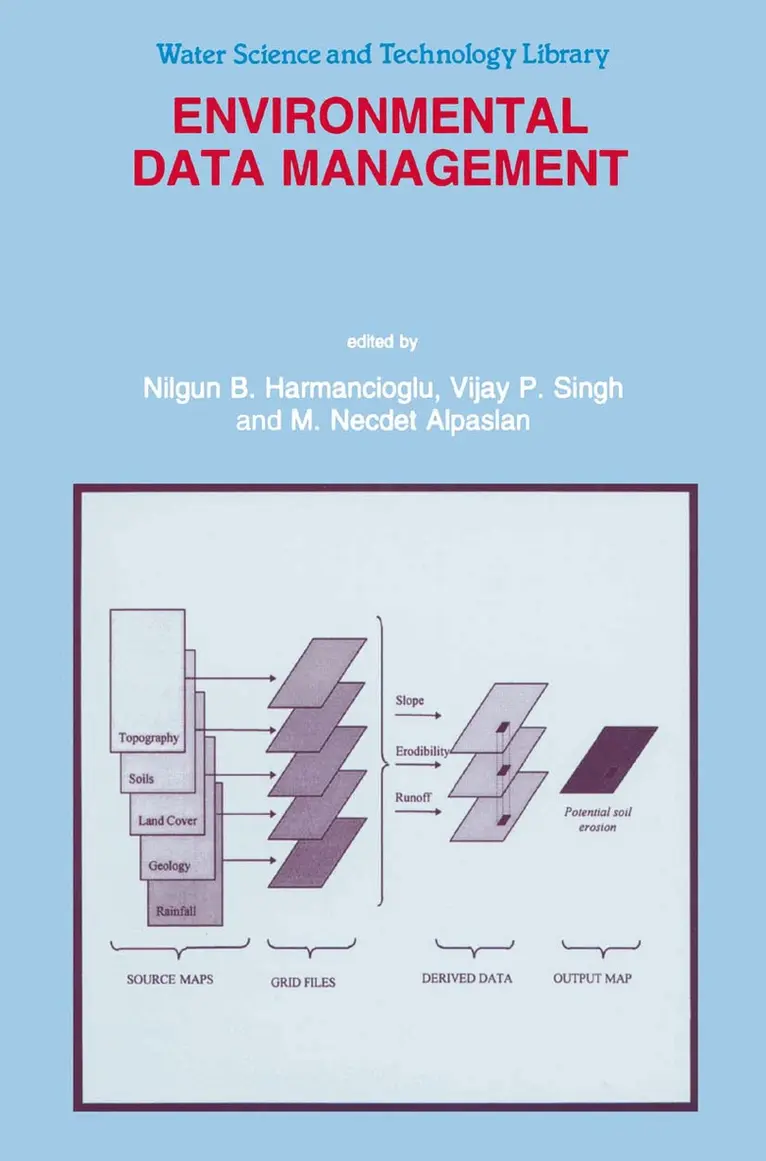
Two basic tools for integrated management of the environment are modelling and environmental data. Both tools were available and valid in the past; however, the recent requirements for integrated environmental management have also led to a significant evolution of both modelling procedures and data management systems. This volume provides a systematic approach to various aspects of environmental data management. The contents of the book follow the basic steps that constitute an environmental data management system. These steps cover in sequence: collection of environmental data for assessing air quality, surface water quality and solid waste management; reliability considerations in data collection; storage, handling and retrieval of available data; transfer of data into information via data analysis and environmental modelling; and finally the use of available data in decision-making for environmental management. This volume should be useful to researchers, professional engineers, planners and managers and graduate students, who are involved in environmental management, data collection and dissemination, and information retrieval.It should also interest research and data centres, international programmes and organizations related to environmental management.
1 589 kr
Skickas inom 10-15 vardagar
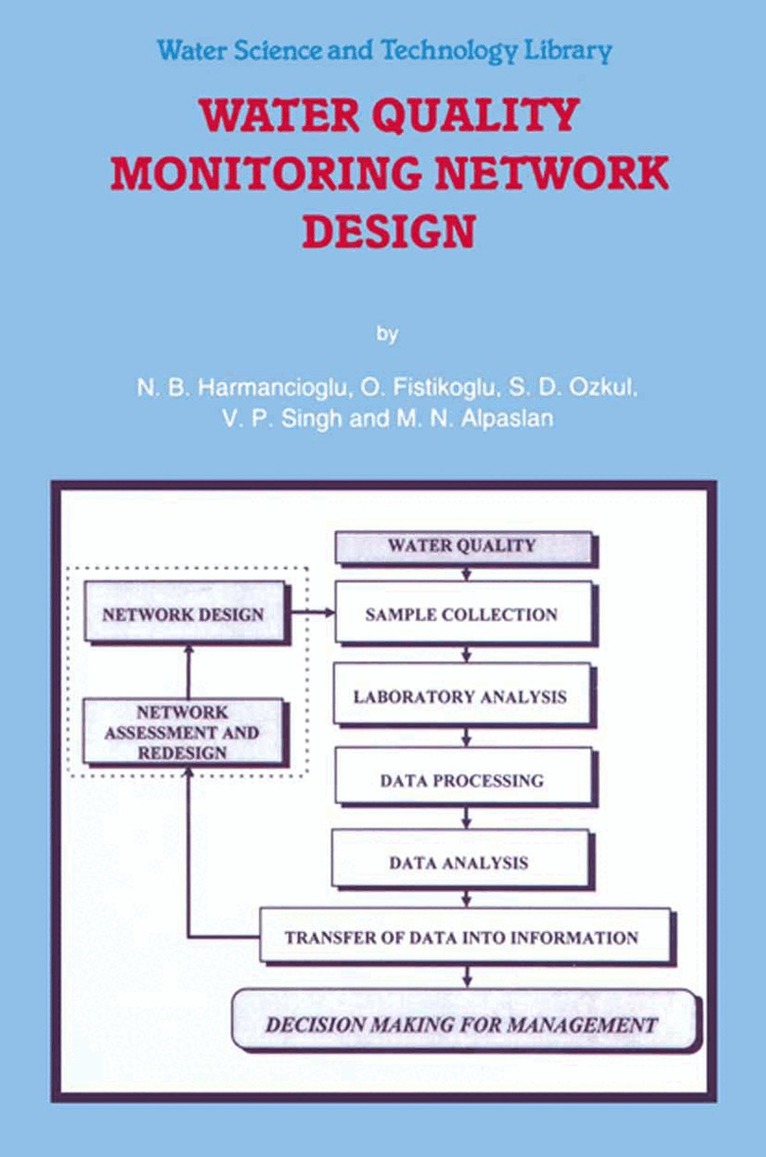
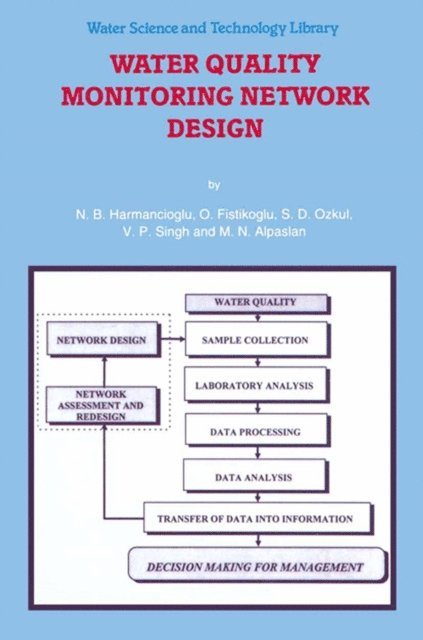
The volume is intended to present an up-to-date overview of the current network design procedures and develop basic guidelines to be followed in both the design and the redesign of water quality monitoring networks. The book treats the network design problem in a comprehensive and systematic framework, starting with objectives of monitoring and elaborating on various technical design features, such as selection of sampling sites, sampling frequences, variables to be monitored, and sampling duration. The design procedures presented are those that the authors have recently applied in a number of national and international projects on the design and redesign of water quality monitoring networks. Thus, the book covers real case studies where not only the methods described in the earlier titles are used but also new techniques are introduced. Where earlier methods are used, they are assessed with respect to their efficiency and applicability to real case problems. Essentially, the framework adopted in the book applies as well to other hydrometric data collection networks besides those of water quality.In this respect, it is expected that planners, designers, scientists, and engineers who are involved in hydrometric network design will benefit from the in-depth approach assumed in this book. It should also be of interest to research and data centres, international programmes and organizations related to environmental monitoring. The book may also be used as a reference text in graduate courses of water resources and environmental engineering programmes.
Integrated Technologies for Environmental Monitoring and Information Production
Inbunden, Engelska, 2003
1 062 kr
Skickas inom 10-15 vardagar
The prevailing universal problem in environmental data management (EDM) systems is the significant incoherence between data collection procedures and the retrieval of information required by the users. In this regard, an integrated approach to EDM has become vital. The problems that must be addressed require interdisciplinary approaches and much more sharing of data and information than in the past. This book focuses on the issue of environmental data management, especially aspects such as: objectives and constraints; design of data collection networks; statistical and physical sampling; remote sensing and GIS; databases; reliability of data; data analysis; and transformation of data into information. The subject has an international, interdisciplinary nature and constitutes the basis for all environmental management activities.The text presents an integrated approach to the problem, consisting of: integration of different levels and aspects of environmental data management; state-of-the-art evaluation of problems and solutions relevant to each aspect; integration of views and expertise of scientists from different disciplines and different countries; and integration of interdisciplinary approaches to data collection and information retrieval.
Integrated Technologies for Environmental Monitoring and Information Production
Häftad, Engelska, 2003
1 062 kr
Skickas inom 10-15 vardagar
The prevailing universal problem in environmental data management (EDM) systems is the significant incoherence between data collection procedures and the retrieval of information required by the users. In this regard, an integrated approach to EDM has become vital. The problems that must be addressed require interdisciplinary approaches and much more sharing of data and information than in the past. This book focuses on the issue of environmental data management, especially aspects such as: objectives and constraints; design of data collection networks; statistical and physical sampling; remote sensing and GIS; databases; reliability of data; data analysis; and transformation of data into information. The subject has an international, interdisciplinary nature and constitutes the basis for all environmental management activities.The text presents an integrated approach to the problem, consisting of: integration of different levels and aspects of environmental data management; state-of-the-art evaluation of problems and solutions relevant to each aspect; integration of views and expertise of scientists from different disciplines and different countries; and integration of interdisciplinary approaches to data collection and information retrieval.
1 589 kr
Skickas inom 10-15 vardagar
Two basic tools for integrated management of the environment are modeling and environmental data. Both tools were available and valid in the past; however, the recent requirements for integrated environmental management have also led to a significant evolution of both modeling procedures and data management systems. Regarding these advances, current literature provides vast amounts of studies on modeling of different environmental processes. However, issues related to data management systems are barely touched on in a comprehensive framework. Data requirements and data availability are mentioned merely as subtopics in most environmental studies, although it is well recognized that data constitute the basis for all environmental management activities. In particular, there is no book yet published that focuses exclusively on data management systems. In this respect, the present book fills an important gap by providing a systematic approach to various aspects of environmental data management. The contents of the book follow the basic steps that constitute an environmental data management system.These steps cover in sequence: collection of environmental data for assessing air quality, surface water quality and solid waste management; reliability considerations in data collection; storage, handling and retrieval of available data; transfer of data into information via data analysis and environmental modeling; and finally the use of available data in decision-making for environmental management. This volume will be useful to faculty members, researchers, professional engineers, planners and managers, and graduate students, who are involved in environmental management, data collection and dissemination, and information retrieval. It will also be of interest to research and data centres, international programmes and organizations related to environmental management.
1 589 kr
Skickas inom 10-15 vardagar
In recent years, the adequacy of collected water quality data and the performance of existing monitoring networks have been seriously evaluated for two basic reasons. First, an efficient information system is required to satisfy the needs of water quality management plans and to aid in the decision-making process. Second, this system has to be realized under the constraints of limited financial resources, sampling and analysis facilities, and manpower. Problems observed in available data and shortcomings of current networks have led researchers to focus more critically on the design procedures used. The book is intended to present an up-to-date overview of the current network design procedures and develop basic guidelines to be followed in both the design and the redesign of water quality monitoring networks. The book treats the network design problem in a comprehensive and systematic framework, starting with objectives of monitoring and elaborating on various technical design features, e.g. selection of sampling sites, sampling frequencies, variables to be monitored, and sampling duration.The design procedures presented are those that the authors have recently applied in a number of national and international projects on the design and redesign of water quality monitoring networks. Thus, the book covers real case studies where not only the methods described in the earlier titles are used but also new techniques are introduced. Where earlier methods are used, they are assessed with respect to their efficiency and applicability to real case problems. Audience: Essentially, the framework adopted in the book applies as well to other hydrometric data collection networks besides those of water quality. In this respect, it is expected that planners, designers, scientists, and engineers who are involved in hydrometric network design will benefit from the in-depth approach assumed in this book. It will also be of interest to research and data centers, international programs and organizations related to environmental monitoring. The book may also be used as a reference text in graduate courses of water resources and environmental engineering programs.
6 334 kr
Skickas inom 10-15 vardagar
Floods are natural hazards whose effects can deeply affect the economic and environmental equilibria of a region. Quality of life of people living in areas close to rivers depends on both the risk that a flood would occur and the reliability of flood forecast, warning and control systems. Tools for forecasting and mitigating floods have been developed through research in the recent past. Two innovations currently influence flood hazard mitigation, after many decades of lack of significant progress: they are the development of new technologies for real-time flood forecast and warning (based on weather radars and satellites) and a shift from structural to non-structural flood control measures, due to increased awareness of the importance of protecting the environment and the adverse impacts of hydraulic works on it. This book is a review of research progress booked in the improvements of forecast capability and the control of floods. Mostly the book presents the results of recent research in hydrology, modern techniques of real-time forecast and warning, and ways of controlling floods for smaller impacts on the environment. A number of case studies of floods in different geographical areas are also presented. Scientists and specialists working in fields of hydrology, environmental protection and hydraulic engineering will appreciate this book for its theoretical and practical content.
534 kr
Skickas inom 10-15 vardagar
An integrated approach to environmental data management is necessitated by the complexity of the environmental problems that need to be addresses, coupled with the interdisciplinary approach that needs to be adopted to solve them. Agenda 21 of the Rio Environmental Conference mandated international programmes and organizations to take steps to develop common data and information management plans, and steps have been taken in this direction. The key word that defines the framework of the present book is `integration'. The book establishes the basics of integrated approaches and covers environmental data management systems within that framework, covering all aspects of data management, from objectives and constraints, design of data collection networks, statistical and physical sampling, remote sensing and GIS, databases, reliability of data, data analysis, and the transformation of data into information.