O. Orringer – författare
Visar alla böcker från författaren O. Orringer. Handla med fri frakt och snabb leverans.
6 produkter
6 produkter
3 842 kr
Skickas inom 10-15 vardagar
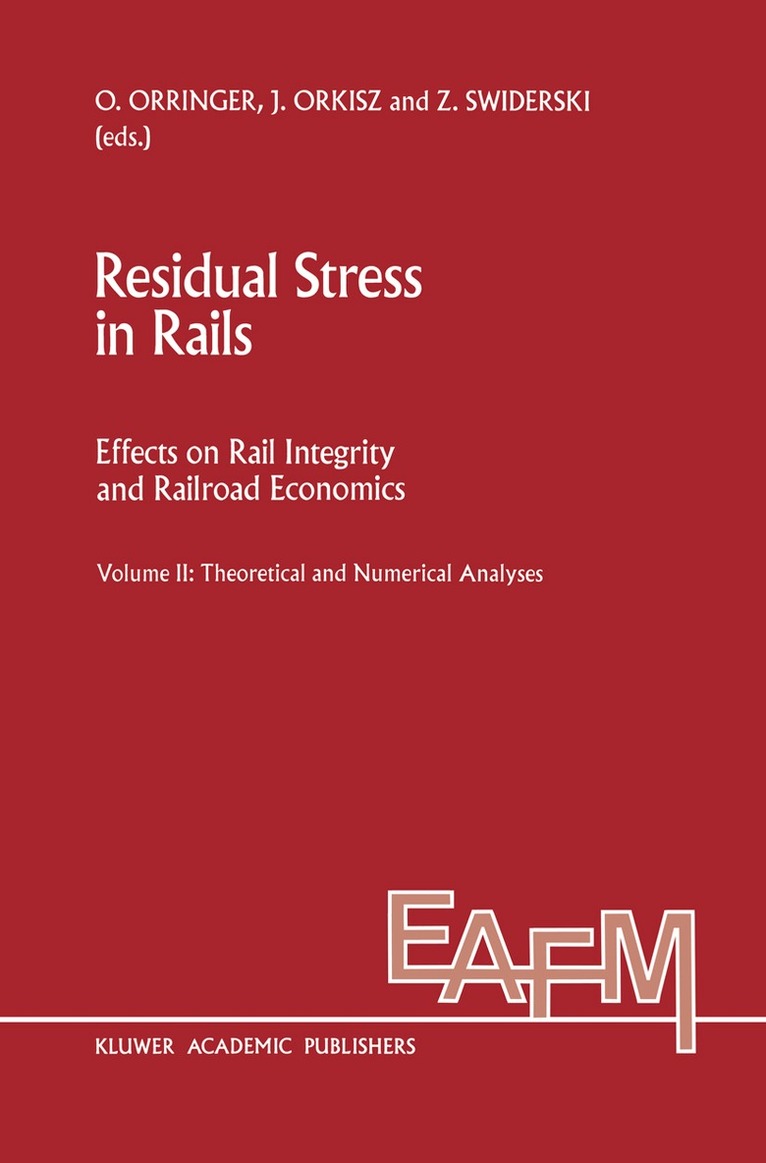
These volumes contain contributions from a conference on the themes of measurement and prediction of residual stress in railroad rails. Volume I contains elements of practical railway experience, laboratory tests, including experimental stress analysis, and theoretical evaluations of residual stress, crack propagation, and rail fracture. Theoretical and numerical analyses are presented in Volume II, in the hope that models based on solid mechanics can correlate the experimental stress measurements and lead to better understanding of the effects of residual stress upon crack propagation, fracture, and ultimately the economics of rail in the modern railroad environment.
Inbunden, Engelska, 1993
1 633 kr
Skickas inom 10-15 vardagar
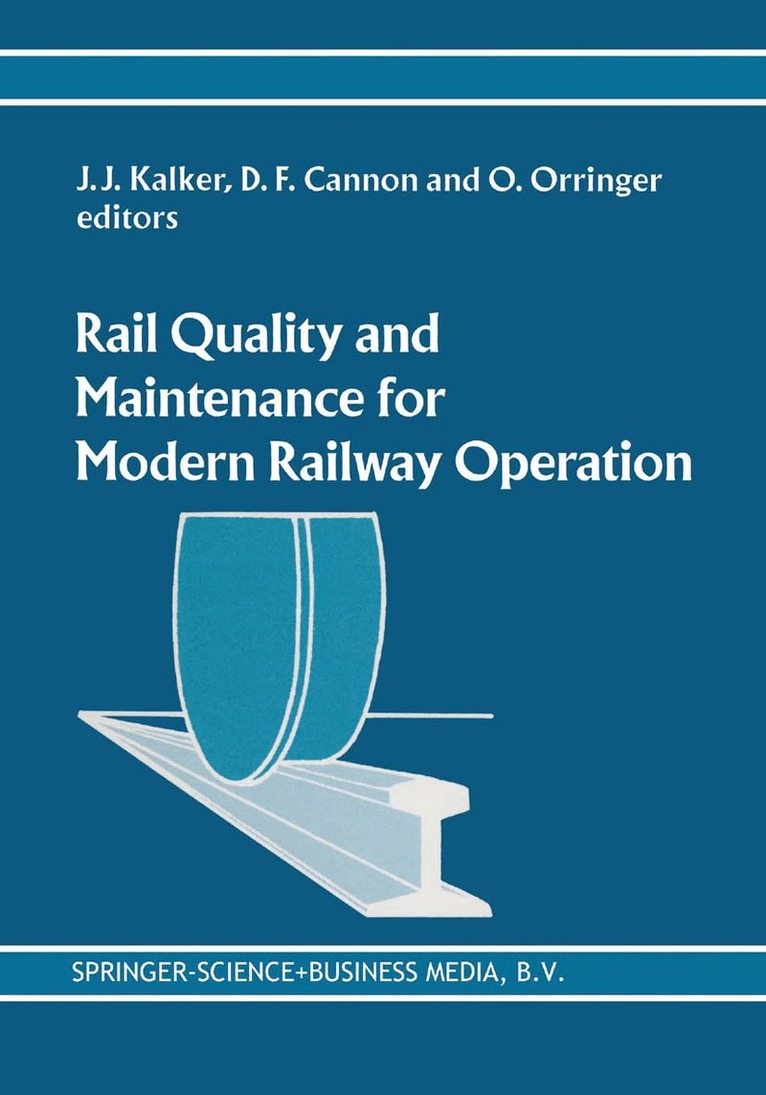
In April 1990 a conference was held at the Cracow Institute of Technology, Cracow, Poland. The title of that conference was "Residual Stresses in Rails - Effects on Rail Integrity and Railroad Economics" and its themes were the measurement and prediction of residual stresses in rails, but, as the sub-title suggests, the intention was also to provide a link between research and its application to the practical railway world. At the Cracow conference there were 40 participants with 5 railways and 5 rail makers being represented and 25 papers were given. The Cracow conference was a success, and by March 1991 its off-spring, "The International Conference on Rail Quality and Maintenance for Modern Railway Operations", was conceived and birth was ultimately given in June 1992 at the Technical University, Delft. It turned out to be some baby, with 112 delegates from 24 countries taking part! As with its predecessor, the conference was to provide a forum for the exchange of ideas between research investigators, rail makers and railway engineers. A cursory examination of the list of participants suggests that about 57% were from the railway industry, 34% from universities and other research institutions and 9% from the steel industry. Bearing in mind that some of the railway industry participants were from their respective research and development organisations the balance of interests was about right.
Häftad, Engelska, 2010
1 635 kr
Skickas inom 10-15 vardagar
In April 1990 a conference was held at the Cracow Institute of Technology, Cracow, Poland. The title of that conference was "Residual Stresses in Rails - Effects on Rail Integrity and Railroad Economics" and its themes were the measurement and prediction of residual stresses in rails, but, as the sub-title suggests, the intention was also to provide a link between research and its application to the practical railway world. At the Cracow conference there were 40 participants with 5 railways and 5 rail makers being represented and 25 papers were given. The Cracow conference was a success, and by March 1991 its off-spring, "The International Conference on Rail Quality and Maintenance for Modern Railway Operations", was conceived and birth was ultimately given in June 1992 at the Technical University, Delft. It turned out to be some baby, with 112 delegates from 24 countries taking part! As with its predecessor, the conference was to provide a forum for the exchange of ideas between research investigators, rail makers and railway engineers. A cursory examination of the list of participants suggests that about 57% were from the railway industry, 34% from universities and other research institutions and 9% from the steel industry. Bearing in mind that some of the railway industry participants were from their respective research and development organisations the balance of interests was about right.
2012
3 848 kr
Skickas inom 10-15 vardagar
Rail integrity is a current application of engineering fracture mechanics at a practical level. Although railroad rails have been manufactured and used for more than a century, it is only in the last ten years that the effects of their crack propagation and fracture characteristics have been considered from a rational viewpoint. The J,Jractical objectives are to develop damage tolerance ~delines for rail inspection and to improve the fracture resistance of new rail productiOn. Rail fatigue crack propagation rates and fracture resistance are strongly influenced by residual stresses, which are introduced into the rail both during proouction and in service. Therefore, the rail residual stress field must be well understood before fracture mechanics can be usefully applied to the subject of rail integrity. The three-dintensional character of rail and its stress fields make it essential to apply both experimental and analytical methods in order to twderstand the effects of pro duction and service variables on residual stress and the effects of the stress on fatigue crack propagation and fracture. This volume brings to~ether field observations and experimental stress analysis of railroad rails in the Umted States and Europe. The ongoing search for an efficient and accurate technique is emphasized. A companion volume brings together several analytical investigations, based on advanced compu tational mechanics methods, for correlation of the experimental data as well as eval uation of the effects of residual stress on rail integrity.
E-bok
PDF, Engelska, 20173 948 kr
Läs direkt efter köp
Rail integrity is a current application of engineering fracture mechanics at a practical level. Although railroad rails have been manufactured and used for more than a century, it is only in the last ten years that the effects of their crack propagation and fracture characteristics have been considered from a rational viewpoint. The J,Jractical objectives are to develop damage tolerance ~delines for rail inspection and to improve the fracture resistance of new rail productiOn. Rail fatigue crack propagation rates and fracture resistance are strongly influenced by residual stresses, which are introduced into the rail both during proouction and in service. Therefore, the rail residual stress field must be well understood before fracture mechanics can be usefully applied to the subject of rail integrity. The three-dintensional character of rail and its stress fields make it essential to apply both experimental and analytical methods in order to twderstand the effects of pro duction and service variables on residual stress and the effects of the stress on fatigue crack propagation and fracture. This volume brings to~ether field observations and experimental stress analysis of railroad rails in the Umted States and Europe. The ongoing search for an efficient and accurate technique is emphasized. A companion volume brings together several analytical investigations, based on advanced compu tational mechanics methods, for correlation of the experimental data as well as eval uation of the effects of residual stress on rail integrity.
E-bok
PDF, Engelska, 20132 049 kr
Läs direkt efter köp
In April 1990 a conference was held at the Cracow Institute of Technology, Cracow, Poland. The title of that conference was "Residual Stresses in Rails - Effects on Rail Integrity and Railroad Economics" and its themes were the measurement and prediction of residual stresses in rails, but, as the sub-title suggests, the intention was also to provide a link between research and its application to the practical railway world. At the Cracow conference there were 40 participants with 5 railways and 5 rail makers being represented and 25 papers were given. The Cracow conference was a success, and by March 1991 its off-spring, "The International Conference on Rail Quality and Maintenance for Modern Railway Operations", was conceived and birth was ultimately given in June 1992 at the Technical University, Delft. It turned out to be some baby, with 112 delegates from 24 countries taking part! As with its predecessor, the conference was to provide a forum for the exchange of ideas between research investigators, rail makers and railway engineers. A cursory examination of the list of participants suggests that about 57% were from the railway industry, 34% from universities and other research institutions and 9% from the steel industry. Bearing in mind that some of the railway industry participants were from their respective research and development organisations the balance of interests was about right.