Oleg I. Larichev - Böcker
Visar alla böcker från författaren Oleg I. Larichev. Handla med fri frakt och snabb leverans.
6 produkter
6 produkter
2 101 kr
Skickas inom 10-15 vardagar
During the 1970s and 1980s, Sitka spruce (Picea sitchensis, Bong. Carr. ) was planted extensively on northern Vancouver Island (B. C. , Canada) to regenerate slashburned clearcuts previously occupied by old-growth Thuja p1icata, Donn, Tsuga heterophy11a, Raf. Sarg. , and an ericaceous unders tory shrub salal (Gaul ther ia sha11on, Pursh [CH sites 1 ) . The planted Sitka spruce grew well initially on these sites, but experienced nutritional stress and reduced growth 8 to 14 yr after planting (Germain, 1985; Weetman et a1. , 1990a,b). Accompanying the onset of the nutritional stress was the reestablishment of a complete ground cover of salal, and it has been suggested that there is a causal connection between these two temporally synchronous events (Weetman et al. , 1990a,b). Other ericaceous species have been implicated in nutritional stress in conifer plantations (Mallik, 1987; Robinson, 1972; Handley, 1963; Rose et a1. , 1983).Three hypotheses to explain this nutritional stress were tested in the study reported in this paper: (1) that salal competition for N can provide an adequate explanation for the observed nutritional stress; (2) that salal inhibits the availability of nutrients to seedlings by interfering with their mycorrhizae; and (3) that the fertility of these CH sites declines after 8 yr following clearcutting and slashburning due to the termination of the flush of nutrients (or "assart effect") associated with this disturbance. A series of pot and field experiments was carried out to test these hypotheses. 1 2.
1 064 kr
Skickas inom 10-15 vardagar
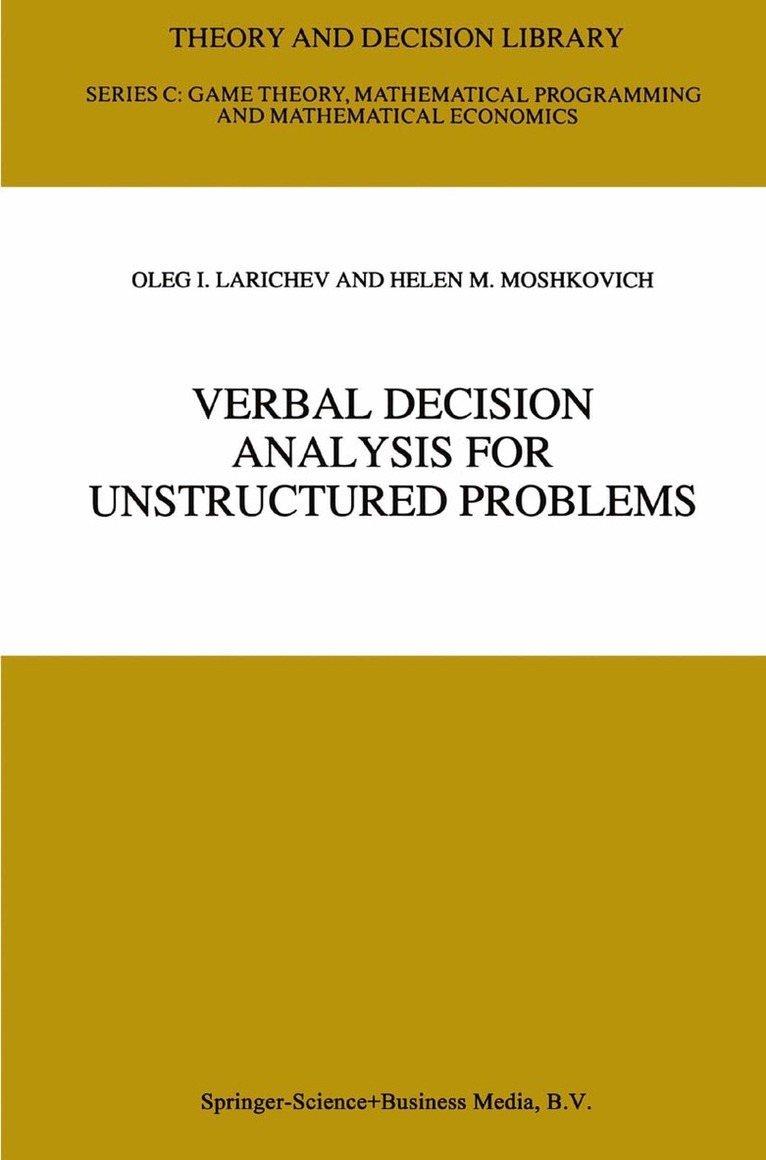
This text is devoted to a special class of decision making problems, called "unstructured problems". The peculiarity of these problems is connected with the essentially qualitative description of the involved factors and the subjective character of relations between these factors. The work describes the world of human decisions and methods of action that improve the chances of making sensible decisions in a complicated, contradictory and incompletely definite environment. A new procedure of decision making in non-structured problems is constructed and some methods that are logical inferences from it are demonstrated. The studies proceed from the contradiction between the normative methods of decision making, which prescribes the decision maker how to make the best decisions and the descriptive results showing how in real life people act when making a decision. The authors propose an approach that integrates modelling procedures with elicitation methods.
1 096 kr
Skickas inom 10-15 vardagar
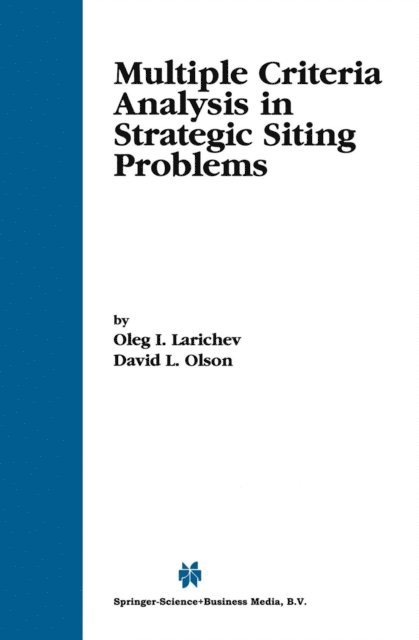
The purpose of this work is to demonstrate how multiple criteria can be used in analysis of facility location problems. The book begins with an overview, explains the internationally most popular multiple objective analysis methods, and demonstrates their applications on real problems. Siting problems reviewed include nuclear waste disposal in the US, solid waste management in Finland, pipeline location in India, and pipeline location in Russia. Methods covered are multi-attribute utility analysis, analytic hierarchy process, the ELECTRE outranking method, and verbal decision analysis. The book concludes with a comparative review of methods. The book uses the multi-attribute, multi-party framework of Kunreuther to present the decision context, to include parties with interests in the decisions, as well as the sequence of project events. This perspective is valuable in identifying the qualitative backgrounds of siting problems that need to be considered. The book demonstrates the importance of multiple criteria in hazardous facility site selection.It also shows how each of the four methodologies covered operate, both in terms of demonstration problems worked with numbers, and how these methods have been applied in the real applications. The real applications were taken from refereed journal documentation, with the exception of Russian pipeline analysis decisions in which Professor Larichev participated. The book is recommended for those interested in decision-making involving problems with social import. This includes environmental aspects, as well as international aspects of decision making.
1 096 kr
Skickas inom 10-15 vardagar
This book is devoted to a special class of decision making problems, called 'unstructured problems'. The peculiarity of these problems is connected with the essentially qualitative description of the involved factors and the subjective character of relations between these factors. The work describes the world of human decisions and methods of action that improve the chances of making sensible decisions in a complicated, contradictory and incompletely definite environment. A new procedure of decision making in non-structured problems is constructed and some methods that are logical inferences from it are demonstrated. The studies proceed from the contradiction between the normative methods of decision making, which prescribes the decision maker how to make the best decisions and the descriptive results showing how in real life people act when making a decision. The authors propose an approach that integrates modelling procedures with elicitation methods.
1 096 kr
Skickas inom 10-15 vardagar
The purpose of Multiple Criteria Analysis in Strategic Siting Problems is to demonstrate how multiple criteria can be used in analysis of facility location problems. The book begins with an overview, explains the internationally most popular multiple objective analysis methods, and demonstrates their applications on real problems. Siting problems reviewed include nuclear waste disposal in the U.S., solid waste management in Finland, pipeline location in India, and pipeline location in Russia. Methods covered are multiattribute utility analysis, analytic hierarchy process, the ELECTRE outranking method, and verbal decision analysis. The book concludes with a comparative review of methods. The book uses the multi-attribute, multi-party framework of Kunreuther to present the decision context, to include parties with interests in the decisions, as well as the sequence of project events. This perspective is valuable in identifying the qualitative backgrounds of siting problems that need to be considered. The book demonstrates the importance of multiple criteria in hazardous facility site selection.It also shows how each of the four methodologies covered operate, both in terms of demonstration problems worked with numbers, and how these methods have been applied in the real applications. The real applications were taken from refereed journal documentation, with the exception of Russian pipeline analysis decisions in which Professor Larichev participated. The book is recommended for those interested in decision-making involving problems with social import. This includes environmental aspects, as well as international aspects of decision making.
2 101 kr
Skickas inom 10-15 vardagar
During the 1970s and 1980s, Sitka spruce (Picea sitchensis, Bong. Carr. ) was planted extensively on northern Vancouver Island (B. C. , Canada) to regenerate slashburned clearcuts previously occupied by old-growth Thuja p1icata, Donn, Tsuga heterophy11a, Raf. Sarg. , and an ericaceous unders tory shrub salal (Gaul ther ia sha11on, Pursh [CH sites 1 ) . The planted Sitka spruce grew well initially on these sites, but experienced nutritional stress and reduced growth 8 to 14 yr after planting (Germain, 1985; Weetman et a1. , 1990a,b). Accompanying the onset of the nutritional stress was the reestablishment of a complete ground cover of salal, and it has been suggested that there is a causal connection between these two temporally synchronous events (Weetman et al. , 1990a,b). Other ericaceous species have been implicated in nutritional stress in conifer plantations (Mallik, 1987; Robinson, 1972; Handley, 1963; Rose et a1. , 1983).Three hypotheses to explain this nutritional stress were tested in the study reported in this paper: (1) that salal competition for N can provide an adequate explanation for the observed nutritional stress; (2) that salal inhibits the availability of nutrients to seedlings by interfering with their mycorrhizae; and (3) that the fertility of these CH sites declines after 8 yr following clearcutting and slashburning due to the termination of the flush of nutrients (or "assart effect") associated with this disturbance. A series of pot and field experiments was carried out to test these hypotheses. 1 2.