Pablo Oyarzun - Böcker
Visar alla böcker från författaren Pablo Oyarzun. Handla med fri frakt och snabb leverans.
6 produkter
6 produkter
1 674 kr
Skickas inom 3-6 vardagar
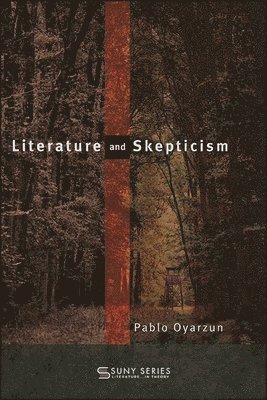
Examines the skeptical foundations of literature in order to reassess the status of fiction.Literature and Skepticism links the skeptic attitude to the conditions of possibility in (modern) literature-in particular, the narrative form and the essay. Pablo Oyarzun proposes that narrative and the essay document the relationship between literature and skepticism in different but complementary and, at the same time, complicit ways. As the narrative performance reaches the structural limit of the literary-understood as the domain of fiction-a sort of para-discursive reflection critically accompanies this performance, discussing it, ironizing it, feigning to disbelieve it, or overtly belying it. Yet the narrative doubtfully takes distance from itself, surrendering all right to a final truth at the very moment at which truth emerges, essayistic, to the surface. The authors considered-Montaigne, Swift, Lichtenberg, Kleist, Kafka, and Borges-are eminent representatives of one and the other form, and all of the works analyzed are cases of a complex interplay between narrative and essay.
651 kr
Skickas inom 3-6 vardagar
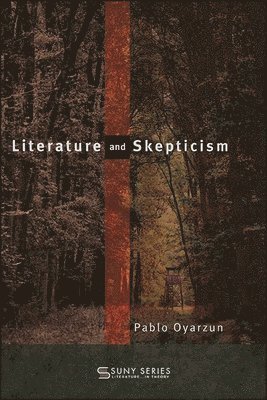
Examines the skeptical foundations of literature in order to reassess the status of fiction.Literature and Skepticism links the skeptic attitude to the conditions of possibility in (modern) literature-in particular, the narrative form and the essay. Pablo Oyarzun proposes that narrative and the essay document the relationship between literature and skepticism in different but complementary and, at the same time, complicit ways. As the narrative performance reaches the structural limit of the literary-understood as the domain of fiction-a sort of para-discursive reflection critically accompanies this performance, discussing it, ironizing it, feigning to disbelieve it, or overtly belying it. Yet the narrative doubtfully takes distance from itself, surrendering all right to a final truth at the very moment at which truth emerges, essayistic, to the surface. The authors considered-Montaigne, Swift, Lichtenberg, Kleist, Kafka, and Borges-are eminent representatives of one and the other form, and all of the works analyzed are cases of a complex interplay between narrative and essay.
651 kr
Skickas inom 3-6 vardagar
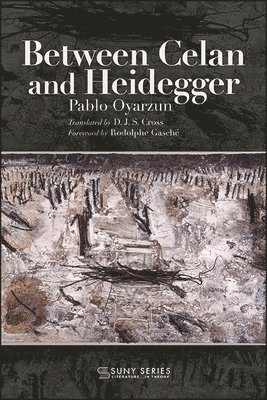
Probing reassessment of the relation between Celan's poetry and Heidegger's thought.The relevance of Martin Heidegger's thinking to Paul Celan's poetry is well known. Between Celan and Heidegger proposes that, while the relation between them is undeniable, it is also marked by irreducible discord. Pablo Oyarzun begins with a deconstruction of Celan's Todtnauberg, written after the poet visited Heidegger in his Schwarzwald cabin. The poem stands as a milestone, not only in the complex relationship between the two men but also in the state of poetry and philosophy in late modernity, in the aftermath of the Holocaust. Discussion then turns to The Meridian, Celan's acceptance speech for the prestigious Büchner Prize for German language literature. Other issues are insistently addressed-place, art, language, pain, existence, and the Heideggerian notion of dialogue-as Oyarzun revisits several essential poems from Celan's oeuvre. A rare translation of Oyarzun's work into English, Between Celan and Heidegger affirms the uniqueness of Celan's poetry in confrontation both with Heidegger's discourse on Dichtung (a poetic saying centered in the idea of gathering) and with Western philosophical notions of art, technē, mimesis, poiesis, language, and thinking more broadly.
1 674 kr
Skickas inom 3-6 vardagar
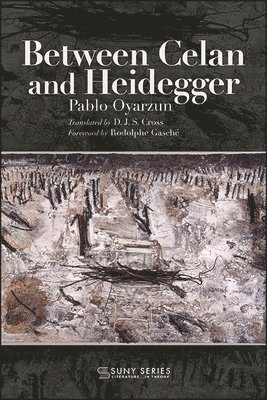
Probing reassessment of the relation between Celan's poetry and Heidegger's thought.The relevance of Martin Heidegger's thinking to Paul Celan's poetry is well known. Between Celan and Heidegger proposes that, while the relation between them is undeniable, it is also marked by irreducible discord. Pablo Oyarzun begins with a deconstruction of Celan's Todtnauberg, written after the poet visited Heidegger in his Schwarzwald cabin. The poem stands as a milestone, not only in the complex relationship between the two men but also in the state of poetry and philosophy in late modernity, in the aftermath of the Holocaust. Discussion then turns to The Meridian, Celan's acceptance speech for the prestigious Büchner Prize for German language literature. Other issues are insistently addressed-place, art, language, pain, existence, and the Heideggerian notion of dialogue-as Oyarzun revisits several essential poems from Celan's oeuvre. A rare translation of Oyarzun's work into English, Between Celan and Heidegger affirms the uniqueness of Celan's poetry in confrontation both with Heidegger's discourse on Dichtung (a poetic saying centered in the idea of gathering) and with Western philosophical notions of art, technē, mimesis, poiesis, language, and thinking more broadly.
736 kr
Skickas inom 7-10 vardagar
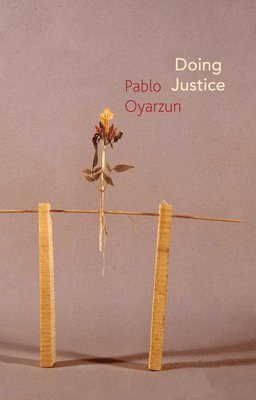
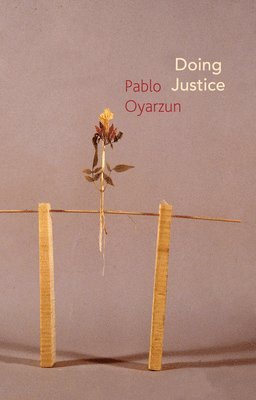
Pablo Oyarzun is one of the foremost Benjamin scholars in Latin America. His writings have shaped the reception of Benjamin’s work in Latin America and have been central to the effort to identify the tasks and responsibilities of the kind of critical theory that would interrupt social violence. In this book Oyarzun examines some of the key concepts in Benjamin’s work – including his concepts of translation, experience, history and storytelling – and relates them to his own systematic reflection on the nature and implications of ‘doing justice’. What is meant by the words ‘justice was done’? The passive voice is important here. On the one hand, justice does nothing: it is not an agent, it can only prevail or fail, and if it fails, it does so without limit. On the other hand, the passive voice alludes to the agents of an action while covering them up; the allusion is the masking of the identity and traces of the person who accomplishes the action. And this cover-up can be dangerous: it can cover-up the executioners, who are subjects that everyone can confirm anonymously, without their being recognized and without their wanting to be recognized. Justice, argues Oyarzun, can only be done in the active effort to do justice – or, as Benjamin would say, in the striving to turn the world into the highest good. This book by one of Chile’s most distinguished philosophers will be of value to anyone interested in Benjamin’s work and in the development of critical theory in Latin America.
250 kr
Skickas inom 7-10 vardagar
Pablo Oyarzun is one of the foremost Benjamin scholars in Latin America. His writings have shaped the reception of Benjamin’s work in Latin America and have been central to the effort to identify the tasks and responsibilities of the kind of critical theory that would interrupt social violence. In this book Oyarzun examines some of the key concepts in Benjamin’s work – including his concepts of translation, experience, history and storytelling – and relates them to his own systematic reflection on the nature and implications of ‘doing justice’. What is meant by the words ‘justice was done’? The passive voice is important here. On the one hand, justice does nothing: it is not an agent, it can only prevail or fail, and if it fails, it does so without limit. On the other hand, the passive voice alludes to the agents of an action while covering them up; the allusion is the masking of the identity and traces of the person who accomplishes the action. And this cover-up can be dangerous: it can cover-up the executioners, who are subjects that everyone can confirm anonymously, without their being recognized and without their wanting to be recognized. Justice, argues Oyarzun, can only be done in the active effort to do justice – or, as Benjamin would say, in the striving to turn the world into the highest good. This book by one of Chile’s most distinguished philosophers will be of value to anyone interested in Benjamin’s work and in the development of critical theory in Latin America.