
Panel on Statistical Methods for Measuring the Group Quarters Population in the American Community Survey – författare
363 kr
Skickas inom 3-6 vardagar
194 kr
Läs direkt efter köp
Following several years of testing and evaluation, the American Community Survey (ACS) was launched in 2005 as a replacement for the census "long form," used to collect detailed social, economic, and housing data from a sample of the U.S. population as part of the decennial census. During the first year of the ACS implementation, the Census Bureau collected data only from households. In 2006 a sample of group quarters (GQs)—such as correctional facilities, nursing homes, and college dorms—was added to more closely mirror the design of the census long-form sample. The design of the ACS relies on monthly samples that are cumulated to produce multiyear estimates based on 1, 3, and 5 years of data. The data published by the Census Bureau for a geographic area depend on the area''s size. The multiyear averaging approach enables the Census Bureau to produce estimates that are intended to be robust enough to release for small areas, such as the smallest governmental units and census block groups. However, the sparseness of the GQ representation in the monthly samples affects the quality of the estimates in many small areas that have large GQ populations relative to the total population. The Census Bureau asked the National Research Council to review and evaluate the statistical methods used for measuring the GQ population. This book presents recommendations addressing improvements in the sample design, sample allocation, weighting, and estimation procedures to assist the Census Bureau''s work in the very near term, while further research is conducted to address the underlying question of the relative importance and costs of the GQ data collection in the context of the overall ACS design.
286 kr
Läs direkt efter köp
Following several years of testing and evaluation, the American Community Survey (ACS) was launched in 2005 as a replacement for the census "long form," used to collect detailed social, economic, and housing data from a sample of the U.S. population as part of the decennial census. During the first year of the ACS implementation, the Census Bureau collected data only from households. In 2006 a sample of group quarters (GQs)—such as correctional facilities, nursing homes, and college dorms—was added to more closely mirror the design of the census long-form sample. The design of the ACS relies on monthly samples that are cumulated to produce multiyear estimates based on 1, 3, and 5 years of data. The data published by the Census Bureau for a geographic area depend on the area''s size. The multiyear averaging approach enables the Census Bureau to produce estimates that are intended to be robust enough to release for small areas, such as the smallest governmental units and census block groups. However, the sparseness of the GQ representation in the monthly samples affects the quality of the estimates in many small areas that have large GQ populations relative to the total population. The Census Bureau asked the National Research Council to review and evaluate the statistical methods used for measuring the GQ population. This book presents recommendations addressing improvements in the sample design, sample allocation, weighting, and estimation procedures to assist the Census Bureau''s work in the very near term, while further research is conducted to address the underlying question of the relative importance and costs of the GQ data collection in the context of the overall ACS design.
605 kr
Läs direkt efter köp
In the early 1990s, the Census Bureau proposed a program of continuous measurement as a possible alternative to the gathering of detailed social, economic, and housing data from a sample of the U.S. population as part of the decennial census. The American Community Survey (ACS) became a reality in 2005, and has included group quarters (GQ)-such places as correctional facilities for adults, student housing, nursing facilities, inpatient hospice facilities, and military barracks-since 2006, primarily to more closely replicate the design and data products of the census long-form sample.
The decision to include group quarters in the ACS enables the Census Bureau to provide a comprehensive benchmark of the total U.S. population (not just those living in households). However, the fact that the ACS must rely on a sample of what is a small and very diverse population, combined with limited funding available for survey operations, makes the ACS GQ sampling, data collection, weighting, and estimation procedures more complex and the estimates more susceptible to problems stemming from these limitations. The concerns are magnified in small areas, particularly in terms of detrimental effects on the total population estimates produced for small areas.
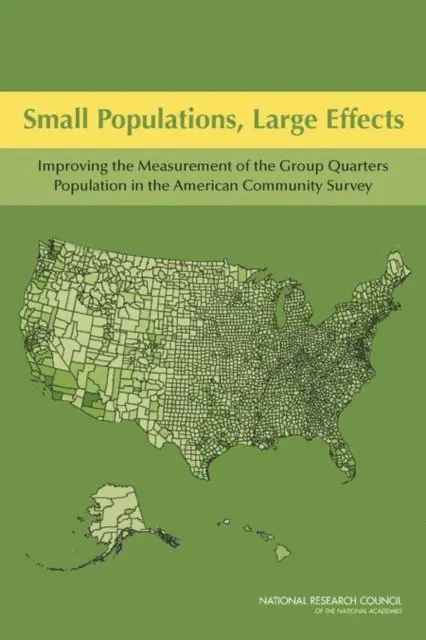
Small Populations, Large Effects provides an in-depth review of the statistical methodology for measuring the GQ population in the ACS. This report addresses difficulties associated with measuring the GQ population and the rationale for including GQs in the ACS. Considering user needs for ACS data and of operational feasibility and compatibility with the treatment of the household population in the ACS, the report recommends alternatives to the survey design and other methodological features that can make the ACS more useful for users of small-area data.
399 kr
Tillfälligt slut