Patrick Sevestre – författare
Visar alla böcker från författaren Patrick Sevestre. Handla med fri frakt och snabb leverans.
7 produkter
7 produkter
Inbunden, Engelska, 2008
4 216 kr
Skickas inom 10-15 vardagar
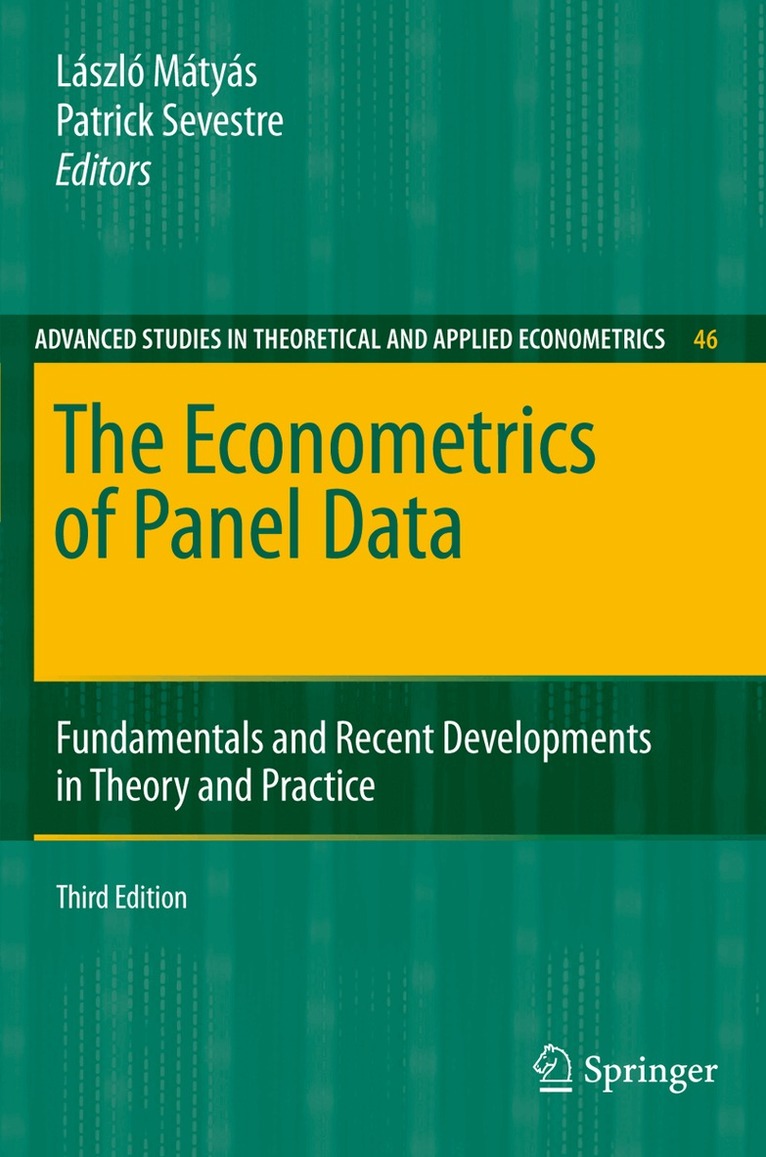
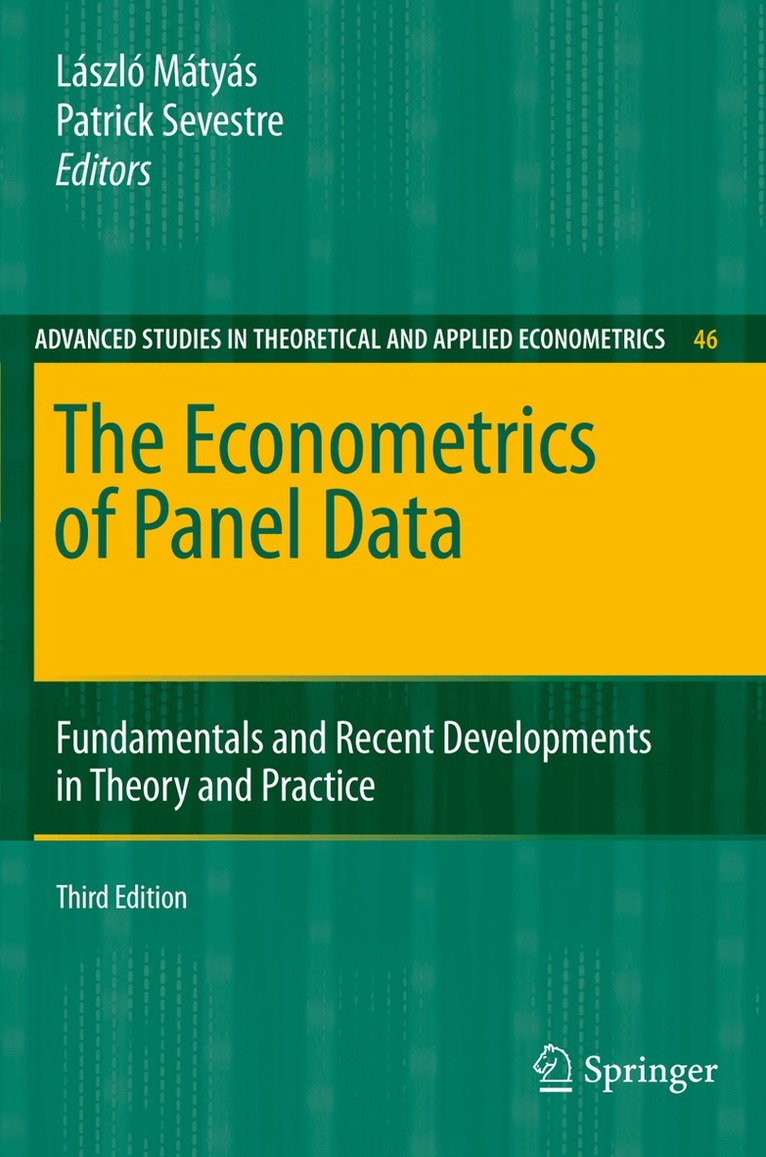
The aim of this third, completely re-written, re-edited and considerably expanded, edition of this book is to provide a general overview of both the basics and - cent, more sophisticated, theoretical developments in panel data econometrics. It also aims at covering a number of ?elds of applications where these methods are used for improving our knowledge and understanding of economic agents’ beh- iors. Since the pioneering works of Edwin Kuh (1959), Yair Mundlak (1961), Irving Hoch (1962), and Pietro Balestra and Marc Nerlove (1966), the pooling of cross s- tions and time series data has become an increasingly popular way of quantifying economic relationships. Each series provides information lacking in the other, so a combination of both leads to more accurate, reliable and informative results than would be achievable by one type of series alone. Over the last three decades of the last century, much fundamental work has been done: investigation of the properties of different estimators and test statistics, analysis of dynamic models and the effects of eventual measurement errors, etc. The more recent years and in particular the ten years elapsed since the second edition of this book have witnessed even more considerable changes. Indeed, our ability to estimate and test nonlinear models have dramatically improved and issues such as the unobserved heterogeneity in nonlinear models, attrition and selectivity bias have received considerable attention. This explains why the number of chapters dealing with such issues has increased in this third edition.
E-bok
PDF, Engelska, 20085 030 kr
Läs direkt efter köp
The aim of this third, completely re-written, re-edited and considerably expanded, edition of this book is to provide a general overview of both the basics and - cent, more sophisticated, theoretical developments in panel data econometrics. It also aims at covering a number of ?elds of applications where these methods are used for improving our knowledge and understanding of economic agents’ beh- iors. Since the pioneering works of Edwin Kuh (1959), Yair Mundlak (1961), Irving Hoch (1962), and Pietro Balestra and Marc Nerlove (1966), the pooling of cross s- tions and time series data has become an increasingly popular way of quantifying economic relationships. Each series provides information lacking in the other, so a combination of both leads to more accurate, reliable and informative results than would be achievable by one type of series alone. Over the last three decades of the last century, much fundamental work has been done: investigation of the properties of different estimators and test statistics, analysis of dynamic models and the effects of eventual measurement errors, etc. The more recent years and in particular the ten years elapsed since the second edition of this book have witnessed even more considerable changes. Indeed, our ability to estimate and test nonlinear models have dramatically improved and issues such as the unobserved heterogeneity in nonlinear models, attrition and selectivity bias have received considerable attention. This explains why the number of chapters dealing with such issues has increased in this third edition.
Häftad, Engelska, 2016
4 093 kr
Skickas inom 10-15 vardagar
The aim of this third, completely re-written, re-edited and considerably expanded, edition of this book is to provide a general overview of both the basics and - cent, more sophisticated, theoretical developments in panel data econometrics. It also aims at covering a number of ?elds of applications where these methods are used for improving our knowledge and understanding of economic agents’ beh- iors. Since the pioneering works of Edwin Kuh (1959), Yair Mundlak (1961), Irving Hoch (1962), and Pietro Balestra and Marc Nerlove (1966), the pooling of cross s- tions and time series data has become an increasingly popular way of quantifying economic relationships. Each series provides information lacking in the other, so a combination of both leads to more accurate, reliable and informative results than would be achievable by one type of series alone. Over the last three decades of the last century, much fundamental work has been done: investigation of the properties of different estimators and test statistics, analysis of dynamic models and the effects of eventual measurement errors, etc. The more recent years and in particular the ten years elapsed since the second edition of this book have witnessed even more considerable changes. Indeed, our ability to estimate and test nonlinear models have dramatically improved and issues such as the unobserved heterogeneity in nonlinear models, attrition and selectivity bias have received considerable attention. This explains why the number of chapters dealing with such issues has increased in this third edition.
E-bok
PDF, Engelska, 20132 036 kr
Läs direkt efter köp
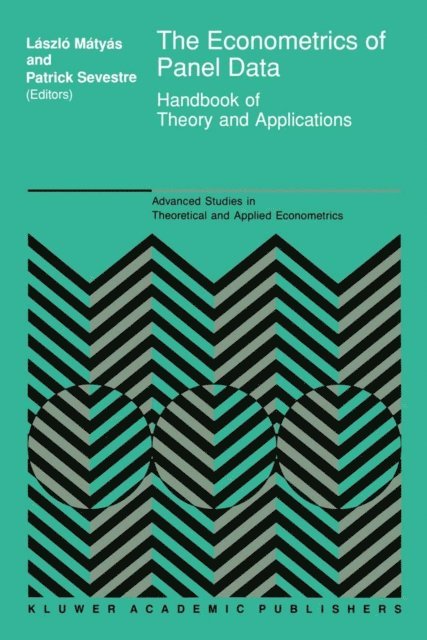
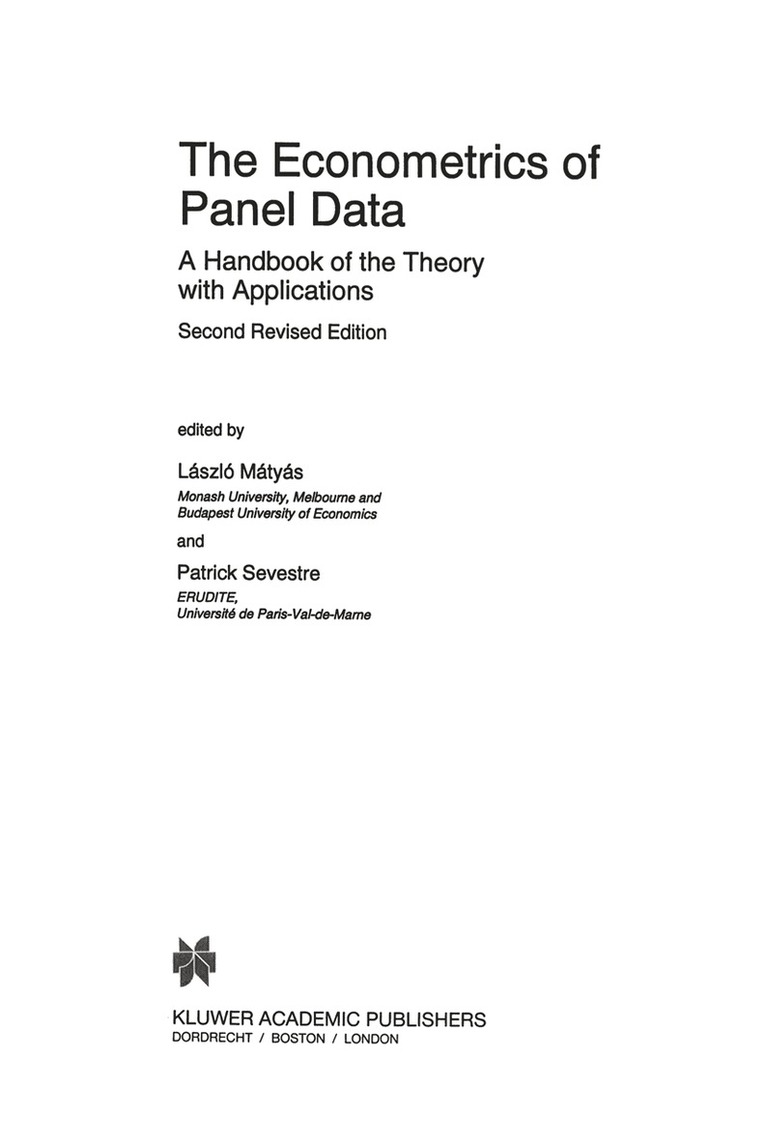
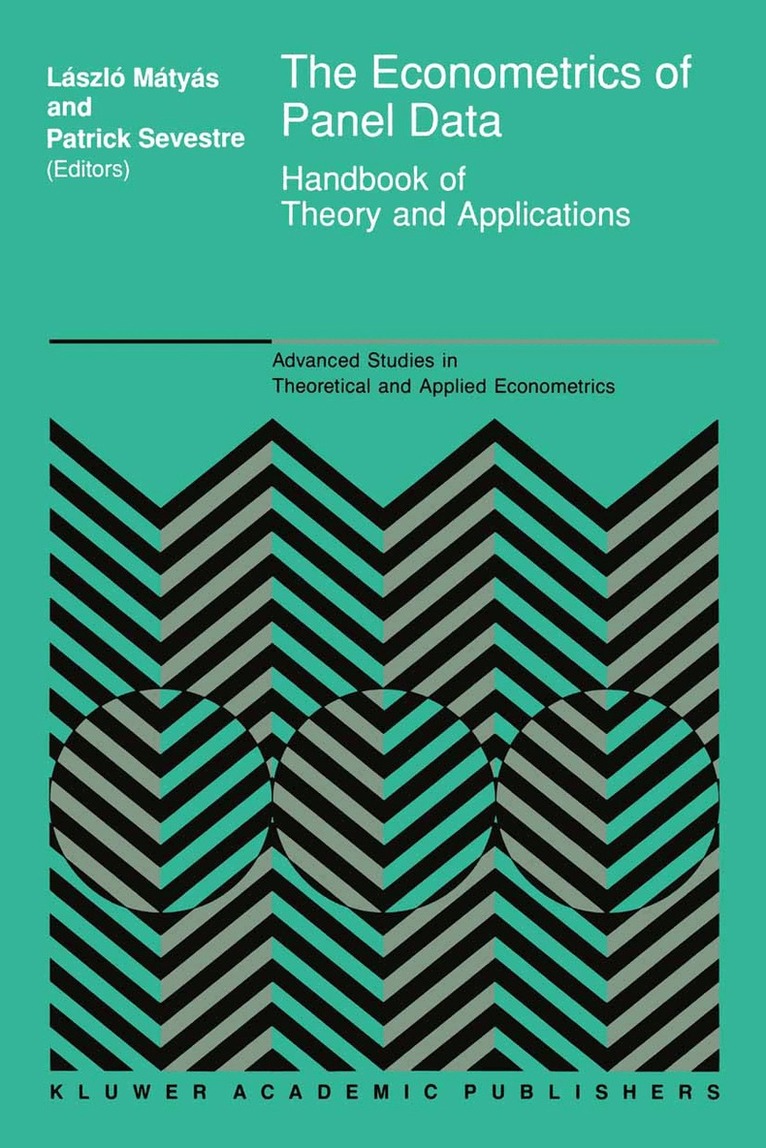
The aim of this volume is to provide a general overview of the econometrics of panel data, both from a theoretical and from an applied viewpoint. Since the pioneering papers by Edwin Kuh (1959), Yair Mundlak (1961), Irving Hoch (1962), and Pietro Balestra and Marc Nerlove (1966), the pooling of cross sections and time series data has become an increasingly popular way of quantifying economic relationships. Each series provides information lacking in the other, so a combination of both leads to more accurate and reliable results than would be achievable by one type of series alone. Over the last 30 years much work has been done: investigation of the properties of the applied estimators and test statistics, analysis of dynamic models and the effects of eventual measurement errors, etc. These are just some of the problems addressed by this work. In addition, some specific diffi culties associated with the use of panel data, such as attrition, heterogeneity, selectivity bias, pseudo panels etc., have also been explored. The first objective of this book, which takes up Parts I and II, is to give as complete and up-to-date a presentation of these theoretical developments as possible. Part I is concerned with classical linear models and their extensions; Part II deals with nonlinear models and related issues: logit and pro bit models, latent variable models, duration and count data models, incomplete panels and selectivity bias, point processes, and simulation techniques.
E-bok
PDF, Engelska, 20131 977 kr
Läs direkt efter köp
The aim of this volume is to provide a general overview of the econometrics of panel data, both from a theoretical and from an applied viewpoint. Since the pioneering papers by Kuh (1959), Mundlak (1961), Hoch (1962), and Balestra and Nerlove (1966), the pooling of cross section and time series data has become an increasingly popular way of quantifying economic relationships. Each series provides information lacking in the other, so a combination of both leads to more accurate and reliable results than would be achievable by one type of series alone. Over the last 30 years much work has been done: investigation of the properties of the applied estimators and test statistics, analysis of dynamic models and the effects of eventual measurement errors, etc. These are just some of the problems addressed by this work. In addition, some specific diffi culties associated with the use of panel data, such as attrition, heterogeneity, selectivity bias, pseudo panels etc., have also been explored. The first objective of this book, which takes up Parts I and II, is to give as complete and up-to-date a presentation of these theoretical developments as possible. Part I is concerned with classical linear models and their extensions; Part II deals with nonlinear models and related issues: logit and probit models, latent variable models, incomplete panels and selectivity bias, and point processes.
Häftad, Engelska, 2011
1 668 kr
Skickas inom 10-15 vardagar
The aim of this volume is to provide a general overview of the econometrics of panel data, both from a theoretical and from an applied viewpoint. Since the pioneering papers by Edwin Kuh (1959), Yair Mundlak (1961), Irving Hoch (1962), and Pietro Balestra and Marc Nerlove (1966), the pooling of cross sections and time series data has become an increasingly popular way of quantifying economic relationships. Each series provides information lacking in the other, so a combination of both leads to more accurate and reliable results than would be achievable by one type of series alone. Over the last 30 years much work has been done: investigation of the properties of the applied estimators and test statistics, analysis of dynamic models and the effects of eventual measurement errors, etc. These are just some of the problems addressed by this work. In addition, some specific diffi culties associated with the use of panel data, such as attrition, heterogeneity, selectivity bias, pseudo panels etc., have also been explored. The first objective of this book, which takes up Parts I and II, is to give as complete and up-to-date a presentation of these theoretical developments as possible. Part I is concerned with classical linear models and their extensions; Part II deals with nonlinear models and related issues: logit and pro bit models, latent variable models, duration and count data models, incomplete panels and selectivity bias, point processes, and simulation techniques.
Häftad, Engelska, 2011
1 668 kr
Skickas inom 10-15 vardagar
The aim of this volume is to provide a general overview of the econometrics of panel data, both from a theoretical and from an applied viewpoint. Since the pioneering papers by Kuh (1959), Mundlak (1961), Hoch (1962), and Balestra and Nerlove (1966), the pooling of cross section and time series data has become an increasingly popular way of quantifying economic relationships. Each series provides information lacking in the other, so a combination of both leads to more accurate and reliable results than would be achievable by one type of series alone. Over the last 30 years much work has been done: investigation of the properties of the applied estimators and test statistics, analysis of dynamic models and the effects of eventual measurement errors, etc. These are just some of the problems addressed by this work. In addition, some specific diffi culties associated with the use of panel data, such as attrition, heterogeneity, selectivity bias, pseudo panels etc., have also been explored. The first objective of this book, which takes up Parts I and II, is to give as complete and up-to-date a presentation of these theoretical developments as possible. Part I is concerned with classical linear models and their extensions; Part II deals with nonlinear models and related issues: logit and probit models, latent variable models, incomplete panels and selectivity bias, and point processes.