Paul Hong – författare
Visar alla böcker från författaren Paul Hong. Handla med fri frakt och snabb leverans.
16 produkter
Building Network Capabilities in Turbulent Competitive Environments
Business Success Stories from the BRICs
E-bok, 2014
1535 kr
Lägg i varukorg
Brazil, Russia, India, and China (BRIC) are among the largest and fastest-growing economies in the world. The enormous size of the customer base in these emerging markets is the strategic concern of global business firms. Successful market performance in these markets requires sound understanding …
Building Network Capabilities in Turbulent Competitive Environments
Practices of Global Firms from Korea and Japan
E-bok, 2011
1727 kr
Lägg i varukorg
Since the start of the recent financial crisis, as most global firms struggle to remain competitive, an increasing number of Korean and Japanese firms have experienced an amazing rate of growth and expansion. Although academic researchers and business leaders in the United States, China, Brazil, …
Building Network Capabilities in Turbulent Competitive Environments
Practices of Global Firms from Korea and Japan
E-bok, 2011
1765 kr
Lägg i varukorg
Since the start of the recent financial crisis, as most global firms struggle to remain competitive, an increasing number of Korean and Japanese firms have experienced an amazing rate of growth and expansion. Although academic researchers and business leaders in the United States, China, Brazil, …
Building Network Capabilities in Turbulent Competitive Environments
Business Success Stories from the BRICs
Inbunden, 2014
1572 kr
Lägg i varukorg
Brazil, Russia, India, and China (BRIC) are among the largest and fastest-growing economies in the world. The enormous size of the customer base in these emerging markets is the strategic concern of global business firms. Successful market performance in these markets requires sound understanding …
Building Network Capabilities in Turbulent Competitive Environments
Business Success Stories from the BRICs
E-bok, 2014
1535 kr
Lägg i varukorg
Brazil, Russia, India, and China (BRIC) are among the largest and fastest-growing economies in the world. The enormous size of the customer base in these emerging markets is the strategic concern of global business firms. Successful market performance in these markets requires sound understanding …
Creative Innovative Firms from Japan
A Benchmark Inquiry into Firms from Three Rival Nations
Inbunden, 2019
1425 kr
Lägg i varukorg
This book discusses the ways in which characteristics of innovative firms and innovative talents with core competence in Japanese, Korean, German, and American contexts are developed and nurtured, and compares innovative firms with a long history of business operations from these four …
Creative Innovative Firms from Japan
A Benchmark Inquiry into Firms from Three Rival Nations
E-bok, 2019
1838 kr
Lägg i varukorg
This book discusses the ways in which characteristics of innovative firms and innovative talents with core competence in Japanese, Korean, German, and American contexts are developed and nurtured, and compares innovative firms with a long history of business operations from these four countries. …
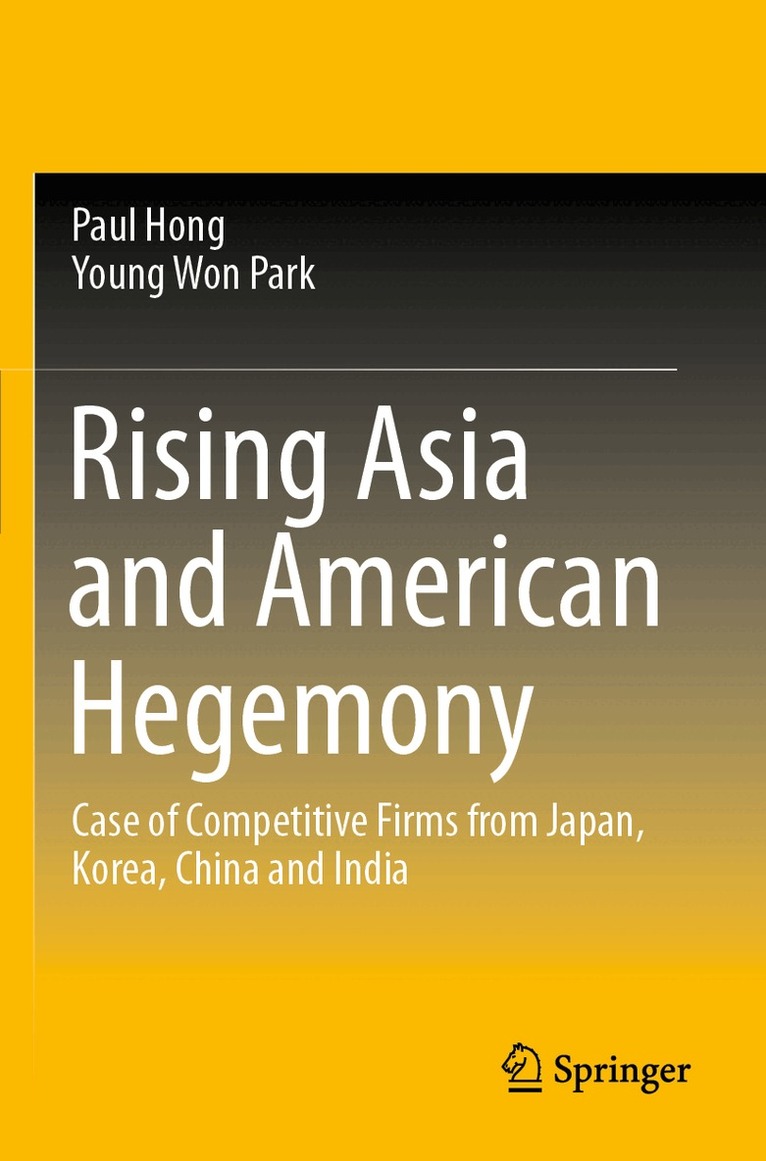
Rising Asia and American Hegemony
Case of Competitive Firms from Japan, Korea, China and India
Inbunden, 2020
1467 kr
Lägg i varukorg
This book provides an overview of evolving patterns of trade partnership with historical perspective. It presents changing requirements of industry competitiveness and explains the vital relationships between trade partnerships and industry competitiveness. As well, it further examines the …
Rising Asia and American Hegemony
Case of Competitive Firms from Japan, Korea, China and India
E-bok, 2020
1838 kr
Lägg i varukorg
This book provides an overview of evolving patterns of trade partnership with historical perspective. It presents changing requirements of industry competitiveness and explains the vital relationships between trade partnerships and industry competitiveness. As well, it further examines the …
Rising Asia and American Hegemony
Case of Competitive Firms from Japan, Korea, China and India
Häftad, 2021
1467 kr
Lägg i varukorg
This book provides an overview of evolving patterns of trade partnership with historical perspective. It presents changing requirements of industry competitiveness and explains the vital relationships between trade partnerships and industry competitiveness. As well, it further examines the …
Cosmetics Marketing Strategy in the Era of the Digital Ecosystem
Revolutionizing Beauty in the New Market Frontier
Inbunden, 2024
1580 kr
Lägg i varukorg
This book explores how cosmetics firms have made the transition to technology-enabled beauty companies to meet changing customer demands. For this purpose, the contexts of cosmetics industry growth and digital marketing strategy in the post-pandemic world are presented here. The digital marketing …
Cosmetics Marketing Strategy in the Era of the Digital Ecosystem
Revolutionizing Beauty in the New Market Frontier
E-bok, 2024
2006 kr
Lägg i varukorg
This book explores how cosmetics firms have made the transition to technology-enabled beauty companies to meet changing customer demands. For this purpose, the contexts of cosmetics industry growth and digital marketing strategy in the post-pandemic world are presented here. The digital marketing …
Cosmetics Marketing Strategy in the Era of the Digital Ecosystem
Revolutionizing Beauty in the New Market Frontier
Häftad, 2025
1580 kr
Lägg i varukorg
This book explores how cosmetics firms have made the transition to technology-enabled beauty companies to meet changing customer demands. For this purpose, the contexts of cosmetics industry growth and digital marketing strategy in the post-pandemic world are presented here. The digital marketing …
Encyclopedia of New Populism and Responses in the 21st Century
Av Joseph Chacko Chennattuserry, Madhumati Deshpande m. fl.
Inbunden, 2024
6551 kr
Lägg i varukorg
This book mainly seeks to explain, define and update the recurring forms of populism in the 21st century. Examples used in this Introduction are limited to English speaking countries. But populism's existent expressions are ecumenically global. Like any long-lasting perennial organism it is sturdy …
Encyclopedia of New Populism and Responses in the 21st Century
Av Paul Hong, Madhumati Deshpande m. fl.
E-bok, 2024
8962 kr
Lägg i varukorg
This book mainly seeks to explain, define and update the recurring forms of populism in the 21st century. Examples used in this Introduction are limited to English speaking countries. But populism''s existent expressions are ecumenically global. Like any long-lasting perennial organism it is sturdy …
Building Network Capabilities in Turbulent Competitive Environments
Practices of Global Firms from Korea and Japan
Inbunden, 2011
1311 kr
Tillfälligt slut
Since the start of the recent financial crisis, as most global firms struggle to remain competitive, an increasing number of Korean and Japanese firms have experienced an amazing rate of growth and expansion. Although academic researchers and business leaders in the United States, China, Brazil, …