Paul J. Kosmin - Böcker
Visar alla böcker från författaren Paul J. Kosmin. Handla med fri frakt och snabb leverans.
8 produkter
8 produkter
1 438 kr
Skickas inom 5-8 vardagar
This collaborative volume examines revolts and resistance to the successor states, formed after Alexander the Great's conquest of the Persian empire, as a transregional phenomenon. The editors have assembled an array of specialists in the study of the various regions and cultures of the Hellenistic world - Judea, Egypt, Babylonia, Central Asia, and Asia Minor - in an effort to trace comparisons and connections between episodes and modes of resistance. The volume seeks to unite the currently dominant social-scientific orientation to ancient resistance and revolt with perspectives, often coming from religious studies, that are more attentive to local cultural, religious, and moral frameworks. In re-assessing these frameworks, contributors move beyond Greek/non-Greek binaries to examine resistance as complex and entangled: acts and articulations of resistance are not purely nativistic or 'nationalist', but conditioned by local traditions of government, historical memories of prior periods, as well as emergent transregional Hellenistic political and cultural idioms.Cultures of Resistance in the Hellenistic East is organized into three parts. The first part investigates the Great Theban Revolt and the Maccabean Revolt, the central cases for large, organized, and prolonged military uprisings against the Hellenistic kingdoms. The second part examines the full gamut of indigenous self-assertion and resistant action, including theologies of monarchic inadequacy, patterns of historical periodization and textual interpretation, and claims to sites of authority. The volume's final part turns to the more ambiguous assertions of local autonomy and identity that emerge in the frontier regions that slipped in and out of the grasp of the great Hellenistic powers.
1 416 kr
Skickas inom 7-10 vardagar
Sardis, in western Turkey, was one of the great cities of the Aegean and Near Eastern worlds for almost a millennium—a political keystone with a legendary past. Recent archeological work has revealed how the city was transformed in the century following Alexander’s conquests from a traditional capital to a Greek polis, setting the stage for its blossoming as a Roman urban center. This integrated collection of essays by more than a dozen prominent scholars illuminates a crucial stage, from the early fourth century to 189 BCE, when it became one of the most important political centers of Asia Minor.The contributors to this volume are members of the Hellenistic Sardis Project, a research collaboration between long-standing expedition members and scholars keenly interested in the site. These new discussions on the pre-Roman history of Sardis restore the city in the scholarship of the Hellenistic East and will be enlightening to scholars of classical archaeology.
243 kr
Skickas inom 7-10 vardagar
Winner of the Runciman AwardWinner of the Charles J. Goodwin Award“Tells the story of how the Seleucid Empire revolutionized chronology by picking a Year One and counting from there, rather than starting a new count, as other states did, each time a new monarch was crowned…Fascinating.”—Harper’sIn the aftermath of Alexander the Great’s conquests, his successors, the Seleucid kings, ruled a vast territory stretching from Central Asia and Anatolia to the Persian Gulf. In 305 BCE, in a radical move to impose unity and regulate behavior, Seleucus I introduced a linear conception of time. Time would no longer restart with each new monarch. Instead, progressively numbered years—continuous and irreversible—became the de facto measure of historical duration. This new temporality, propagated throughout the empire and identical to the system we use today, changed how people did business, recorded events, and oriented themselves to the larger world.Some rebellious subjects, eager to resurrect their pre-Hellenic past, rejected this new approach and created apocalyptic time frames, predicting the total end of history. In this magisterial work, Paul Kosmin shows how the Seleucid Empire’s invention of a new kind of time—and the rebellions against this worldview—had far reaching political and religious consequences, transforming the way we organize our thoughts about the past, present, and future.“Without Paul Kosmin’s meticulous investigation of what Seleucus achieved in creating his calendar without end we would never have been able to comprehend the traces of it that appear in late antiquity…A magisterial contribution to this hitherto obscure but clearly important restructuring of time in the ancient Mediterranean world.”—G. W. Bowersock, New York Review of Books“With erudition, theoretical sophistication, and meticulous discussion of the sources, Paul Kosmin sheds new light on the meaning of time, memory, and identity in a multicultural setting.”—Angelos Chaniotis, author of Age of Conquests
415 kr
Skickas inom 7-10 vardagar
An esteemed historian explores the natural and social dynamics of the ancient coastline, demonstrating for the first time its integral place in the world of Mediterranean antiquity.As we learn from The Odyssey and the Argonauts, Greek dramas frequently played out on a watery stage. In particular, antiquity’s key events and exchanges often occurred on coastlines. Yet the shore was not just a site of conquest and trade, ire and yearning. The seacoast was a singular kind of space and was integral to the cosmology of the Greeks and their neighbors. In The Ancient Shore, award-winning historian Paul Kosmin reveals the influence of the coast on the inner lives of the ancients: their political thought, scientific notions, artistic endeavors, and myths; their sense of wonder and of self.The Ancient Shore transports readers to a time when the coast was an unpredictable, formidable site of infinite and humbling possibility. Shorelines served as points of connection and competition that fostered distinctive political identities. It was at the coast—ever violent, ever permeable to predation—that state power ended, and so the coast was fundamental to theories of sovereignty. Then too, the boundary of land and sea symbolized human limitation, making it the subject of elaborate and continuous philosophical, scientific, and religious attention.Kosmin’s ancient world is expansive, connecting the Atlantic to the Straits of Malacca, the Black Sea to the Indian Ocean. And his methods are similarly far-ranging, integrating accounts of statecraft and commerce with intellectual, literary, religious, and environmental history. The Ancient Shore is a radically new encounter with people, places, objects, and ideas we thought we knew.
347 kr
Kommande
An esteemed historian explores the natural and social dynamics of the ancient coastline, demonstrating for the first time its integral place in the world of Mediterranean antiquity.As we learn from The Odyssey and the Argonauts, Greek dramas frequently played out on a watery stage. In particular, antiquity’s key events and exchanges often occurred on coastlines. Yet the shore was not just a site of conquest and trade. The seacoast was a singular kind of space, integral to the cosmology of the Greeks and their neighbors. In The Ancient Shore, Paul Kosmin reveals the influence of the coast on the inner lives of the ancients: their political thought, scientific notions, artistic endeavors, and myths; their sense of wonder and of self.Kosmin transports readers to a time when the coast was unpredictable, formidable, infinite, and humbling. Shorelines were points of connection and competition that fostered distinctive political identities. It was at the coast—ever violent, ever permeable to predation—that state power ended, and so the coast was fundamental to theories of sovereignty. Then too, the boundary of land and sea symbolized human limitation, making it the subject of constant philosophical, scientific, and religious attention.Expansive and far-reaching, The Ancient Shore is a radically new encounter with people, places, objects, and ideas we thought we knew.
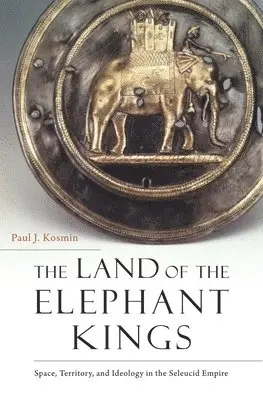
Land of the Elephant Kings
Space, Territory, and Ideology in the Seleucid Empire
Häftad, Engelska, 2018
250 kr
Skickas inom 7-10 vardagar
A Choice Outstanding Academic Title of the YearThe Seleucid Empire (311–64 BCE) was unlike anything the ancient Mediterranean and Near Eastern worlds had seen. Stretching from present-day Bulgaria to Tajikistan—the bulk of Alexander the Great’s Asian conquests—the kingdom encompassed a territory of remarkable ethnic, religious, and linguistic diversity; yet it did not include Macedonia, the ancestral homeland of the dynasty. The Land of the Elephant Kings investigates how the Seleucid kings, ruling over lands to which they had no historic claim, attempted to transform this territory into a coherent and meaningful space.“This engaging book appeals to the specialist and non-specialist alike. Kosmin has successfully brought together a number of disparate fields in a new and creative way that will cause a reevaluation of how the Seleucids have traditionally been studied.”—Jeffrey D. Lerner, American Historical Review“It is a useful and bright introduction to Seleucid ideology, history, and position in the ancient world.”—Jan P. Stronk, American Journal of Archaeology
1 018 kr
Skickas inom 5-8 vardagar
801 kr
Skickas inom 5-8 vardagar