Paul R. Josephson - Böcker
Visar alla böcker från författaren Paul R. Josephson. Handla med fri frakt och snabb leverans.
8 produkter
8 produkter
660 kr
Skickas inom 5-8 vardagar
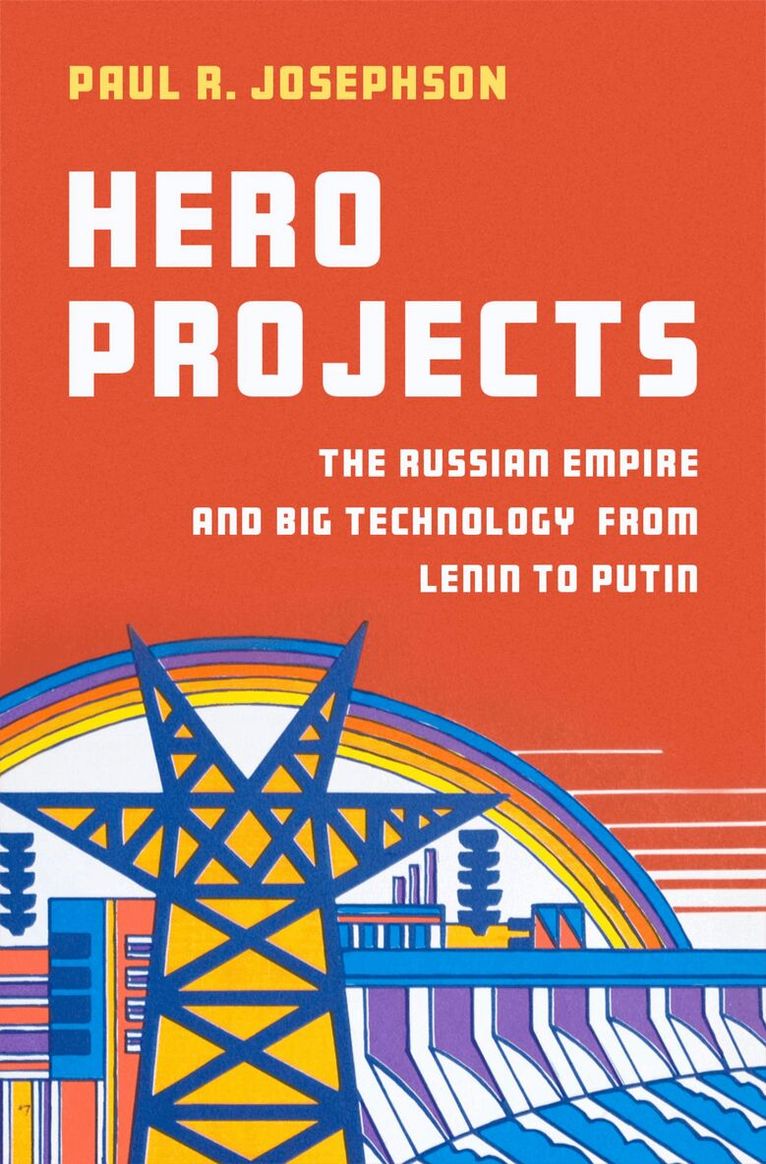
From Lenin and Stalin to Putin, Russia's economic development has relied on large scale technologies. These technologies--often called "hero projects," "projects of the century," or "megaprojects"--have been central to the nation's economic growth and military power. Despite their massive environmental and social costs, hero technologies moved ahead in service of the unbridled interests of state officials, the hubris of engineers, and the coalescence of the masses under a national ideology of glorious achievement and military grandeur. In Hero Projects, Paul R. Josephson traces how, over the last one hundred years, the Russian tsars, commissars, and oligarchs embraced megaprojects to create the world's largest empire. Built by peasants, gulag prisoners, and Communist volunteers, the wide-ranging projects--including pipelines across the tundra, railroads from Europe to the Pacific Ocean, hydropower stations and canals from the northwest to arid Central Asia, and nuclear facilities--forever altered the landscape, politics, and society. As Josephson argues, if hero projects were embraced by the public as showcasing technological wonder, they have always ultimately served to enrich the Kremlin and demonstrate the nation's technological prowess on the global stage. And they continue to be a major feature of authoritarian Russian political rule in the twenty-first century; having rebuilt Russia's resource state and pushed a self-proclaimed "renaissance" of nuclear weapons and reactors, Putin has determined in 2022 to expand the empire to its Soviet borders by war on Ukraine, in Crimea, and against Georgia and Moldova. Sweeping in scope, Hero Projects establishes the strong continuities in political culture in Russian history; reshapes the meaning of empire, extending it to include internal colonization; and expands environmental and social history through the study of big technology.
85 kr
Tillfälligt slut
Del 7 - California Studies in the History of Science
Physics and Politics in Revolutionary Russia
Inbunden, Engelska, 1991
1 002 kr
Skickas inom 3-6 vardagar
Aided by personal documents and institutional archives that were closed for decades, this book recounts the development of physics - or, more aptly, science under stress - in Soviet Russia up to World War II. Focusing on Leningrad, center of Soviet physics until the late 1930s, Josephson discusses the impact of scientific, cultural, and political revolution on physicists' research and professional aspirations. Political and social revolution in Russia threatened to confound the scientific revolution. Physicists eager to investigate new concepts of space, energy, light, and motion were forced to accommodate dialectical materialism and subordinate their interests to those of the state. They ultimately faced Stalinist purges and the shift of physics leadership to Moscow. This account of scientists cut off from their Western colleagues reveals a little-known part of the history of modern physics.
Del 9 - New Histories of Science, Technology, and Medicine
Resources under Regimes
Technology, Environment, and the State
Häftad, Engelska, 2006
297 kr
Skickas inom 10-15 vardagar
Democratic or authoritarian, every society needs clean air and water; every state must manage its wildlife and natural resources. In this provocative, comparative study, Paul R. Josephson asks to what extent the form of a government and its economy--centrally planned or market, colonial or post-colonial--determines how politicians, bureaucrats, scientists, engineers, and industrialists address environmental and social problems presented by the transformation of nature into a humanized landscape. Looking at the experiences of the industrialized and industrializing world, Resources under Regimes explores the relationship between science, technology, and the environment. Josephson considers global responses to deforestation, water pollution, and global warming, showing how different societies bring different values and assumptions to bear on the same problem, and arrive at different conclusions about the ideal outcome and the best way of achieving it. He reveals the important ways in which modern governments facilitate power generation, transportation, water production, and other technologies that improve the quality of life; and the equally critical ways in which they respond to the resulting depredations--the pollution, waste, and depletion that constitute the global environmental crisis at the beginning of the twenty-first century.
650 kr
Skickas inom 10-15 vardagar
Spanning nine time zones from Norway to the Bering Strait, the immense Russian Arctic was mostly unexplored before the twentieth century. This changed rapidly in the 1920s, when the Soviet Union implemented plans for its conquest. The Conquest of the Russian Arctic, a definitive political and environmental history of one of the world’s remotest regions, details the ambitious attempts, from Soviet times to the present, to control and reshape the Arctic, and the terrible costs paid along the way.Paul Josephson describes the effort under Stalin to assimilate the Arctic into the Soviet empire. Extraction of natural resources, construction of settlements, indoctrination of nomadic populations, collectivization of reindeer herding—all was to be accomplished so that the Arctic operated according to socialist principles. The project was in many ways an extension of the Bolshevik revolution, as planners and engineers assumed that policies and plans that worked elsewhere in the empire would apply here. But as they pushed ahead with methods hastily adopted from other climates, the results were political repression, destruction of traditional cultures, and environmental degradation. The effects are still being felt today. At the same time, scientists and explorers led the world in understanding Arctic climes and regularities.Vladimir Putin has redoubled Russia’s efforts to secure the Arctic, seen as key to the nation’s economic development and military status. This history brings into focus a little-understood part of the world that remains a locus of military and economic pressures, ongoing environmental damage, and grand ambitions imperfectly realized.
Would Trotsky Wear a Bluetooth?
Technological Utopianism under Socialism, 1917–1989
Inbunden, Engelska, 2010
885 kr
Skickas inom 5-8 vardagar
After visiting Russia in 1921, the journalist Lincoln Steffens famously declared, "I have seen the future, and it works." Steffens referred to the social experiment of technological utopianism he found in the Soviet Union, where subway cars and farm tractors would carry the worker and peasant-figuratively and literally-into the twentieth century. Believing that socialism and technology together created a brave new world, Boleslaw Bierut of Poland and Kim Il Sung of North Korea-and other leaders-joined Russia's Vladimir Lenin and Leon Trotsky in embracing big technology with a verve and conviction that rivaled the western world's. Paul R. Josephson here explores these utopian visions of technology-and their unanticipated human and environmental costs. He examines the role of technology in communist plans and policies and the interplay between ideology and technological development. He shows that while technology was a symbol of regime legitimacy and an engine of progress, the changes it spurred were not unequivocally positive.Instead of achieving a worker's paradise, socialist technologies exposed the proletariat to dangerous machinery and deadly pollution; rather than freeing women from exploitation in family and labor, they paradoxically created for them the dual-and exhausting-burdens of mother and worker. The future did not work. The fall of the Soviet Union in 1991 marked the end of communism's self-proclaimed glorious quest to "reach and surpass" the West. Josephson's intriguing study of how technology both helped and hindered this effort asks new and important questions about the crucial issues inextricably linked with the development and diffusion of technology in any sociopolitical system.
Fish Sticks, Sports Bras, and Aluminum Cans
The Politics of Everyday Technologies
Häftad, Engelska, 2016
363 kr
Skickas inom 7-10 vardagar
Who would have guessed that the first sports bra was made out of two jockstraps sewn together or that it succeeded because of federal anti-discrimination laws? What do simple decisions about where to build a road or whether to buy into the carbon economy have to do with Hurricane Katrina or the Fukushima nuclear disaster? How did massive flood control projects on the Mississippi River and New Deal dams on the Columbia River lead to the ubiquity of high fructose corn syrup? And what explains the creation-and continued popularity-of the humble fish stick? In Fish Sticks, Sports Bras, and Aluminum Cans, historian Paul R Josephson explores the surprising origins, political contexts, and social meanings of ordinary objects. Drawing on archival materials, technical journals, interviews, and field research, this engaging collection of essays reveals the forces that shape (and are shaped by) everyday objects. Ultimately, Josephson suggests that the most familiar and comfortable objects-sugar and aluminum, for example, which are inextricably tied together by their linked history of slavery and colonialism-may have the more astounding and troubling origins.Students of consumer studies and the history of technology, as well as scholars and general readers, will be captivated by Josephson's insights into the complex relationship between society and technology.
144 kr
Skickas inom 7-10 vardagar
Why has the chicken become the meat par excellence, the most plentifully eaten and popular animal protein in the world, consumed from Beijing to Barcelona? As renowned historian Paul Josephson shows, the story of the chicken's rise involves a whole host of factors; from art, to nineteenth-century migration patterns to cold-war geopolitics. And whereas sheep needed too much space, or the cow was difficult to transport, these compact, lightweight birds produced relatively little waste, were easy to transport and could happily peck away in any urban back garden.Josephson tells this story from all sides: the transformation of the chicken from backyard scratcher to hyper-efficient industrial meat-product has been achieved due to the skill of entrepreneurs who first recognized the possibilities of chicken meat and the gene scientists who bred the plumpest and most fertile birds. But it has also been forced through by ruthless capitalists and lobbyists for “big farmer”, at the expense of animal welfare and the environment. With no sign of our lust for chicken abating, we're now reaching a crisis point: billions of birds are slaughtered every year, after having lived lives that are nasty, brutish and short. The waste from these victims is polluting rivers and poisoning animals. We’re now plunging “egg-first” into environmental disaster.Alongside this story Josephson tells another, of an animal with endearing characteristics who, arguably, can lay claim to being man’s best friend long before the dog reared its snout or the cat came in from the cold. Lionized in medieval romances and modern cartoons, the chicken’s relationship to humanity runs deep; by treating these animals as mere food products, we become less than human.