Paula Smithka – författare
Visar alla böcker från författaren Paula Smithka. Handla med fri frakt och snabb leverans.
4 produkter
4 produkter
Häftad, Engelska, 2010
190 kr
Skickas inom 3-6 vardagar
In Doctor Who and Philosophy, a team of mostly human philosophers (who are also fans) looks at the deeper issues raised by the Doctor's mind-blowing adventures. They discuss, among other topics, the Doctor's philosophy of science, the ethics of a universe with millions of intelligent species, what makes one life-form more important than another, whether time travelers can change history, and how the Doctor Who TV show is changing the world we live in. The chapters draw freely on both the classic series (1963--1989) and the new series. The book includes a collection of entertaining and insightful quotes from Doctor Who plus a complete list of episodes and companions.
E-bok
Engelska, 2010273 kr
Läs direkt efter köp
Not only is Doctor Who the longest-running science fiction television show in history, but it has also been translated into numerous languages, broadcast around the world, and referred to as the “way of the future” by some British political leaders. The old (or Classic) Doctor Who series built up a loyal American cult following, with regular conventions and other activities. The new series, relaunched in 2005, has emerged from culthood into mass awareness, with a steadily growing viewership and major sales of DVDs. The current series, featuring the Eleventh Doctor, Matt Smith, is breaking all earlier records, in both the UK and the US. Doctor Who is a continuing story about the adventures of a mysterious alien known as “the Doctor,” a traveller of both time and space whose spacecraft is the TARDIS (Time and Relative Dimensions in Space), which from the outside looks like a British police telephone box of the 1950s. The TARDIS is “bigger on the inside than on the outside”—actually the interior is immense. The Doctor looks human, but has two hearts, and a knowledge of all languages in the universe. Periodically, when the show changes the leading actor, the Doctor “regenerates,” changing his body and his personality quirks, but retaining all his memories. Regeneration causes the Doctor to be temporarily disoriented and weakened, both before and after. The Doctor usually has one or more companions, most often attractive young females, who also change from time to time, giving the Doctor the opportunity to explain some basic facts about himself to the new companion. The Doctor is a Time Lord from the planet Gallifrey and battles various evil forces in the universe, including the nasty robot Daleks and The Master, a renegade Time Lord.2010 will see the release of four other major books about Doctor Who, but they are addressed to academic readers whereas Doctor Who and Philosophy, like other volumes in the Popular Culture and Philosophy series, is aimed at thoughtful fans.For almost fifty years Doctor Who has brought both entertainment and philosophy into millions of households through television, comics, magazines, books, and the internet. Doctor Who’s cultural relevance and the deep conviction that it inspires in fans suggests that it successfully portrays philosophical themes that are important to individuals. Now, more than ever, the philosophical themes found in Doctor Who need to be explained and understood.Doctor Who and Philosophy contains contributions from some of the sharpest minds in philosophy. Everyone involved was dedicated to producing a work that would honor both Doctor Who and the art of philosophy, and it doesn’t take long for the reader to realize the quality of work contained within the volume. The book starts by examining issues of personal identity and how the Doctor provides valuable insights into how we should understand “who” we are. Next, the volume discusses Doctor Who’s representation of science, logic, speciesism, perception, physics, and causation. After discussing several fascinating issues from the philosophy of science, the volume moves on to a wonderful discussion of ethics. In this section, the reader receives both a nice introduction to ethics and some important insights into how the Doctor tells us to live the good life. The final two chapters deal with human existence and aesthetics. Both chapters complement each other by giving readers a discussion of how Doctor Who illuminates several philosophically important features of what it means to be human and how one should understand the beauty, the fear, and the excitement of existence. The end of the volume includes two bonuses. First, there is a collection of insightful quotes from the Classic and New serie
Häftad, Engelska, 2015
245 kr
Skickas inom 3-6 vardagar
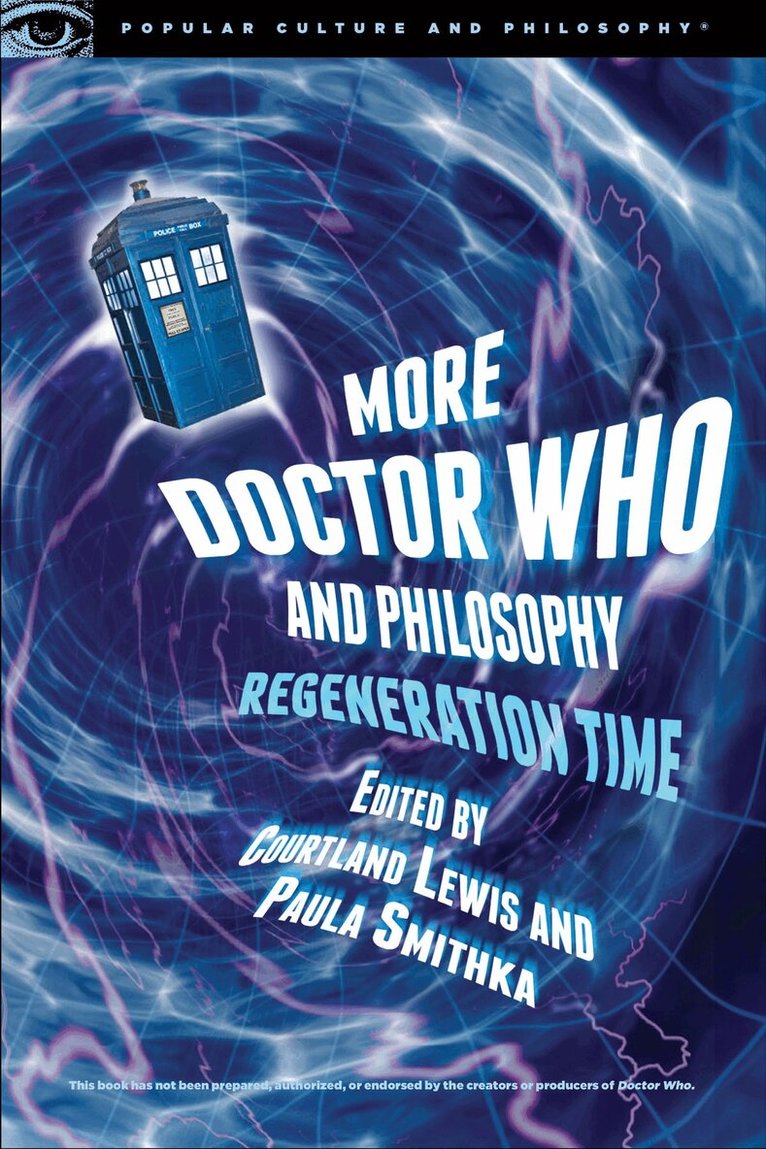
More Doctor Who and Philosophy is a completely new collection of chapters, additional to Doctor Who and Philosophy (2010), by the same editors. Since that first Doctor Who and Philosophy, much has happened in the Whoniverse: a new and controversial regeneration of the Doctor, multiple new companions, a few creepy new enemies of both the Doctor and planet Earth. New questions have been raised and new questioners have come along, so there are plenty of new topics for philosophical scrutiny. Is the "impossible" girl really impossible? Is there anything wrong with an inter-species lesbian relationship (the kids weren't quite ready for that in 1963, but no one blinks an eye in 2015)? Can it really be right for the Doctor to lie and to selectively forget? We even have two authors who have figured out how to build a TARDIS -- instructions included! An added feature of this awesome new volume is that the editors have reached out to insiders of Who fandom, people who run hugely successful Who conventions, play in Who-inspired bands, and run wildly popular podcasts and websites, to share their privileged insights into why the Doctor is so philosophically deep.
E-bok
Engelska, 2015224 kr
Läs direkt efter köp
More Doctor Who and Philosophy is a completely new collection of chapters, additional to Doctor Who and Philosophy (2010) by the same editors. Since that first Doctor Who and Philosophy, much has happened in the Whoniverse: a new and controversial regeneration of the Doctor, multiple new companions, a few creepy new enemies of both the Doctor and planet Earth. And the show’s fiftieth anniversary! We’ve learned some astounding new things from the ever-developing story: that the Doctor’s number one rule is to lie, that he claims to have forgotten his role in the mass extermination of the Time Lords and the Daleks, that the Daleks do have a concept of divine beauty (divine hatred, of course), and that Daleks may become insane (didn’t we assume they already were?) Oh, and the cult of the Doctor keeps growing worldwide, with more cultish fans in the US, more and bigger Who conventions, more viewers of all ages, and more serious treatment by scholars from many disciplines. New questions have been raised and new questioners have come along, so there are plenty of new topics for philosophical scrutiny. Is the “impossible” girl really impossible? Is there anything wrong with an inter-species lesbian relationship (the kids weren’t quite ready for that in 1963, but no one blinks an eye in 2015)? Can it really be right for the Doctor to lie and to selectively forget? We even have two authors who have figured out how to build a TARDIS—instructions included! (Wait, there’s a catch, no . . . ?) And then there’s that old question that just won’t go away: why does the Doctor always regenerate as a male, and is that ever going to change? An added feature of this awesome new volume is that the editors have reached out to insiders of Who fandom, people who run hugely successful Who conventions, play in Who-inspired bands, and run wildly popular podcasts and websites, to share their privileged insights into why the Doctor is so philosophically deep. No more spoilers. It’s time for the truly thoughtful travelers in both time and space to rev up the TARDIS once more. . . . Allons-y, Alonzo!