Peter Elbow - Böcker
Visar alla böcker från författaren Peter Elbow. Handla med fri frakt och snabb leverans.
11 produkter
11 produkter
278 kr
Skickas inom 5-8 vardagar
Peter Elbow's widely acclaimed and original theories on the writing process, set forth in Writing without Teachers and Writing with Power, have earned him a reputation as a leading educational innovator. For this book Elbow has drawn together twelve of his essays on the nature of learning and teaching to suggest a comprehensive philosophy of education.
Everyone Can Write
Essays Toward a Hopeful Theory of Writing and Teaching Writing
Inbunden, Engelska, 2000
1 877 kr
Skickas inom 5-8 vardagar
With Writing without Teachers (OUP 1975) and Writing with Power (OUP 1995) Peter Elbow revolutionized the teaching of writing. His process method--and its now commonplace "free writing" techniques--liberated generations of students and teachers from the emphasis on formal principles of grammar that had dominated composition pedagogy.This new collection of essays brings together the best of Elbow's writing since the publication of Embracing Contraries in 1987. The volume includes sections on voice, the experience of writing, teaching, and evaluation. Implicit throughout is Elbow's commitment to humanizing the profession, and his continued emphasis on the importance of binary thinking and nonadversarial argument. The result is a compendium of a master teacher's thought on the relation between good pedagogy and good writing; it is sure to be of interest to all professional teachers of writing, and will be a valuable book for use in composition courses at all levels.
Everyone Can Write
Essays Toward a Hopeful Theory of Writing and Teaching Writing
Häftad, Engelska, 2000
488 kr
Skickas inom 5-8 vardagar
With Writing without Teachers (OUP 1975) and Writing with Power (OUP 1995) Peter Elbow revolutionized the teaching of writing. His process method--and its now commonplace "free writing" techniques--liberated generations of students and teachers from the emphasis on formal principles of grammar that had dominated composition pedagogy. This new collection of essays brings together the best of Elbow's writing since the publication of Embracing Contraries in 1987. The volume includes sections on voice, the experience of writing, teaching, and evaluation. Implicit throughout is Elbow's commitment to humanizing the profession, and his continued emphasis on the importance of binary thinking and nonadversarial argument. The result is a compendium of a master teacher's thought on the relation between good pedagogy and good writing; it is sure to be of interest to all professional teachers of writing, and will be a valuable book for use in composition courses at all levels.
157 kr
Skickas
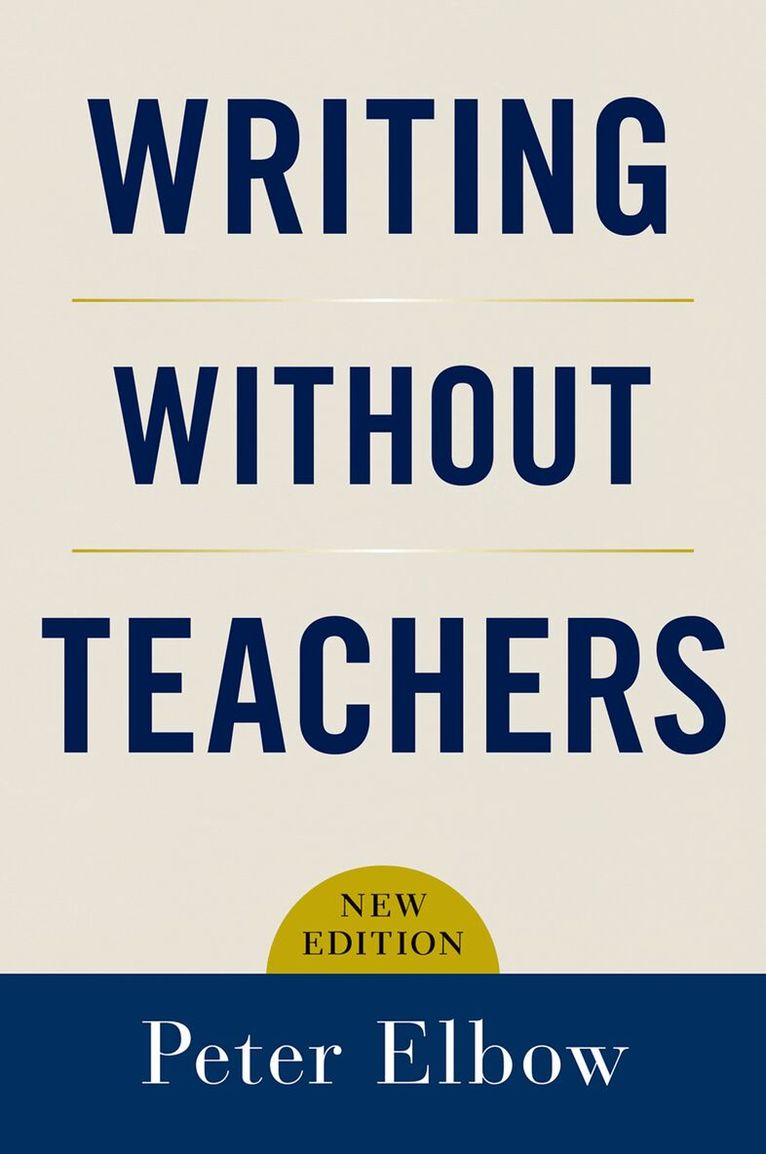
In Writing Without Teachers, well-known advocate of innovative teaching methods Peter Elbow outlines a practical program for learning how to write. His approach is especially helpful to people who get "stuck" or blocked in their writing, and is equally useful for writing fiction, poetry, and essays, as well as reports, lectures, and memos.The core of Elbow's thinking is a challenge against traditional writing methods. Instead of editing and outlining material in the initial steps of the writing process, Elbow celebrates non-stop or free uncensored writing, without editorial checkpoints first, followed much later by the editorial process. This approach turns the focus towards encouraging ways of developing confidence and inspiration through free writing, multiple drafts, diaries, and notes. Elbow guides the reader through his metaphor of writing as "cooking:" his term for heating up the creative process where the subconscious bubbles up to the surface and the writing gets good.1998 marks the twenty-fifth anniversary of Writing Without Teachers. In this edition, Elbow reexamines his program and the subsequent influence his techniques have had on writers, students, and teachers. This invaluable guide will benefit anyone, whether in the classroom, boardroom, or living room, who has ever had trouble writing.
462 kr
Skickas inom 5-8 vardagar
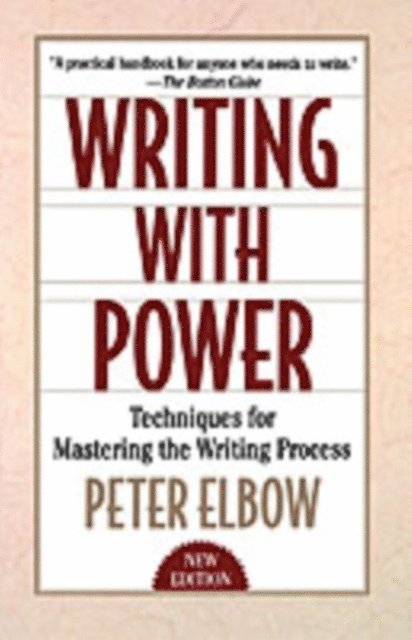
Writing with Power is a guide for the student writing an essay, the professional writer working on a story, or the manager writing a memo for a tight deadline. As Elbow explains, `Writing with power doesn't just mean getting power over readers. It means getting power over yourself and over the writing process.' For the second edition, Elbow has written a new introduction in which he discusses in detail the `mysterious' dimensions of `Writing with Power' -- voice, quality and bad writing, wrongness and felt sense, and sharing written work with others.
183 kr
Skickas
Writing with Power is a guide for the student writing an essay, the professional writer working on a story, or the manager writing a memo for a tight deadline. As Elbow explains, "Writing with power doesn't just mean getting power over readers. It means getting power over yourself and over the writing process: knowing what you are doing as you write; figuring out what you really mean; being in charge, having control; not feeling stuck or helpless or intimidated. I am particularly interested in this second kind of power in writing, and I have found that without it you seldom achieve the first kind". For the second edition, Elbow has written a new introduction in which he discusses in detail the "mysterious" dimensions of "Writing with Power" - voice, quality and bad writing, wrongness and felt sense, and sharing written work with others.
2 221 kr
Skickas inom 5-8 vardagar
Since the publication of his groundbreaking books Writing Without Teachers and Writing with Power, Peter Elbow has revolutionized the way we think about writing. As a theorist, teacher, and uncommonly engaging writer himself, he has long championed our innate ability to write effectively. Now, in Vernacular Eloquence, Elbow turns his attention to the role of the spoken word in writing. He begins by questioning the basic cultural assumption that speaking and writing are two very different, incompatible modes of expression, and that we should keep them separate. The book explores the many linguistic and rhetorical virtues of speech--spontaneity, naturalness of expression, fluidity of thought--to show that many of these virtues can usefully be brought to writing. Elbow suggests that we begin the writing process by "speaking " our words onto the page, letting the words and ideas flow without struggling to be "correct. " Speaking can help us at the later stages of writing, too, as we read drafts aloud and then revise until the language feels right in the mouth and sounds right in the ear. The result is stronger, clearer, more natural writing that avoids the stilted, worried-over quality that so often alienates (and bores) the reader. Elbow connects these practices to a larger theoretical discussion of literacy in our culture, arguing that our rules for correct writing make it harder than necessary to write well. In particular, our culture's conception of proper writing devalues the human voice, the body, and the linguistic power of people without privilege. Written with Elbow's customary verve and insight, Vernacular Eloquence shows how to bring the pleasures we all enjoy in speaking to the all-too-often needlessly arduous task of writing.
301 kr
Skickas inom 7-10 vardagar
Since the publication of his groundbreaking books Writing Without Teachers and Writing with Power, Peter Elbow has revolutionized the way we think about writing. As a theorist, teacher, and uncommonly engaging writer himself, he has long championed our innate ability to write effectively. Now, in Vernacular Eloquence, Elbow turns his attention to the role of the spoken word in writing. He begins by questioning the basic cultural assumption that speaking and writing are two very different, incompatible modes of expression, and that we should keep them separate. The book explores the many linguistic and rhetorical virtues of speech--spontaneity, naturalness of expression, fluidity of thought--to show that many of these virtues can usefully be brought to writing. Elbow suggests that we begin the writing process by "speaking " our words onto the page, letting the words and ideas flow without struggling to be "correct. " Speaking can help us at the later stages of writing, too, as we read drafts aloud and then revise until the language feels right in the mouth and sounds right in the ear. The result is stronger, clearer, more natural writing that avoids the stilted, worried-over quality that so often alienates (and bores) the reader. Elbow connects these practices to a larger theoretical discussion of literacy in our culture, arguing that our rules for correct writing make it harder than necessary to write well. In particular, our culture's conception of proper writing devalues the human voice, the body, and the linguistic power of people without privilege. Written with Elbow's customary verve and insight, Vernacular Eloquence shows how to bring the pleasures we all enjoy in speaking to the all-too-often needlessly arduous task of writing.
2 371 kr
Skickas inom 10-15 vardagar
Classical rhetoric was originally all about speech; then as the new technology emerged, it took an interest in writing. We are at a kind of mirror moment now. The present field of composition and rhetoric has been preoccupied with writing for the last fifty or more years, but scholars are looking once again at speech and how it relates to writing.At this moment, then, we are inheritors of research showing that writing can be thought of as different and yet not different from speech. In this Landmark Essays volume, Peter Elbow, a leading expert on speech and writing, gathers a selection of classic essays that show the main streams of thinking that scholars have published about speech and writing. Through the interdisciplinary essays included, he invites readers to think critically about the relationship between speech, writing, and our notion of literacy.
939 kr
Skickas inom 10-15 vardagar
Classical rhetoric was originally all about speech; then as the new technology emerged, it took an interest in writing. We are at a kind of mirror moment now. The present field of composition and rhetoric has been preoccupied with writing for the last fifty or more years, but scholars are looking once again at speech and how it relates to writing.At this moment, then, we are inheritors of research showing that writing can be thought of as different and yet not different from speech. In this Landmark Essays volume, Peter Elbow, a leading expert on speech and writing, gathers a selection of classic essays that show the main streams of thinking that scholars have published about speech and writing. Through the interdisciplinary essays included, he invites readers to think critically about the relationship between speech, writing, and our notion of literacy.
722 kr
Skickas inom 10-15 vardagar
Section 1 of this volume describes three major debates about voice. They include: * the overarching debate: discourse as text vs. discourse as voice; * the traditional debate in rhetoric: ethos as real virtue in the real person vs. ethos as the appearance of virtue; and * the modern debate: voice as self vs. voice as role. These debates involve large, ideological questions about the nature of self or identity and about the relation of the text to the writer. They are all the more troublesome and unresolvable because they tend to be cast in binary, either/or terms. Section 2 responds to these debates by showing that they don't need to be resolved in either/or terms. Looking carefully at the term voice shows that it has some fairly noncontroversial meanings when applied to writing. Thus, most of this section is devoted to an extended exploration of a family of five meanings for the term voice in writing -- audible voice or information, dramatic voice, recognizable or distinctive voice, voice with authority, and resonant voice or presence. These meanings make the concept of voice solid and usable apart from the theoretical debates. The two theoretical debates only come up in relatively circumscribed arenas and so don't muddy most uses of the concept of voice in writing. In short, Elbow's hope is that he can make descriptive claims about the meanings of voice in writing about which people from various ideological camps will be able to agree.