Peter Hellekalek – författare
Visar alla böcker från författaren Peter Hellekalek. Handla med fri frakt och snabb leverans.
4 produkter
4 produkter
Del 127 - Lecture Notes in Statistics
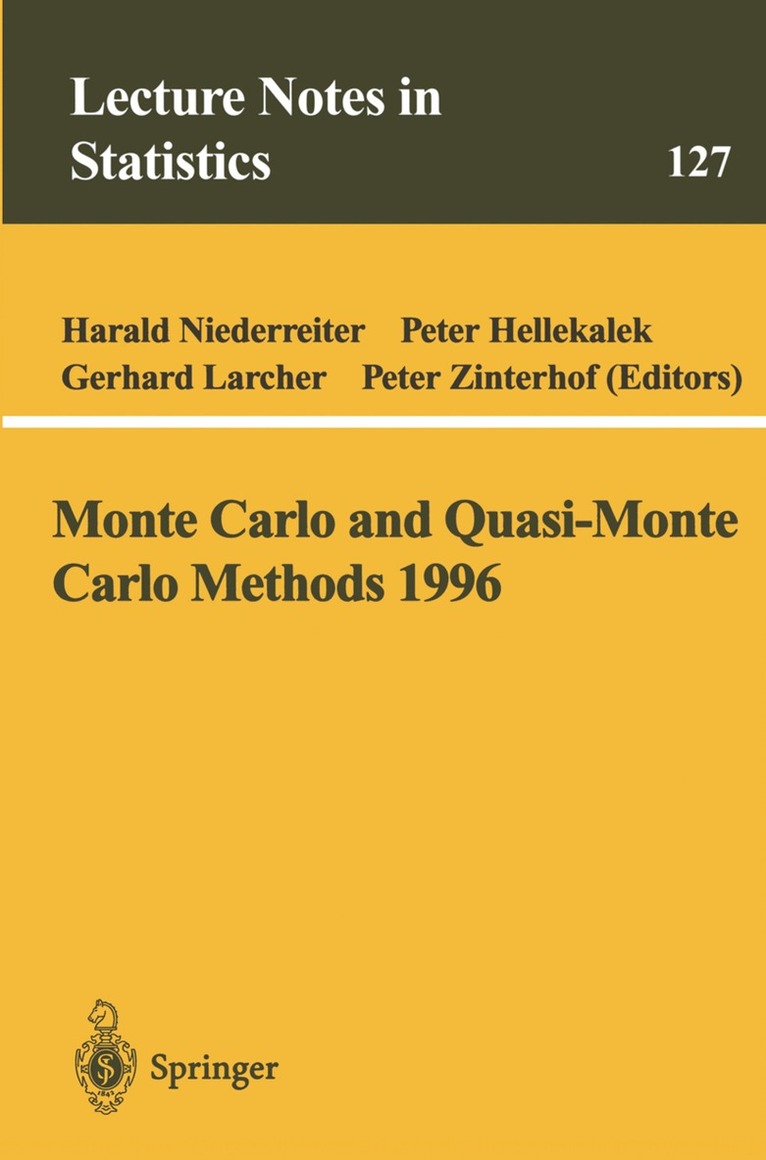
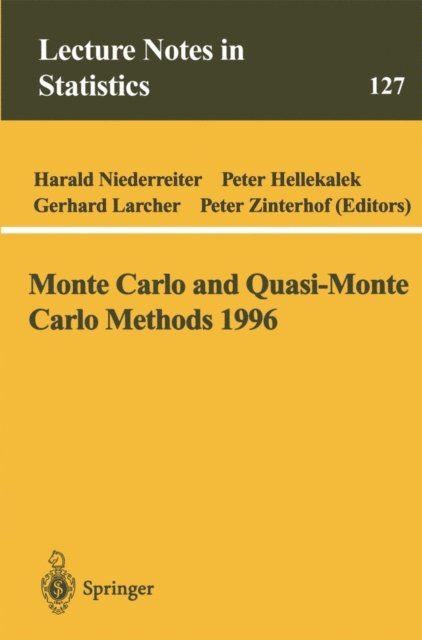
Monte Carlo and Quasi-Monte Carlo Methods 1996
Proceedings of a Conference at the University of Salzburg, Austria, July 9-12, 1996
Häftad, Engelska, 1997
548 kr
Skickas inom 10-15 vardagar
Monte Carlo methods are numerical methods based on random sampling and quasi-Monte Carlo methods are their deterministic versions. This volume contains the refereed proceedings of the Second International Conference on Monte Carlo and Quasi-Monte Carlo Methods in Scientific Computing which was held at the University of Salzburg (Austria) from July 9--12, 1996. The conference was a forum for recent progress in the theory and the applications of these methods. The topics covered in this volume range from theoretical issues in Monte Carlo and simulation methods, low-discrepancy point sets and sequences, lattice rules, and pseudorandom number generation to applications such as numerical integration, numerical linear algebra, integral equations, binary search, global optimization, computational physics, mathematical finance, and computer graphics. These proceedings will be of interest to graduate students and researchers in Monte Carlo and quasi-Monte Carlo methods, to numerical analysts, and to practitioners of simulation methods.
Del 138 - Lecture Notes in Statistics
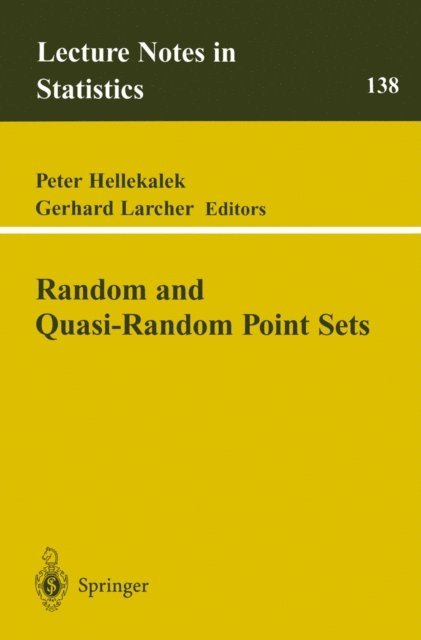
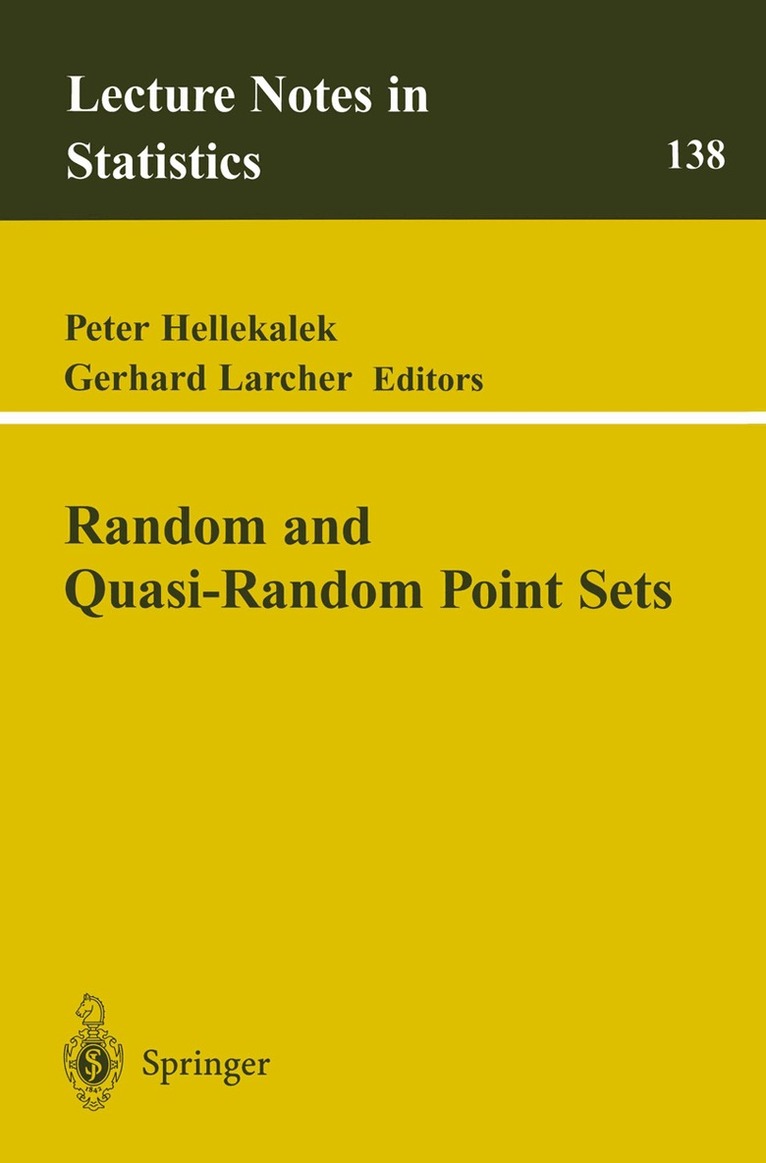
Random and Quasi-Random Point Sets
Häftad, Engelska, 1998
1 089 kr
Skickas inom 10-15 vardagar
This book sumarizes recent theoretical and practical developments. The generation and the assessment of pseudo- and quasi-random point sets is one of the basic tasks of applied mathematics and statistics, with implications for Monte Carlo methods, stochastic simulation, and applied statistics. They are also of strong theoretical interest, with applications to algebraic geometry, metric number theory, probability theory, and cryptology.
E-bok
PDF, Engelska, 2012687 kr
Läs direkt efter köp
Monte Carlo methods are numerical methods based on random sampling and quasi-Monte Carlo methods are their deterministic versions. This volume contains the refereed proceedings of the Second International Conference on Monte Carlo and Quasi-Monte Carlo Methods in Scientific Computing which was held at the University of Salzburg (Austria) from July 9--12, 1996. The conference was a forum for recent progress in the theory and the applications of these methods. The topics covered in this volume range from theoretical issues in Monte Carlo and simulation methods, low-discrepancy point sets and sequences, lattice rules, and pseudorandom number generation to applications such as numerical integration, numerical linear algebra, integral equations, binary search, global optimization, computational physics, mathematical finance, and computer graphics. These proceedings will be of interest to graduate students and researchers in Monte Carlo and quasi-Monte Carlo methods, to numerical analysts, and to practitioners of simulation methods.
E-bok
PDF, Engelska, 20121 367 kr
Läs direkt efter köp
This volume is a collection of survey papers on recent developments in the fields of quasi-Monte Carlo methods and uniform random number generation. We will cover a broad spectrum of questions, from advanced metric number theory to pricing financial derivatives. The Monte Carlo method is one of the most important tools of system modeling. Deterministic algorithms, so-called uniform random number gen erators, are used to produce the input for the model systems on computers. Such generators are assessed by theoretical ("a priori") and by empirical tests. In the a priori analysis, we study figures of merit that measure the uniformity of certain high-dimensional "random" point sets. The degree of uniformity is strongly related to the degree of correlations within the random numbers. The quasi-Monte Carlo approach aims at improving the rate of conver gence in the Monte Carlo method by number-theoretic techniques. It yields deterministic bounds for the approximation error. The main mathematical tool here are so-called low-discrepancy sequences. These "quasi-random" points are produced by deterministic algorithms and should be as "super" uniformly distributed as possible. Hence, both in uniform random number generation and in quasi-Monte Carlo methods, we study the uniformity of deterministically generated point sets in high dimensions. By a (common) abuse oflanguage, one speaks of random and quasi-random point sets. The central questions treated in this book are (i) how to generate, (ii) how to analyze, and (iii) how to apply such high-dimensional point sets.