Peter Kovács – författare
Visar alla böcker från författaren Peter Kovács. Handla med fri frakt och snabb leverans.
6 produkter
6 produkter
Inbunden, Engelska, 1993
1 633 kr
Skickas inom 10-15 vardagar
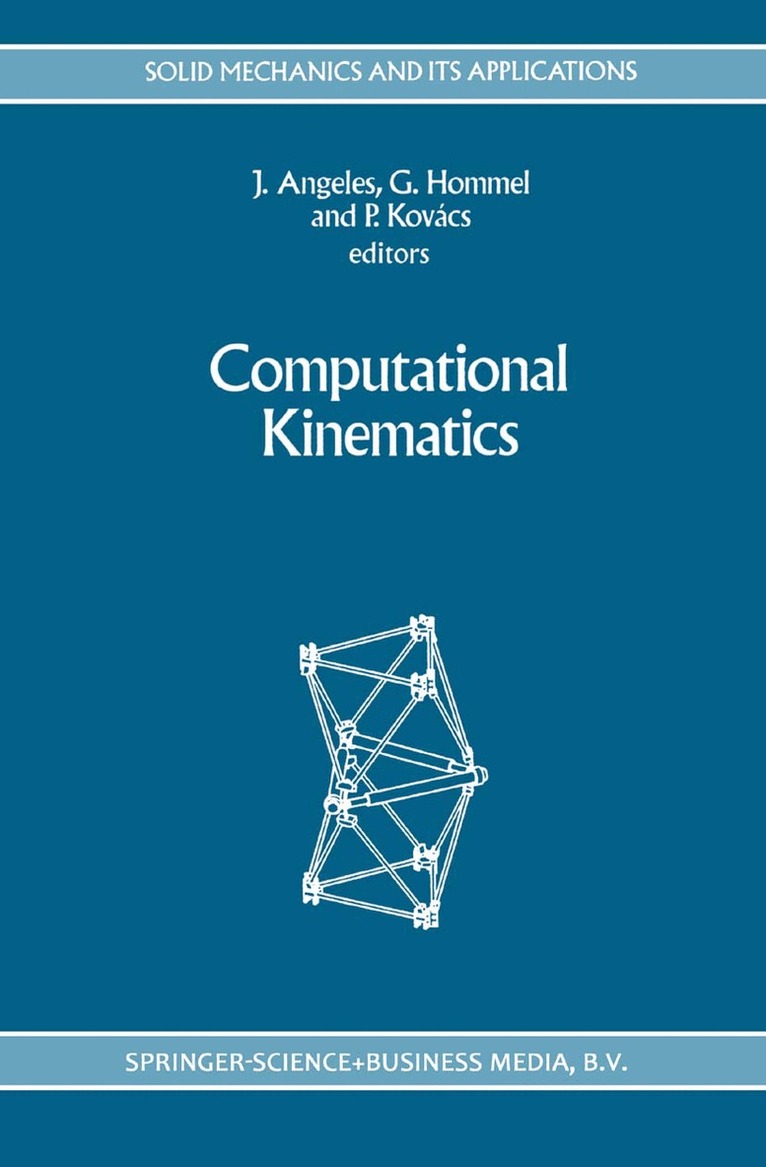
This volume provides an account of developments in computational kinematics. Included are both numerical computations and symbolic manipulations. The volume reports on trends and progress in a broad class of problems, and the information is collated into six parts describing the main themes: (i) kinematic algorithms, whereby general kinematic problems are discussed in light of their solution algorithms; (ii) redundant manipulators; (iii) kinematic and dynamic control, in which the link between kinematics and the disciplines of dynamics and control is highlighted; (iv) parallel manipulators; (v) motion planning, touching on computational geometry; and (vi) kinematics of mechanisms, describing the closed kinematic chains. The volume contains a representative sample of current techniques available for kinematics problems. It should be of interest to researchers, graduate students and practising engineers engaged in work relating to kinematics, robotics, machine design and computer science.
Häftad, Ungerska, 2023
385 kr
Skickas inom 5-8 vardagar
Del 308 - Mnemosyne, Supplements, History and Archaeology of Classical Antiquity
Marcus Aurelius’ Rain Miracle and the Marcomannic Wars
Inbunden, Engelska, 2008
2 718 kr
Skickas inom 5-8 vardagar
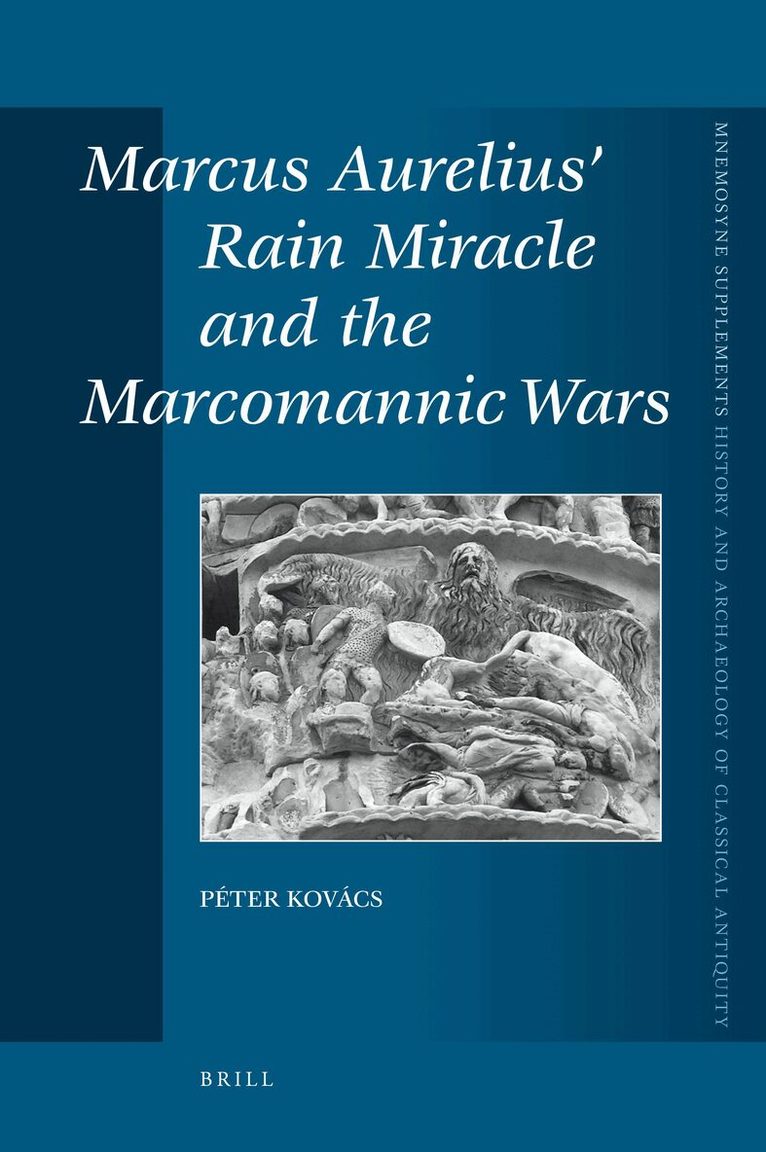
The longest war of the Roman imperial period is the war Marcus Aurelius waged with the northern German and Sarmatian tribes. The best-known events of these wars were the lightning and rain miracles. Divine intervention saved the Roman troops who were surrounded by the Germans and suffering from a water shortage, by means of a lightning and rain miracle. Thunderbolts struck the enemy while the rain soothed the Romans’ suffering. Several pagan and Christian versions of the miracle existed already in Antiquity. Péter Kovács examines these events and their sources in detail. The most important source is the Column of Marcus Aurelius in Rome. The scenes of the column depict the miracles as well and therefore it was studied separately. The author also sketches the history of the Marcomannic wars. He publishes all the sources of the miracles and examines the development of the legend from Antiquity to the 14th century.
E-bok
PDF, Franska, 2024259 kr
Läs direkt efter köp
La concretisation tant attendue des engagements de l'ONU des annees 1946-1948 a abouti a la creation de la Cour penale internationale (CPI). Celle-ci a ete mise en place par les Etats participants a la Conference diplomatique de Rome en 1998 dans le but de servir de mecanisme permanent pour traduire en justice les auteurs des crimes les plus horribles. Son objectif est egalement de dissuader ceux qui croient en la perpetuation d'un climat d'impunite pour la commission de tels crimes. Cet ouvrage vise a fournir une breve introduction sur le fonctionnement des mecanismes de la CPI en tant qu'instance judiciaire agissant selon le principe de complementarite. Il se concentre particulierement sur un des aspects du fonctionnement, a savoir la position et les droits respectifs des personnes impliquees dans les procedures et les proces en tant qu'accuse, victime ou temoin. Les droits des accuses et des victimes sont principalement exposes a travers les decisions de la chambre d'appel de la CPI. En suivant les grandes lignes de la reparation des victimes, le lecteur pourra egalement apprehender les difficultes et les progres rencontres lors de l'application des principes juridiques abstraits sur le terrain.
Häftad, Engelska, 2010
1 633 kr
Skickas inom 10-15 vardagar
The aim of this book is to provide an account of the state of the art in Com putational Kinematics. We understand here under this term ,that branch of kinematics research involving intensive computations not only of the numer ical type, but also of a symbolic nature. Research in kinematics over the last decade has been remarkably ori ented towards the computational aspects of kinematics problems. In fact, this work has been prompted by the need to answer fundamental question s such as the number of solutions, whether real or complex, that a given problem can admit. Problems of this kind occur frequently in the analysis and synthesis of kinematic chains, when finite displacements are considered. The associated models, that are derived from kinematic relations known as closure equations, lead to systems of nonlinear algebraic equations in the variables or parameters sought. What we mean by algebraic equations here is equations whereby the unknowns are numbers, as opposed to differen tial equations, where the unknowns are functions. The algebraic equations at hand can take on the form of multivariate polynomials or may involve trigonometric functions of unknown angles. Because of the nonlinear nature of the underlying kinematic models, purely numerical methods turn out to be too restrictive, for they involve iterative procedures whose convergence cannot, in general, be guaranteed. Additionally, when these methods converge, they do so to only isolated solu tions, and the question as to the number of solutions to expect still remains.
E-bok
PDF, Engelska, 20131 977 kr
Läs direkt efter köp
The aim of this book is to provide an account of the state of the art in Com putational Kinematics. We understand here under this term ,that branch of kinematics research involving intensive computations not only of the numer ical type, but also of a symbolic nature. Research in kinematics over the last decade has been remarkably ori ented towards the computational aspects of kinematics problems. In fact, this work has been prompted by the need to answer fundamental question s such as the number of solutions, whether real or complex, that a given problem can admit. Problems of this kind occur frequently in the analysis and synthesis of kinematic chains, when finite displacements are considered. The associated models, that are derived from kinematic relations known as closure equations, lead to systems of nonlinear algebraic equations in the variables or parameters sought. What we mean by algebraic equations here is equations whereby the unknowns are numbers, as opposed to differen tial equations, where the unknowns are functions. The algebraic equations at hand can take on the form of multivariate polynomials or may involve trigonometric functions of unknown angles. Because of the nonlinear nature of the underlying kinematic models, purely numerical methods turn out to be too restrictive, for they involve iterative procedures whose convergence cannot, in general, be guaranteed. Additionally, when these methods converge, they do so to only isolated solu tions, and the question as to the number of solutions to expect still remains.