Peter Mogelvang-Hansen – författare
652 kr
Läs direkt efter köp
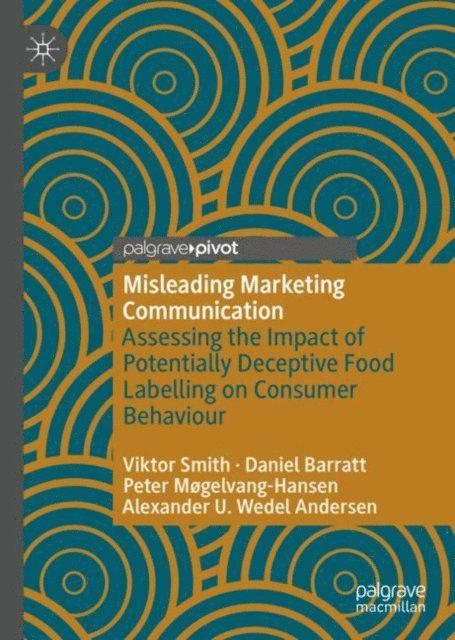
Using the case of food labelling, this book demonstrates that the line between fair and potentially misleading communication can be approached in empirical terms, supplementing the predominantly political and legal deliberations that determine how society deals with these issues.
By first critically reviewing the legal conception of misleading commercial practices manifest in EU law, the authors discuss whether and how it can be transposed into empirically measurable terms. Presenting four complementary experimental studies targeting recurrent grey-zone scenarios on the Danish food market, the book illustrates the potential of the so-called ShopTrip test paradigm which simulates and registers real-life e-shopping behaviour as it unfolds while yielding new types of data against which opposing assessments of potential misleadingness can be matched. The results are discussed in the light of possible paths of theoretical explanation and implications for future regulative practices, including companies’ self-regulation.
939 kr
Läs direkt efter köp
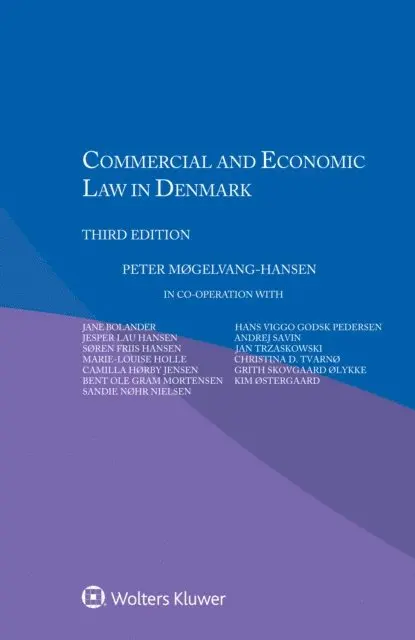
Derived from the renowned multi-volume International Encyclopaedia of Laws, this practical analysis of the law covering merchants’ status and obligations – including the laws governing state intervention in economic activities – in Denmark provides quick and easy guidance on such commercial and economic matters as business assets, negotiable instruments, commercial securities, and regulation of the conditions of commercial transactions. Lawyers who handle transnational business will appreciate the explanation of local variations in terminology and the distinctive concepts that determine practice and procedure.
Starting with a general description of the specifically applicable concepts and sources of commercial law, the book goes on to discuss such factors as obligations of economic operators and institutions, goodwill, broker/client relations, commercial property rights, and bankruptcy. Discussion of economic law covers the laws governing establishment, supervision of economic activities, competition law, and government taxation incentives. These details are presented in such a way that readers who are unfamiliar with specific terms and concepts in varying contexts will fully grasp their meaning and significance.
Thorough yet practical, this convenient volume is a valuable tool for business executives and their legal counsel with international interests. Lawyers representing parties with interests in Denmark will welcome this very useful guide, and academics and researchers will appreciate its value in the study of comparative commercial and economic law.
906 kr
Läs direkt efter köp
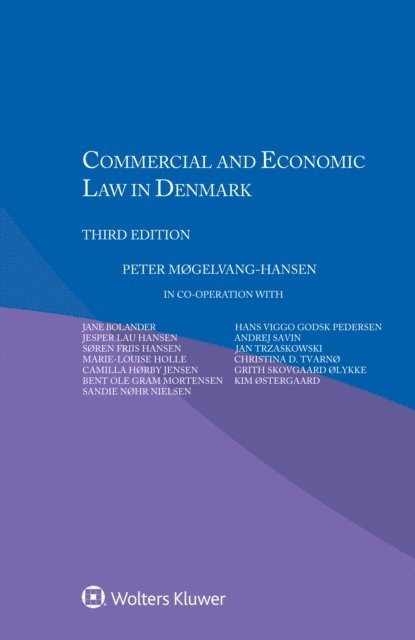
Derived from the renowned multi-volume International Encyclopaedia of Laws, this practical analysis of the law covering merchants’ status and obligations – including the laws governing state intervention in economic activities – in Denmark provides quick and easy guidance on such commercial and economic matters as business assets, negotiable instruments, commercial securities, and regulation of the conditions of commercial transactions. Lawyers who handle transnational business will appreciate the explanation of local variations in terminology and the distinctive concepts that determine practice and procedure.
Starting with a general description of the specifically applicable concepts and sources of commercial law, the book goes on to discuss such factors as obligations of economic operators and institutions, goodwill, broker/client relations, commercial property rights, and bankruptcy. Discussion of economic law covers the laws governing establishment, supervision of economic activities, competition law, and government taxation incentives. These details are presented in such a way that readers who are unfamiliar with specific terms and concepts in varying contexts will fully grasp their meaning and significance.
Thorough yet practical, this convenient volume is a valuable tool for business executives and their legal counsel with international interests. Lawyers representing parties with interests in Denmark will welcome this very useful guide, and academics and researchers will appreciate its value in the study of comparative commercial and economic law.