Peter Paul Dobree - Böcker
Visar alla böcker från författaren Peter Paul Dobree. Handla med fri frakt och snabb leverans.
4 produkter
4 produkter
741 kr
Skickas inom 7-10 vardagar
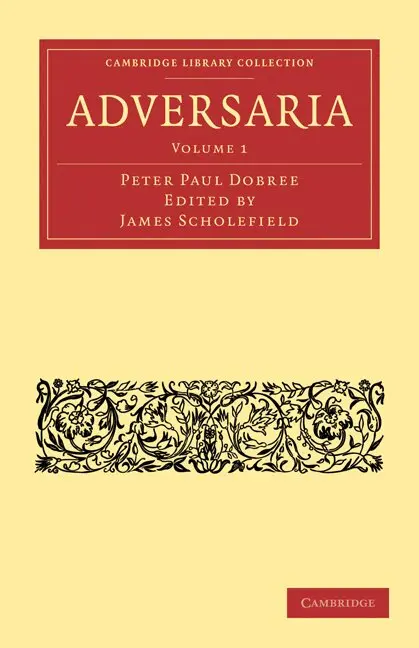
One of the most talented disciples of the illustrious comparative philologist Richard Porson, Peter Paul Dobree (1782-1825) is commemorated in this two-volume edition of Adversaria, consisting of his prolific notes on Greek and Latin literature, history, and philology. Dobree left an enduring impression upon English classical scholarship, despite his premature death shortly after accepting the Regius professorship of Greek at Cambridge. Edited by his successor at Cambridge, James Scholefield, the Adversaria attest to Dobree's scholarly probity and precision, offering insights into a mind whose major achievements undoubtedly still lay ahead. Volume 1 (1831) includes Dobree's praelection on a Pseudo-Lysian funeral oration, which gained him the Regius chair, as well as his notes on Herodotus, Plato, Aristotle, the rhetoricians, and numerous other subjects. Dobree was honoured among 'the first rank of English textual scholars' for his accuracy, rigour, and literary sensitivity - qualities demonstrated in these volumes.
554 kr
Skickas inom 7-10 vardagar
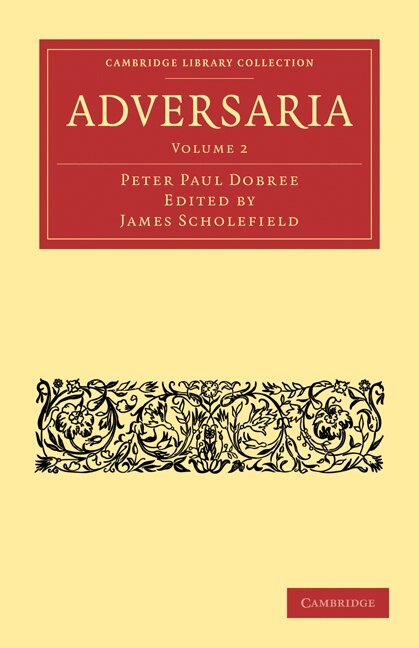
One of the most talented disciples of the illustrious comparative philologist Richard Porson, Peter Paul Dobree (1782-1825) is commemorated in this two-volume edition of Adversaria, consisting of his prolific notes on Greek and Latin literature, history, and philology. Dobree left an enduring impression upon English classical scholarship, despite his premature death shortly after accepting the Regius professorship of Greek at Cambridge. Edited by his successor at Cambridge, James Scholefield, the Adversaria attest to Dobree's scholarly probity and precision, offering insights into a mind whose major achievements undoubtedly still lay ahead. Volume 2 (1833) includes Dobree's notes on Greek literature - including the works of Sophocles, Aeschylus, Euripides, and Aristophanes - as well as his comments on such major Latin writers as Cicero, Livy, Horace, and Juvenal. Dobree was honoured among 'the first rank of English textual scholars' for his accuracy, rigour, and literary sensitivity - qualities demonstrated in these volumes.
538 kr
Skickas inom 7-10 vardagar
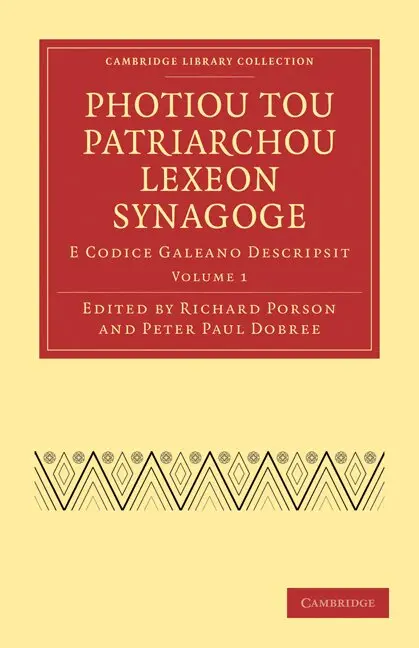
This work, first published in 1822, was edited by Peter Paul Dobree (1782-1825) who had been entrusted with the literary remains of the eminent classical scholar Richard Porson (1759-1808). It contains the text of a ninth-century Greek lexicon compiled by Photius, Patriarch of Constantinople. The lexicon was a tool for Byzantine Greeks studying the works of ancient authors, whose language and vocabulary differed significantly from the day-to-day language spoken in the Byzantine Empire. The lexicon offers the modern scholar a wealth of information regarding ancient works that Photius had access to but are no longer extant. The edition is based on a transcription, made by Porson, of the only remaining manuscript of the lexicon: Codex Galeanus, in Trinity College Library, Cambridge. Volume 1 contains entries for the letters alpha to omicron. The edition has served as an important source for the study of Byzantine lexicography.
632 kr
Skickas inom 7-10 vardagar
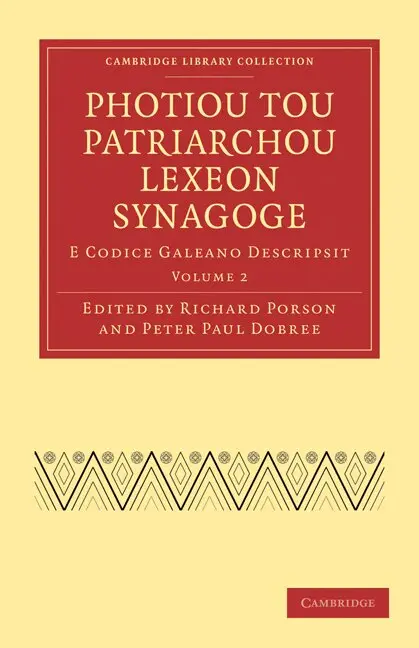
This work, first published in 1822, was edited by Peter Paul Dobree (1782-1825) who had been entrusted with the literary remains of the eminent classical scholar Richard Porson (1759-1808). It contains the text of a ninth-century Greek lexicon compiled by Photius, Patriarch of Constantinople. The lexicon was a tool for Byzantine Greeks studying the works of ancient authors, whose language and vocabulary differed significantly from the day-to-day language spoken in the Byzantine Empire. The lexicon offers the modern scholar a wealth of information regarding ancient works that Photius had access to but are no longer extant. The edition is based on a transcription, made by Porson, of the only remaining manuscript of the lexicon: Codex Galeanus, in Trinity College Library, Cambridge. Volume 2 contains entries for the letters pi to omega. The edition has served as an important source for the study of Byzantine lexicography.