P.H. Schmitt – författare
Visar alla böcker från författaren P.H. Schmitt. Handla med fri frakt och snabb leverans.
11 produkter
11 produkter
Del 8 - Applied Logic Series
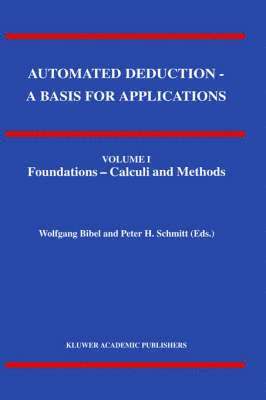
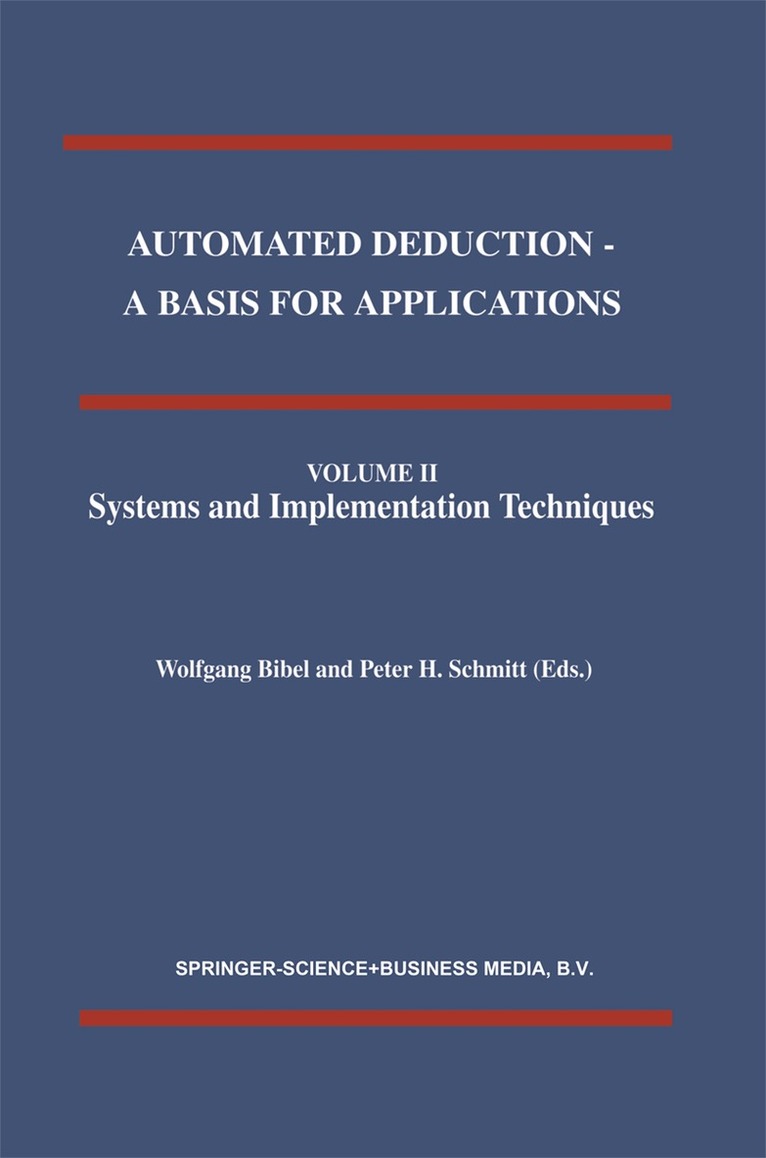
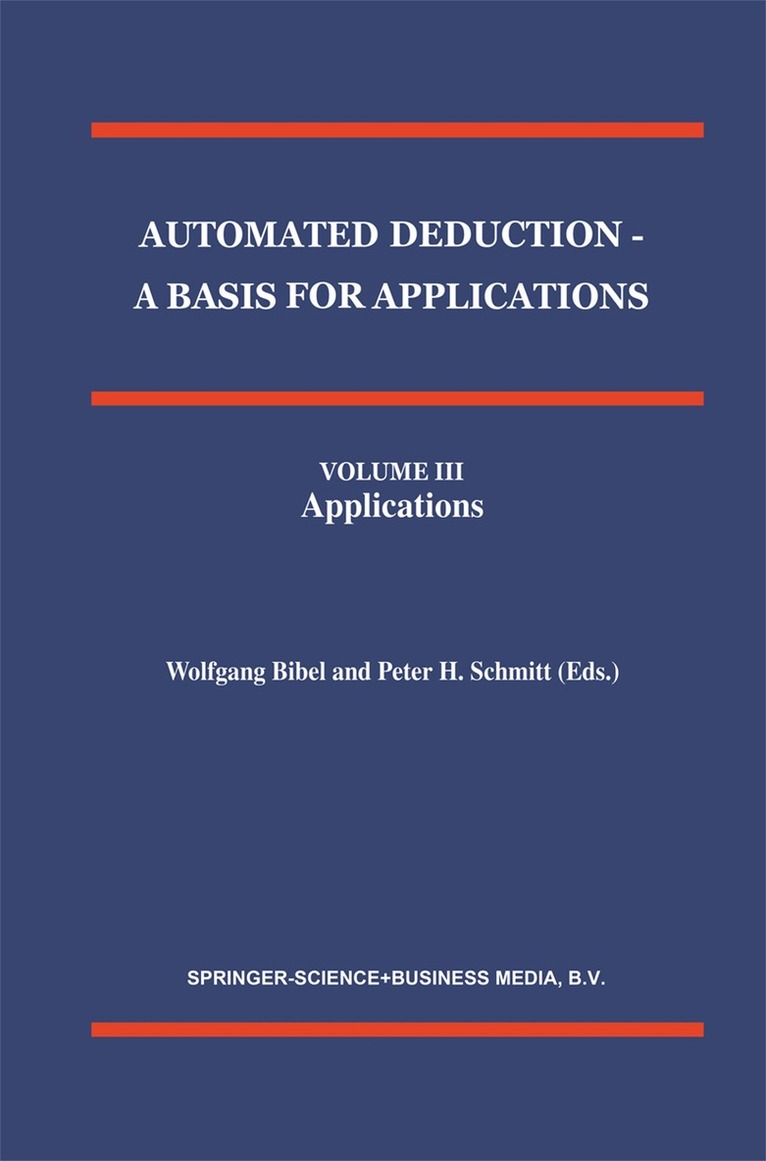
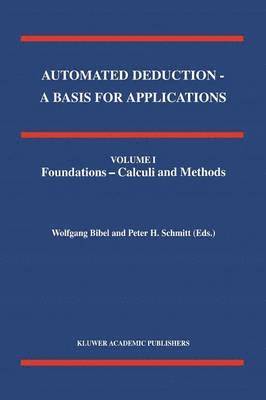
Automated Deduction - A Basis for Applications Volume I Foundations - Calculi and Methods Volume II Systems and Implementation Techniques Volume III Applications
Inbunden, Engelska, 1998
2 166 kr
Skickas inom 10-15 vardagar
The nationwide research project `Deduktion', funded by the `Deutsche Forschungsgemeinschaft (DFG)' for a period of six years, brought together almost all research groups within Germany engaged in the field of automated reasoning. Intensive cooperation and exchange of ideas led to considerable progress both in the theoretical foundations and in the application of deductive knowledge. This three-volume book covers these original contributions moulded into the state of the art of automated deduction. The three volumes are intended to document and advance a development in the field of automated deduction that can now be observed all over the world. Rather than restricting the interest to purely academic research, the focus now is on the investigation of problems derived from realistic applications. In fact industrial applications are already pursued on a trial basis. In consequence the emphasis of the volumes is not on the presentation of the theoretical foundations of logical deduction as such, as in a handbook; rather the books present the concepts and methods now available in automated deduction in a form which can be easily accessed by scientists working in applications outside of the field of deduction. This reflects the strong conviction that automated deduction is on the verge of being fully included in the evolution of technology. Volume I focuses on basic research in deduction and on the knowledge on which modern deductive systems are based. Volume II presents techniques of implementation and details about system building. Volume III deals with applications of deductive techniques mainly, but not exclusively, to mathematics and the verification of software. Each chapter was read by two referees, one an international expert from abroad and the other a knowledgeable participant in the national project. It has been accepted for inclusion on the basis of these review reports. Audience: Researchers and developers in software engineering, formal methods, certification, verification, validation, specification of complex systems and software, expert systems, natural language processing.
Del 9 - Applied Logic Series
Automated Deduction - A Basis for Applications Volume I Foundations - Calculi and Methods Volume II Systems and Implementation Techniques Volume III Applications
Inbunden, Engelska, 1998
2 166 kr
Skickas inom 10-15 vardagar
1. BASIC CONCEPTS OF INTERACTIVE THEOREM PROVING Interactive Theorem Proving ultimately aims at the construction of powerful reasoning tools that let us (computer scientists) prove things we cannot prove without the tools, and the tools cannot prove without us. Interaction typi cally is needed, for example, to direct and control the reasoning, to speculate or generalize strategic lemmas, and sometimes simply because the conjec ture to be proved does not hold. In software verification, for example, correct versions of specifications and programs typically are obtained only after a number of failed proof attempts and subsequent error corrections. Different interactive theorem provers may actually look quite different: They may support different logics (first-or higher-order, logics of programs, type theory etc.), may be generic or special-purpose tools, or may be tar geted to different applications. Nevertheless, they share common concepts and paradigms (e.g. architectural design, tactics, tactical reasoning etc.). The aim of this chapter is to describe the common concepts, design principles, and basic requirements of interactive theorem provers, and to explore the band width of variations. Having a 'person in the loop', strongly influences the design of the proof tool: proofs must remain comprehensible, - proof rules must be high-level and human-oriented, - persistent proof presentation and visualization becomes very important.
Del 10 - Applied Logic Series
Automated Deduction - A Basis for Applications Volume I Foundations - Calculi and Methods Volume II Systems and Implementation Techniques Volume III Applications
Inbunden, Engelska, 1998
1 674 kr
Skickas inom 10-15 vardagar
We are invited to deal with mathematical activity in a sys tematic way [ ... ] one does expect and look for pleasant surprises in this requirement of a novel combination of psy chology, logic, mathematics and technology. Hao Wang, 1970, quoted from(Wang, 1970). The field of mathematics has been a key application area for automated theorem proving from the start, in fact the very first automatically found the orem was that the sum of two even numbers is even (Davis, 1983). The field of automated deduction has witnessed considerable progress and in the last decade, automated deduction methods have made their way into many areas of research and product development in computer science. For instance, deduction systems are increasingly used in software and hardware verification to ensure the correctness of computer hardware and computer programs with respect to a given specification. Logic programming, while still falling somewhat short of its expectations, is now widely used, deduc tive databases are well-developed and logic-based description and analysis of hard-and software is commonplace today.
4 212 kr
Skickas inom 10-15 vardagar
The nationwide research project "Deduktion", funded by the "Deutsche Forschungsgemeinschaft (DFG)" for a period of six years, brought together almost all research groups within Germany engaged in the field of automated reasoning. Intensive co-operation and exchange of ideas led to considerable progress both in the theoretical foundations and in the application of deductive knowledge. This three-volume set covers these original contributions moulded into the state of the art of automated deduction. The three volumes are intended to document and advance a development in the field of automated deduction that can now be observed all over the world. Rather than restricting the interest to purely academic research, the focus now is on the investigation of problems derived from realistic applications. In fact industrial applications are already pursued on a trial basis.In consequence the emphasis of the volumes is not on the presentation of the theoretical foundations of logical deduction as such, as in a handbook; rather the books present the concepts and methods now available in automated deduction in a form which can be easily accessed by scientists working in applications outside of the field of deduction. This reflects the strong conviction that automated deduction is on the verge of being fully included in the evolution of technology. Volume I focuses on basic research in deduction and on the knowledge on which modern deductive systems are based. Volume II presents techniques of implementation and details about system building. Volume III deals with applications of deductive techniques mainly, but not exclusively, to mathematics and the verification of software. Each chapter was read by two referees, one an international expert from abroad and the other a knowledgeable participant in the national project. It has been accepted for inclusion on the basis of these review reports.The text should be of interest to researchers and developers in software engineering, formal methods, certification, verification, validation, specification of complex systems and software, expert systems and natural language processing.
Häftad, Franska, 2018
196 kr
Skickas inom 5-8 vardagar
Häftad, Franska, 2018
194 kr
Skickas inom 5-8 vardagar
Häftad, Engelska, 2010
2 174 kr
Skickas inom 10-15 vardagar
The nationwide research project 'Deduktion', funded by the 'Deutsche Forschungsgemeinschaft (DFG)' for a period of six years, brought together almost all research groups within Germany engaged in the field of automated reasoning. Intensive cooperation and exchange of ideas led to considerable progress both in the theoretical foundations and in the application of deductive knowledge. This three-volume book covers these original contributions moulded into the state of the art of automated deduction. The three volumes are intended to document and advance a development in the field of automated deduction that can now be observed all over the world. Rather than restricting the interest to purely academic research, the focus now is on the investigation of problems derived from realistic applications. In fact industrial applications are already pursued on a trial basis.In consequence the emphasis of the volumes is not on the presentation of the theoretical foundations of logical deduction as such, as in a handbook; rather the books present the concepts and methods now available in automated deduction in a form which can be easily accessed by scientists working in applications outside of the field of deduction. This reflects the strong conviction that automated deduction is on the verge of being fully included in the evolution of technology. Volume I focuses on basic research in deduction and on the knowledge on which modern deductive systems are based. Volume II presents techniques of implementation and details about system building. Volume III deals with applications of deductive techniques mainly, but not exclusively, to mathematics and the verification of software. Each chapter was read by two referees, one an international expert from abroad and the other a knowledgeable participant in the national project. It has been accepted for inclusion on the basis of these review reports.Audience: Researchers and developers in software engineering, formal methods, certification, verification, validation, specification of complex systems and software, expert systems, natural language processing.
Del 9 - Applied Logic Series
Automated Deduction - A Basis for Applications Volume I Foundations - Calculi and Methods Volume II Systems and Implementation Techniques Volume III Applications
Häftad, Engelska, 2010
2 174 kr
Skickas inom 10-15 vardagar
1. BASIC CONCEPTS OF INTERACTIVE THEOREM PROVING Interactive Theorem Proving ultimately aims at the construction of powerful reasoning tools that let us (computer scientists) prove things we cannot prove without the tools, and the tools cannot prove without us. Interaction typi cally is needed, for example, to direct and control the reasoning, to speculate or generalize strategic lemmas, and sometimes simply because the conjec ture to be proved does not hold. In software verification, for example, correct versions of specifications and programs typically are obtained only after a number of failed proof attempts and subsequent error corrections. Different interactive theorem provers may actually look quite different: They may support different logics (first-or higher-order, logics of programs, type theory etc.), may be generic or special-purpose tools, or may be tar geted to different applications. Nevertheless, they share common concepts and paradigms (e.g. architectural design, tactics, tactical reasoning etc.). The aim of this chapter is to describe the common concepts, design principles, and basic requirements of interactive theorem provers, and to explore the band width of variations. Having a 'person in the loop', strongly influences the design of the proof tool: proofs must remain comprehensible, - proof rules must be high-level and human-oriented, - persistent proof presentation and visualization becomes very important.
Del 10 - Applied Logic Series
Automated Deduction - A Basis for Applications Volume I Foundations - Calculi and Methods Volume II Systems and Implementation Techniques Volume III Applications
Häftad, Engelska, 2010
1 633 kr
Skickas inom 10-15 vardagar
We are invited to deal with mathematical activity in a sys tematic way [ ... ] one does expect and look for pleasant surprises in this requirement of a novel combination of psy chology, logic, mathematics and technology. Hao Wang, 1970, quoted from(Wang, 1970). The field of mathematics has been a key application area for automated theorem proving from the start, in fact the very first automatically found the orem was that the sum of two even numbers is even (Davis, 1983). The field of automated deduction has witnessed considerable progress and in the last decade, automated deduction methods have made their way into many areas of research and product development in computer science. For instance, deduction systems are increasingly used in software and hardware verification to ensure the correctness of computer hardware and computer programs with respect to a given specification. Logic programming, while still falling somewhat short of its expectations, is now widely used, deduc tive databases are well-developed and logic-based description and analysis of hard-and software is commonplace today.
E-bok
PDF, Engelska, 20132 840 kr
Läs direkt efter köp
1. BASIC CONCEPTS OF INTERACTIVE THEOREM PROVING Interactive Theorem Proving ultimately aims at the construction of powerful reasoning tools that let us (computer scientists) prove things we cannot prove without the tools, and the tools cannot prove without us. Interaction typi cally is needed, for example, to direct and control the reasoning, to speculate or generalize strategic lemmas, and sometimes simply because the conjec ture to be proved does not hold. In software verification, for example, correct versions of specifications and programs typically are obtained only after a number of failed proof attempts and subsequent error corrections. Different interactive theorem provers may actually look quite different: They may support different logics (first-or higher-order, logics of programs, type theory etc.), may be generic or special-purpose tools, or may be tar geted to different applications. Nevertheless, they share common concepts and paradigms (e.g. architectural design, tactics, tactical reasoning etc.). The aim of this chapter is to describe the common concepts, design principles, and basic requirements of interactive theorem provers, and to explore the band width of variations. Having a ''person in the loop'', strongly influences the design of the proof tool: proofs must remain comprehensible, - proof rules must be high-level and human-oriented, - persistent proof presentation and visualization becomes very important.
E-bok
PDF, Engelska, 20131 977 kr
Läs direkt efter köp
We are invited to deal with mathematical activity in a sys tematic way [ ... ] one does expect and look for pleasant surprises in this requirement of a novel combination of psy chology, logic, mathematics and technology. Hao Wang, 1970, quoted from(Wang, 1970). The field of mathematics has been a key application area for automated theorem proving from the start, in fact the very first automatically found the orem was that the sum of two even numbers is even (Davis, 1983). The field of automated deduction has witnessed considerable progress and in the last decade, automated deduction methods have made their way into many areas of research and product development in computer science. For instance, deduction systems are increasingly used in software and hardware verification to ensure the correctness of computer hardware and computer programs with respect to a given specification. Logic programming, while still falling somewhat short of its expectations, is now widely used, deduc tive databases are well-developed and logic-based description and analysis of hard-and software is commonplace today.