Philip J. Kain – författare
Visar alla böcker från författaren Philip J. Kain. Handla med fri frakt och snabb leverans.
11 produkter
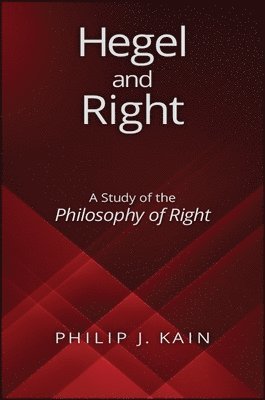
Hegel and Right
A Study of the Philosophy of Right
Häftad, 2019
619 kr
Lägg i varukorg
An especially accessible introduction to Hegel's moral and political philosophy.In this book, Philip J. Kain introduces Hegel's Philosophy of Right by focusing on disagreements, both with standard interpretations of his work and with Hegel himself. Arguing that Hegel's justification for punishment …
Marx, Revolution, and Social Democracy
Inbunden, 2023
934 kr
Lägg i varukorg
Many people think Marx a totalitarian and Soviet Marxism the predictable outcome of his thought. If one shows them the texts-proves to them that Marx was a radical democrat--they often flip and think him utopian. Totalitarian or utopian--for many those seem to be the alternatives. How might one …
Marx, Revolution, and Social Democracy
E-bok, 2023
844 kr
Lägg i varukorg
Many people think Marx a totalitarian and Soviet Marxism the predictable outcome of his thought. If one shows them the texts-proves to them that Marx was a radical democrat--they often flip and think him utopian. Totalitarian or utopian--for many those seem to be the alternatives. How might one …
Marx, Revolution, and Social Democracy
E-bok, 2023
844 kr
Lägg i varukorg
Many people think Marx a totalitarian and Soviet Marxism the predictable outcome of his thought. If one shows them the texts-proves to them that Marx was a radical democrat--they often flip and think him utopian. Totalitarian or utopian--for many those seem to be the alternatives. How might one …
Marx and Ethics
Häftad, 1991
986 kr
Lägg i varukorg
This book traces the development of Marx's ethics as they underwent various shifts and changes during different periods of his thought. In his early writings, his ethics are based on a concept of essence much like Aristotle's which Marx tries to link to a principle of universalization similar to …
Nietzsche and the Horror of Existence
Inbunden, 2009
1547 kr
Lägg i varukorg
Nietzsche believed in the horror of existence: a world filled with meaningless suffering_suffering for no reason at all. He also believed in eternal recurrence, the view that that our lives will repeat infinitely, and that in each life every detail will be exactly the same. Furthermore, it was not …
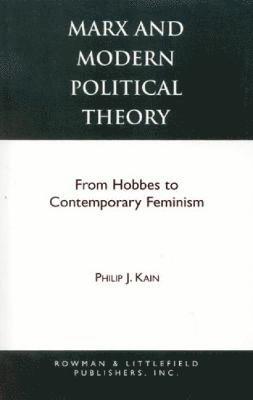
Marx and Modern Political Theory
From Hobbes to Contemporary Feminism
Häftad, 1993
852 kr
Lägg i varukorg
Philip J. Kain deftly demonstrates the historical antecedents to and continuing relevance of Karl Marx's thought. Kain reveals the unappreciated pluralism of Marx, how it has endured and how it will continue to adapt to the challenges of modern day thought such as feminist theory.
Hegel and Right
A Study of the Philosophy of Right
Inbunden, 2018
1286 kr
Lägg i varukorg
An especially accessible introduction to Hegel's moral and political philosophy.In this book, Philip J. Kain introduces Hegel's Philosophy of Right by focusing on disagreements, both with standard interpretations of his work and with Hegel himself. Arguing that Hegel's justification for punishment …
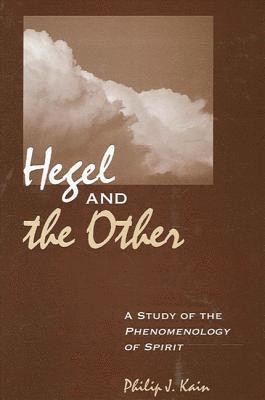
Hegel and the Other
A Study of the Phenomenology of Spirit
Inbunden, 2005
1111 kr
Tillfälligt slut
A new, highly accessible commentary on Hegel's Phenomenology of Spirit.This volume by Philip J. Kain is one of the most accessibly written books on Hegel's Phenomenology of Spirit available. Avoiding technical jargon without diluting Hegel's thought, Kain shows the Phenomenology responding to Kant …
Hegel and the Other
A Study of the Phenomenology of Spirit
Häftad, 2005
422 kr
Tillfälligt slut
A new, highly accessible commentary on Hegel's Phenomenology of Spirit.This volume by Philip J. Kain is one of the most accessibly written books on Hegel's Phenomenology of Spirit available. Avoiding technical jargon without diluting Hegel's thought, Kain shows the Phenomenology responding to Kant …
Marx and Modern Political Theory
From Hobbes to Contemporary Feminism
Inbunden, 1993
997 kr
Tillfälligt slut
Philip J. Kain deftly demonstrates the historical antecedents to and continuing relevance of Karl Marx's thought. Kain reveals the unappreciated pluralism of Marx, how it has endured and how it will continue to adapt to the challenges of modern day thought such as feminist theory.