Philip K. Maini – författare
Visar alla böcker från författaren Philip K. Maini. Handla med fri frakt och snabb leverans.
14 produkter
Mathematical Biology
A Very Short Introduction
Häftad, 2025
116 kr
Lägg i varukorg
Very Short Introductions : Brilliant, Sharp, Inspiring Why are English Premier League football shirt patterns very similar to animal coat markings? And what do invasive species have in common with cancer cells in the body? Mathematical biology develops models which answer these questions, as they …
Patterns and Forms in Nature
From Organisms to Collective Behaviours in Biological Systems
Av Philip K. Maini, Hiraku Nishimori m. fl.
Inbunden, 2026
608 kr
Kommande
This open access book presents a multidisciplinary examination of how biological shapes, structures, and dynamic patterns emerge, evolve, and persist in the natural world. Drawing on genetics, developmental biology, evolutionary theory, physics, chemistry, and mathematical modeling, the book brings …
Mathematical Biology
A Very Short Introduction
E-bok, 2025
95 kr
Lägg i varukorg
Very Short Introductions : Brilliant, Sharp, Inspiring Why are English Premier League football shirt patterns very similar to animal coat markings? And what do invasive species have in common with cancer cells in the body? Mathematical biology develops models which answer these questions, as they …
Mathematical Biology
A Very Short Introduction
E-bok, 2025
95 kr
Lägg i varukorg
Very Short Introductions : Brilliant, Sharp, Inspiring Why are English Premier League football shirt patterns very similar to animal coat markings? And what do invasive species have in common with cancer cells in the body? Mathematical biology develops models which answer these questions, as they …
Mathematical Models for Biological Pattern Formation
Av Philip K. Maini, Hans G. Othmer
Inbunden, 2000
1637 kr
Lägg i varukorg
This 121st IMA volume, entitled MATHEMATICAL MODELS FOR BIOLOGICAL PATTERN FORMATION is the first of a new series called FRONTIERS IN APPLICATION OF MATHEMATICS. The FRONTIERS volumes are motivated by IMA pro grams and workshops, but are specially planned and written to provide an entree to and …
Celebrating J.D. Murray’s contributions to Mathematical Biology
Av Philip K. Maini, Mark A. J. Chaplain m. fl.
Häftad, 2022
1094 kr
Lägg i varukorg
The Bulletin of Mathematical Biology, the official journal of the Society for Mathematical Biology, disseminates original research findings and other information relevant to the interface of biology and the mathematical sciences. Contributions should have relevance to both fields. In order to …
Mathematical Models for Biological Pattern Formation
Av Philip K. Maini, Hans G. Othmer
Häftad, 2012
1637 kr
Lägg i varukorg
This 121st IMA volume, entitled MATHEMATICAL MODELS FOR BIOLOGICAL PATTERN FORMATION is the first of a new series called FRONTIERS IN APPLICATION OF MATHEMATICS. The FRONTIERS volumes are motivated by IMA pro grams and workshops, but are specially planned and written to provide an entree to and …
Mathematical Models for Biological Pattern Formation
Av Hans G. Othmer, Philip K. Maini
E-bok, 2012
2049 kr
Lägg i varukorg
This 121st IMA volume, entitled MATHEMATICAL MODELS FOR BIOLOGICAL PATTERN FORMATION is the first of a new series called FRONTIERS IN APPLICATION OF MATHEMATICS. The FRONTIERS volumes are motivated by IMA pro grams and workshops, but are specially planned and written to provide an entree to and …
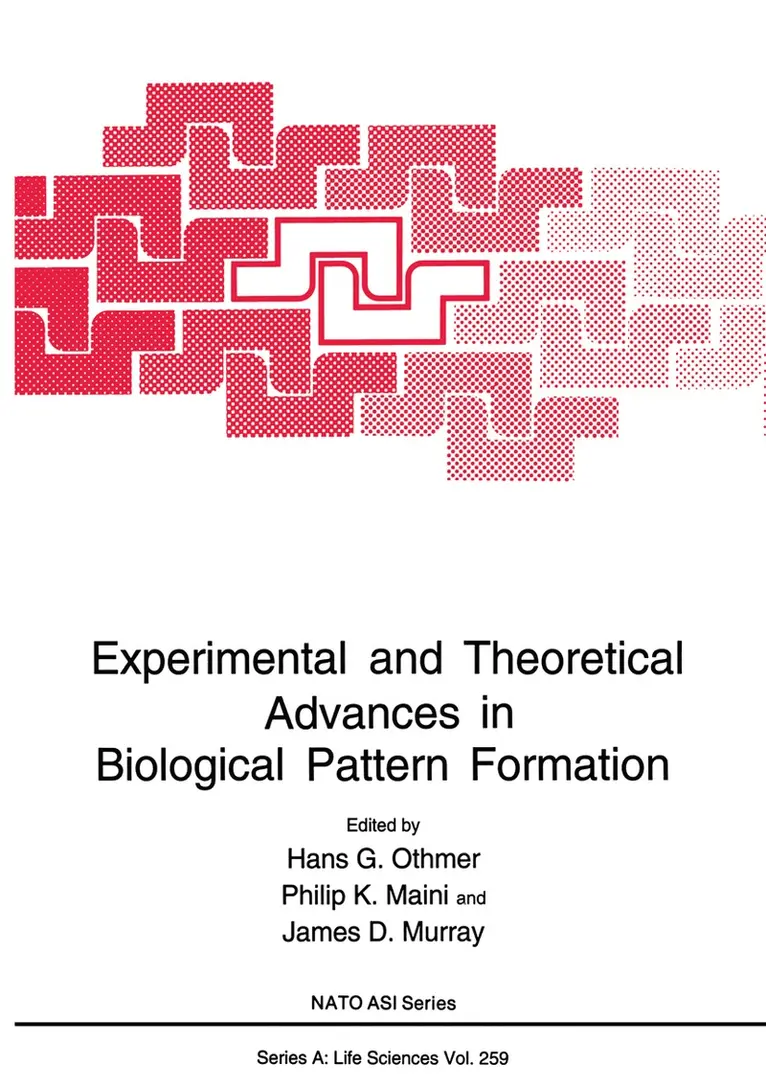
Experimental and Theoretical Advances in Biological Pattern Formation
Av Hans G. Othmer, Philip K. Maini m. fl.
Häftad, 2012
567 kr
Lägg i varukorg
This volume contains the proceedings of the NATO ARW on 'Biological Pattern Formation' held at Merton College, University of Oxford, on 27-31 August, 1992. The objective of the workshop was to bring together a select group of theoreticians and experimental biologists to present the latest results …
Experimental and Theoretical Advances in Biological Pattern Formation
Av James D. Murray, Philip K. Maini m. fl.
E-bok, 2012
755 kr
Lägg i varukorg
This volume contains the proceedings of the NATO ARW on ''Biological Pattern Formation'' held at Merton College, University of Oxford, on 27-31 August, 1992. The objective of the workshop was to bring together a select group of theoreticians and experimental biologists to present the latest results …
Mathematics of Movement
An Interdisciplinary Approach to Mutual Challenges in Animal Ecology and Cell Biology
Av Luca Giuggioli, Philip K. Maini
Inbunden, 2026
1521 kr
Lägg i varukorg
This volume presents insights into the mathematics of movement with a focus on applications to animal ecology and cell biology. With the advances over the past decades in sensor technologies, from Global Positioning Systems (GPS) and radio-telemetry for the observation of moving animals to imaging …
Mathematics of Movement
An Interdisciplinary Approach to Mutual Challenges in Animal Ecology and Cell Biology
Av Philip K. Maini, Luca Giuggioli
E-bok, 2026
1906 kr
Lägg i varukorg
This volume presents insights into the mathematics of movement with a focus on applications to animal ecology and cell biology. With the advances over the past decades in sensor technologies, from Global Positioning Systems (GPS) and radio-telemetry for the observation of moving animals to imaging …
Dispersal, Individual Movement and Spatial Ecology
A Mathematical Perspective
Av Mark A. Lewis, Philip K. Maini m. fl.
Häftad, 2013
550 kr
Lägg i varukorg
Dispersal of plants and animals is one of the most fascinating subjects in ecology. It has long been recognized as an important factor affecting ecosystem dynamics. Dispersal is apparently a phenomenon of biological origin; however, because of its complexity, it cannot be studied comprehensively by …
Dispersal, Individual Movement and Spatial Ecology
A Mathematical Perspective
Av Sergei V. Petrovskii, Philip K. Maini m. fl.
E-bok, 2013
718 kr
Lägg i varukorg
Dispersal of plants and animals is one of the most fascinating subjects in ecology. It has long been recognized as an important factor affecting ecosystem dynamics. Dispersal is apparently a phenomenon of biological origin; however, because of its complexity, it cannot be studied comprehensively by …