Philip Lawn - Böcker
Visar alla böcker från författaren Philip Lawn. Handla med fri frakt och snabb leverans.
7 produkter
7 produkter
2 588 kr
Skickas inom 10-15 vardagar
Mounting evidence suggests that GDP growth is damaging the natural environment and unlikely to be ecologically sustainable in the long-run. At the same time, an annual GDP growth rate of around three percent is regarded as the minimum necessary to prevent unemployment from escalating. Clearly, a trade-off exists between environmental goals and employment goals, yet this trade-off has been largely ignored or denied. This book aims to resolve the environment-employment dilemma by suggesting ways and means to achieve low rates of unemployment, or preferably full employment, in the context of a low-growth or steady-state economy. In search of a solution to this dilemma, this book seeks to answer the following questions: What existing paradigms offer a possible foundation for further investigation into issues dealing with both the environment and employment? What specific initiatives can be implemented to deal with unemployment given that any potential solution must be consistent with responsible macroeconomic policy? To what extent can ecological tax reform provide a solution to the environment-employment dilemma? Under what circumstances is it clear that certain forms of employment generation are antithetic to the goal of ecological sustainability? How can more favourable employment-generating opportunities be exploited in ways which lower unemployment or achieve full employment without the need for ecologically-destructive GDP growth?This book will no doubt stimulate a broader discussion on the issue, and it may just begin a process that leads to the eventual emergence of a viable policy strategy to generate a sustainable, full employment future. This book will be of interest to decision-makers, civil servants, researchers, and NGO employees as well as students of environmental and ecological economics and issues related to employment and unemployment.
673 kr
Skickas inom 10-15 vardagar
Mounting evidence suggests that GDP growth is damaging the natural environment and unlikely to be ecologically sustainable in the long-run. At the same time, an annual GDP growth rate of around three percent is regarded as the minimum necessary to prevent unemployment from escalating. Clearly, a trade-off exists between environmental goals and employment goals, yet this trade-off has been largely ignored or denied. This book aims to resolve the environment-employment dilemma by suggesting ways and means to achieve low rates of unemployment, or preferably full employment, in the context of a low-growth or steady-state economy. In search of a solution to this dilemma, this book seeks to answer the following questions: What existing paradigms offer a possible foundation for further investigation into issues dealing with both the environment and employment? What specific initiatives can be implemented to deal with unemployment given that any potential solution must be consistent with responsible macroeconomic policy? To what extent can ecological tax reform provide a solution to the environment-employment dilemma? Under what circumstances is it clear that certain forms of employment generation are antithetic to the goal of ecological sustainability? How can more favourable employment-generating opportunities be exploited in ways which lower unemployment or achieve full employment without the need for ecologically-destructive GDP growth?This book will no doubt stimulate a broader discussion on the issue, and it may just begin a process that leads to the eventual emergence of a viable policy strategy to generate a sustainable, full employment future. This book will be of interest to decision-makers, civil servants, researchers, and NGO employees as well as students of environmental and ecological economics and issues related to employment and unemployment.
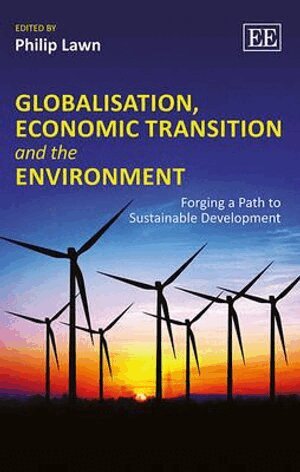
Globalisation, Economic Transition and the Environment
Forging a Path to Sustainable Development
Inbunden, Engelska, 2013
2 278 kr
Skickas inom 7-10 vardagar
This book focuses on three critical issues pertaining to the broader goal of sustainable development - namely, the degenerative forces of globalization, ecological sustainability requirements, and how best to negotiate the economic transition process.While the applicability of ecological sustainability to sustainable development is obvious, the association between economic transition and sustainable development, and, more particularly, how globalization forces can impact negatively on the sustainable development process, is poorly understood. Philip Lawn brings together some of the leading practitioners in the field of sustainable development to discuss these issues and to outline ways to achieve sustainable development without the perceived need for continuous growth. The book culminates with a number of policy recommendations and institutional modifications to assist nations and the global community to achieve sustainable development.This book will prove invaluable for academics and researchers in ecological, environmental and natural resource economics as well as sustainable development, globalization and international trade. Practitioners and policy-makers at all levels will find this resource both interesting and instrumental to their work.Contributors: M. Borucke, M. Clarke, M. Cole, R. Costanza, H. Daly, P. Fredriksson, A. Galli, T. Jackson, I. Kubiszewski, P. Lawn, E. Lazarus, S. Mattoon, W. Rees, J. Rockström, W. Steffen, P. Victor, M. Wackernagel
2 647 kr
Skickas inom 7-10 vardagar
Since the late 1980s and early 1990s, national governments have introduced a range of policy measures designed to steer their economies along a more sustainable path. Yet how are we to know how successful these have been? This significant new book discusses the ways in which sustainable development indicators can be improved in order to both assess the impact of past policies and avoid the repetition of previous failings.Covering a broad range of indicators relating to national accounts, aggregate welfare, natural capital, ecosystem health and human-environment interactions, this volume provides an important assessment of the strengths and weaknesses of each. With contributions from some of the most eminent scholars in the field, the book competently analyses the various methods of measuring the sustainable development performance of nations, and suggests many ways in which these can be developed and improved. While the contributors might offer conflicting views, the message they convey is universal - the quest for appropriate sustainable development indicators is critically important if we are ever to bring about a fairer, sustainable and more efficient world.
2 346 kr
Skickas inom 7-10 vardagar
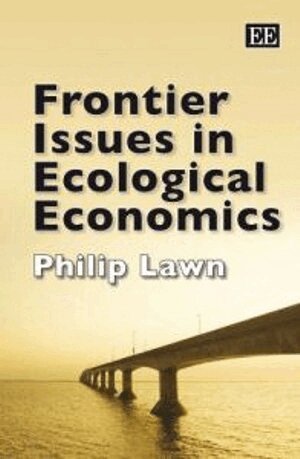
Ecological economics formally emerged in the late 1980s in response to the failure of mainstream economic paradigms to deal adequately with the interdependence of social, economic and ecological systems. Frontier Issues in Ecological Economics focuses on a range of cutting-edge issues in the field of ecological economics and outlines plausible measures to achieve a more sustainable, just, and efficient world for all.Covering a broad range of key subjects, this book deals with some of the frontier issues that have recently emerged in ecological economics and those that continue to remain a source of disagreement and debate. In doing so, the book highlights the importance of natural capital, the limits to growth and markets in achieving sustainable development, the policy-guiding value of sustainable development indicators, ecological tax reform considerations, environmental-macroeconomic issues such as the reconciliation of the ecological sustainability and full employment objectives, and measures to deal with growing globalisation concerns. The book concludes with the optimistic assessment that a transition to a steady-state economy - necessary to achieve sustainable development - is entirely compatible with a democratic-capitalist system.Philip Lawn's latest book will appeal to academics and researchers working in the areas of ecological, environmental and natural resource economics, sustainable development, green national accounting, environmental management and development studies. Policymakers, environmental managers and NGOs will also appreciate this book.
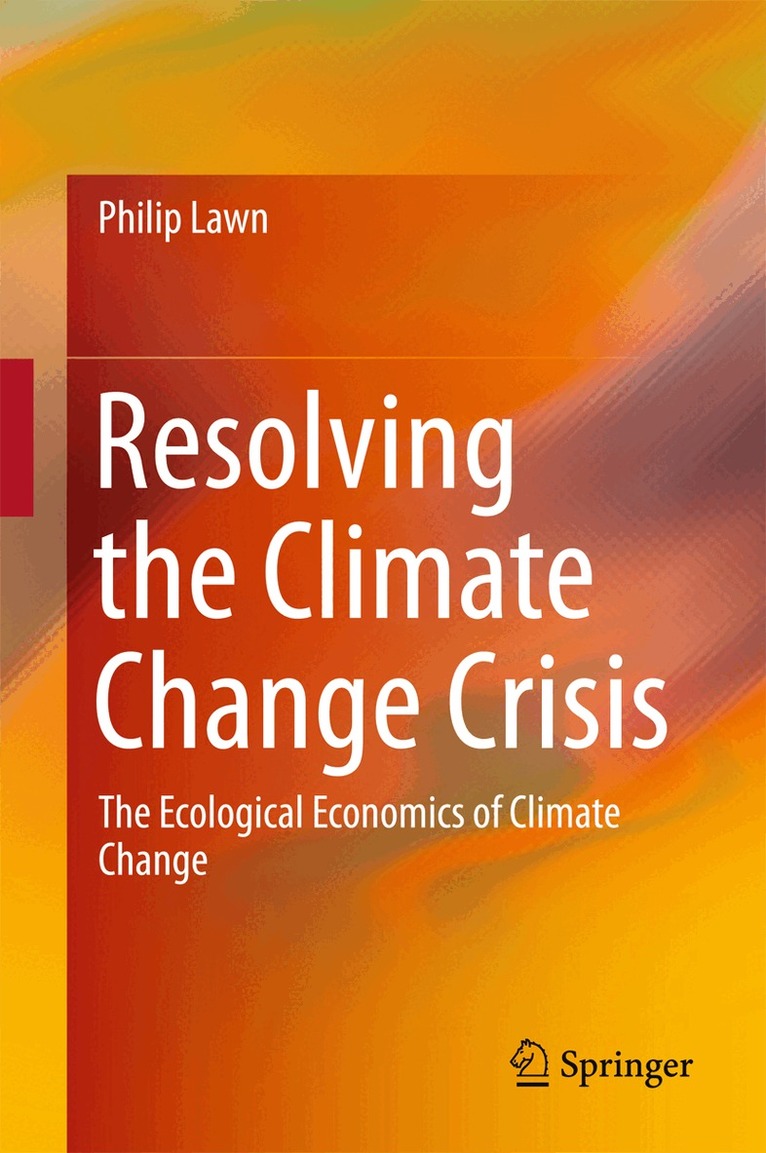
Resolving the Climate Change Crisis
The Ecological Economics of Climate Change
Inbunden, Engelska, 2016
1 589 kr
Skickas inom 10-15 vardagar
This book explains why the climate change crisis is a symptom of a much larger underlying problem – namely, humankind’s predilection with continuous GDP-growth. Given this starting point, the world’s high-income nations must begin the transition to a qualitatively-improving steady-state economy and low-income nations must follow suit at some stage over the next 20-40 years. Unless they do, a well-designed emissions protocol will be as useless as the paper it is written on. Adopting an ecological economic approach, this book sets out why we must abandon the goal of continuous growth; how we can do so in a way that improves human well-being; what constitutes a safe atmospheric concentration of greenhouse gases; and what type of emissions protocol and emissions-trading framework is likely to achieve a desirable climate change outcome. Failure of the world’s leaders to achieve these goals will not only put future human well-being at risk, it will threaten freedom in the liberal-democratic tradition and international peace.
1 589 kr
Skickas inom 10-15 vardagar
This book explains why the climate change crisis is a symptom of a much larger underlying problem – namely, humankind’s predilection with continuous GDP-growth.