Philip Stiles - Böcker
Visar alla böcker från författaren Philip Stiles. Handla med fri frakt och snabb leverans.
5 produkter
5 produkter
1 141 kr
Skickas inom 3-6 vardagar
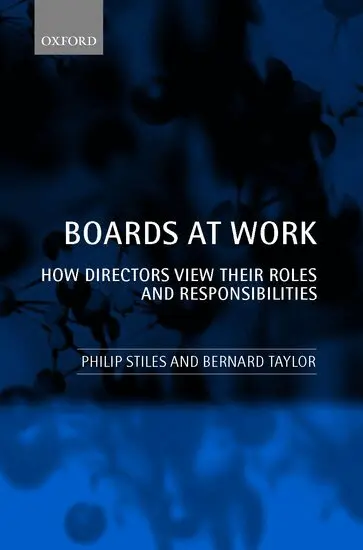
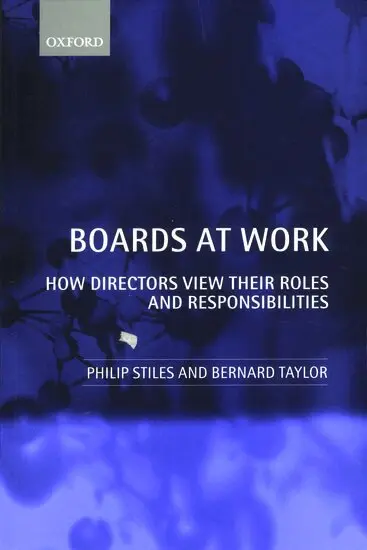
Boards of directors are coming under increasing scrutiny in terms of their contribution in monitoring and controlling management, particularly in the wake of high-profile corporate frauds and failures, and also their potential to add value to organizational performance through involvement in the strategy process and through building relationships with key investors. Despite the importance of these issues, not only to organizations but also arguably to national competitiveness, the nature of board activity remains largely a black box, clouded by prescriptions, prejudices, and half-truths. This book responds to calls for greater scrutiny of boards of directors with an in-depth examination of directors of UK organizations, drawing on the accounts of directors themselves as to their roles, influence, and the potential and limits to their power. Much work on boards of directors has labelled the board as a rubber stamp for dominant management, and non-executive directors in particular have been variously described as poodles, pet rocks, or parsley on the fish. Such accounts are rooted in assumptions of board activity that are essentially adversarial in nature, and that the solution to the 'problem' of reconciling the interests of managers with those of shareholders is to increase the checks and balances available to the board of directors. The findings of this study show that boards, in many cases, are far more than passive rubber stamps for management and that non-executives are encouraged to act as trusted advisers to the executives and the chief executive, rather than solely monitors of executive activity. Boards are important mechanisms in maintaining the strategic framework of the organization through setting the boundaries of organizational activity. The potential of the board members, in particular the non-executives, to fulfil such a mandate depends on a number of factors, including ability, willingness to engage with the organizational issues, and the degree of knowledge they have relevant to the host firm. Above all, the degree of trust built between members of the board, and between the board and key external constituencies, is at the heart of effective board behaviour.
1 003 kr
Skickas inom 7-10 vardagar
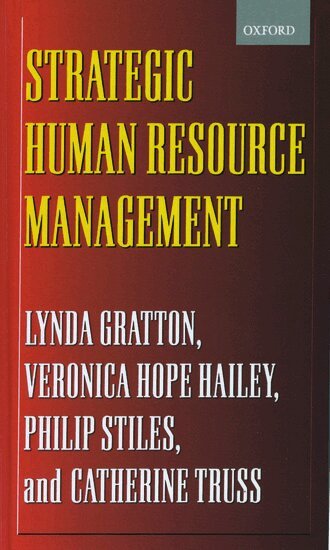
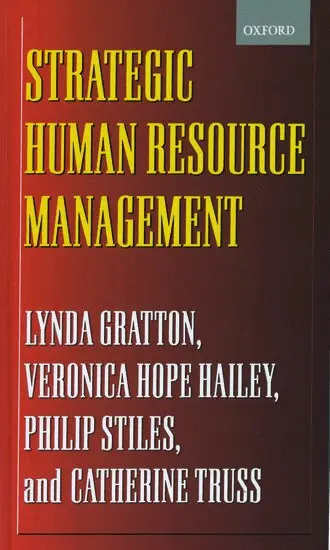
Life is tough in organizations, both for managers and the managed. Negotiating the rapids of restructuring, downsizing, and refocusing the core business brings with it huge upheavals in job security, the smashing of traditional career structures, and a constant imperative for employees to update their skills while working in an environment of great uncertainty. Based on close collaboration with a number of high profile organizations - BT, Citibank, Glaxo Wellcome, Hewlett Packard, Kraft Jacobs, Suchard, Lloyds-TSB Group, the NHS, and WH Smith - this book sheds light on the organizational responses to large scale changes and details the changing demands made of employees in the process. This book goes beyond fashionable management rhetoric to uncover the reality of human resource management. The team of top researchers examines: the organizational strategies pursued in the face of fast-changing circumstances the links between what is intended and what is realised the way in which HR interventions impact on the individual the influence which HR strategies have on everyday management behaviour This book is a key source of new information for both managers and students about the current state of human resource management and its possible future direction.
2 797 kr
Skickas inom 5-8 vardagar
Life is tough in organizations, both for managers and the managed. Negotiating the rapids of restructuring, downsizing, and refocusing the core business brings with it huge upheavals in job security, the smashing of traditional career structures, and a constant imperative for employees to update their skills while working in an environment of great uncertainty. Based on close collaboration with a number of high profile organizations - BT, Citibank, Glaxo Wellcome, Hewlett Packard, Kraft Jacobs, Suchard, Lloyds-TSB Group, the NHS, and WH Smith - this book sheds light on the organizational responses to large scale changes and details the changing demands made of employees in the process. This book goes beyond fashionable management rhetoric to uncover the reality of human resource management. The team of top researchers examines: the organizational strategies pursued in the face of fast-changing circumstances the links between what is intended and what is realised the way in which HR interventions impact on the individual the influence which HR strategies have on everyday management behaviour This book is a key source of new information for both managers and students about the current state of human resource management and its possible future direction.
948 kr
Skickas inom 5-8 vardagar
Boards of directors are coming under increasing scrutiny in terms of ther contribution in monitoring and controlling management, particularly in the wake of high-profile coprorate frauds and failures, and also their potential to add value to organizational performance through involvement in the strategy process and through building relationships with key investors. Despite the importance of these issues, not only to organizations but also arguably to national competitiveness, the nature of board activity remains largely a black box, clouded by prescriptions, prejudices, and half-truths. This book responds to calls for greater scrutiny of boards of directors with an in-depth examination of directors of UK organizations, drawing on the accounts of directors themselves as to their roles, influence, and the potential and limits to their power.Much work on boards of directors has labelled the board as a rubber stamp for dominant management, and non-executive directors in particular have been variously described as poodles, pet rocks, or parsley on the fish. Such accounts are rooted in assumptions of board activity that are essentially adversarial in nature, and that the solution to the 'problem' of reconciling the interests of managers with those of shareholders is to increase the checks and balances available to the board of directors. The findings of this study show that boards, in many cases, are far more than passive rubber stamps for management and that non-executives are encouraged to act as trusted advisers to the executives and the chief executive, rather than solely monitors of executive activity. Boards are important mechanisms in maintaining the strategic framework of the organization through setting the boundaries of organizational activity. The potential of the board members, in particular the non-executives, to fulfil such a mandate depends on a number of factors, including ability, willingness to engage with the organizational issues, and the degree of knowledge they have relevant to the host firm. Above all, the degree of trust built between members of the board, and between the board and key external constituencies, is at the heart of effective board behaviour.
241 kr
Skickas inom 7-10 vardagar
Boards of directors are at the apex of organisational decision-making and so are central in ensuring effective corporate governance. But boards are under increasing scrutiny due to the continuing prevalence of scandals and failures. Boards have been viewed as set up to fail because the demands placed upon them cannot effectively be delivered. In this Element, I examine this tension and look at the board as a working group, one which has an input, a process and an output. Through looking at the board as a group, the dynamics of how boards, and the potential for effective and ineffective operation, are highlighted. I conclude with outlining how the future of board dynamics may evolve.