• Fri frakt över 249 kr
  • •
  • Snabba leveranser
  • •
  • Billiga böcker
Kundservice

Du är på sajten för privatpersoner.

Företag, bibliotek eller offentlig verksamhet?

Du handlar på classic.bokus.com, där alla dina funktioner finns intakta.
Till classic.bokus.com
Bokus logotyp. Gå till startsidan.
  • Erbjudanden
  • Student
  • Topplistor
  • Barn & ungdom
  • Bokus Play
  • E-böcker
  • Ljudböcker
  • Pocketböcker
  • Spel och pussel

5% studentrabatt – använd koden KURSBOK27 →

Sidfot

Mina sidor

    Hjälp

    • Kundservice
    • Vanliga frågor och svar
    • Frakt och leverans
    • Retur vid ångerrätt
    • Reklamera vara
    • Betalning
    • Köpvillkor
    • Allmänna villkor
    • Information om webbplatsens tillgänglighet

    Om Bokus

    • Om oss
    • Pressrum
    • För studenter
    • För företag
    • För bibliotek och offentlig verksamhet
    • För leverantörer
    • Hållbarhet

    Populärt

    • Aktuella erbjudanden
    • Presentkort
    • Studentlitteratur
    • Nya böcker
    • Topplistor
    • Signerade böcker
    • Engelska böcker

    Inspiration

    • Boktips
    • BookTok
    • Barnbokskaraktärer
    • Populära författare
    Logotyp för Bokus
    Följ oss på Facebook (extern länk)Följ oss på Instagram (extern länk)Följ oss på YouTube (extern länk)Följ oss på TikTok (extern länk)
    bokus @ CookiesAnpassa cookiesIntegritetspolicyKöpvillkor
    Till Citymail hemsida (extern länk)Till Budbee hemsida (extern länk)Till Postnord hemsida (extern länk)Till Schenker hemsida (extern länk)Till Early Bird hemsida (extern länk)Till Walleys hemsida (extern länk)
    1. Ekonomi och Ledarskap
    2. Företagsekonomi
    3. Organisation och ägarskap

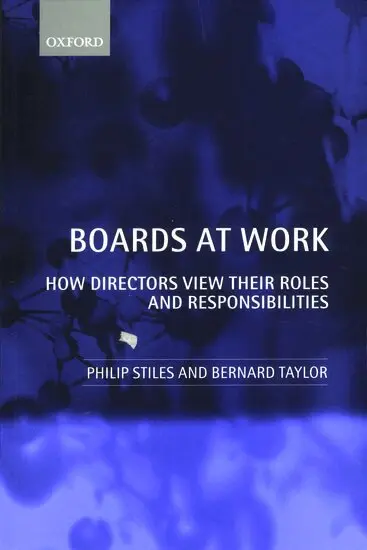
    Boards at Work

    How Directors View their Roles and Responsibilities

    AvPhilip Stiles,Bernard Taylor

    Häftad, Engelska, 2002

    1 002 kr

    Beställningsvara. Skickas inom 5-8 vardagar. Fri frakt över 249 kr.

    Fler format och utgåvor

    Inbunden

    1 094 kr

    Beskrivning

    Boards of directors are coming under increasing scrutiny in terms of ther contribution in monitoring and controlling management, particularly in the wake of high-profile coprorate frauds and failures, and also their potential to add value to organizational performance through involvement in the strategy process and through building relationships with key investors. Despite the importance of these issues, not only to organizations but also arguably to national competitiveness, the nature of board activity remains largely a black box, clouded by prescriptions, prejudices, and half-truths. This book responds to calls for greater scrutiny of boards of directors with an in-depth examination of directors of UK organizations, drawing on the accounts of directors themselves as to their roles, influence, and the potential and limits to their power.Much work on boards of directors has labelled the board as a rubber stamp for dominant management, and non-executive directors in particular have been variously described as poodles, pet rocks, or parsley on the fish. Such accounts are rooted in assumptions of board activity that are essentially adversarial in nature, and that the solution to the 'problem' of reconciling the interests of managers with those of shareholders is to increase the checks and balances available to the board of directors. The findings of this study show that boards, in many cases, are far more than passive rubber stamps for management and that non-executives are encouraged to act as trusted advisers to the executives and the chief executive, rather than solely monitors of executive activity. Boards are important mechanisms in maintaining the strategic framework of the organization through setting the boundaries of organizational activity. The potential of the board members, in particular the non-executives, to fulfil such a mandate depends on a number of factors, including ability, willingness to engage with the organizational issues, and the degree of knowledge they have relevant to the host firm. Above all, the degree of trust built between members of the board, and between the board and key external constituencies, is at the heart of effective board behaviour.

    Produktinformation

    • Utgivningsdatum:2002-10-03
    • Mått:157 x 234 x 13 mm
    • Vikt:278 g
    • Format:Häftad
    • Språk:Engelska
    • Antal sidor:178
    • Förlag:OUP OXFORD
    • ISBN:9780199258161

    Utforska kategorier

    • Organisation och ägarskap inom Ekonomi och Ledarskap
    • Finansiering inom Ekonomi och Ledarskap
    • Affärsförhandlingar inom Ekonomi och Ledarskap

    Mer om författaren

    Philip Stiles is a Lecturer and Senior Research Associate at the Judge Institute of Management Studies, University of Cambridge. He is a member of the Centre for Corporate Leadership and Accountability at Cambridge and is researching into a number of areas including board dynamics, the Chief Executive succession process, and the relationship between both institutional and private investors and the organization.Bernard Taylor is Executive Director of the Centre for Board Effectiveness and Emeritus Professor of Strategic Management at Henley Management College. He is Director of the European Council on Corporate Strategy and Senior Adviser to the European Council on Corporate Governance and Direction for the Conference Board Europe.

    Recensioner i media

    Review from previous edition a valuable work for those who study corporate governance

    Innehållsförteckning

    • 1. The Changing Expectations of Boards of Directors ; 2. Perspectives on the Contribution of Boards of Directors ; 3. Researching Boards of Directors ; 4. The Strategic Role of the Board ; 5. The Control Role of the Board ; 6. The Institutional Role of the Board ; 7. The Dynamics of Board Process ; 8. Conclusions