Philip Tetlock - Böcker
Visar alla böcker från författaren Philip Tetlock. Handla med fri frakt och snabb leverans.
2 produkter
2 produkter
122 kr
Skickas
The international bestseller'A manual for thinking clearly in an uncertain world. Read it.' Daniel Kahneman, author of Thinking, Fast and Slow_________________________What if we could improve our ability to predict the future?Everything we do involves forecasts about how the future will unfold. Whether buying a new house or changing job, designing a new product or getting married, our decisions are governed by implicit predictions of how things are likely to turn out. The problem is, we're not very good at it.In a landmark, twenty-year study, Wharton professor Philip Tetlock showed that the average expert was only slightly better at predicting the future than a layperson using random guesswork. Tetlock's latest project – an unprecedented, government-funded forecasting tournament involving over a million individual predictions – has since shown that there are, however, some people with real, demonstrable foresight. These are ordinary people, from former ballroom dancers to retired computer programmers, who have an extraordinary ability to predict the future with a degree of accuracy 60% greater than average. They are superforecasters.In Superforecasting, Tetlock and his co-author Dan Gardner offer a fascinating insight into what we can learn from this elite group. They show the methods used by these superforecasters which enable them to outperform even professional intelligence analysts with access to classified data. And they offer practical advice on how we can all use these methods for our own benefit – whether in business, in international affairs, or in everyday life._________________________'The techniques and habits of mind set out in this book are a gift to anyone who has to think about what the future might bring. In other words, to everyone.' Economist'A terrific piece of work that deserves to be widely read . . . Highly recommended.' Independent'The best thing I have read on predictions . . . Superforecasting is an indispensable guide to this indispensable activity.' The Times
475 kr
Skickas inom 7-10 vardagar
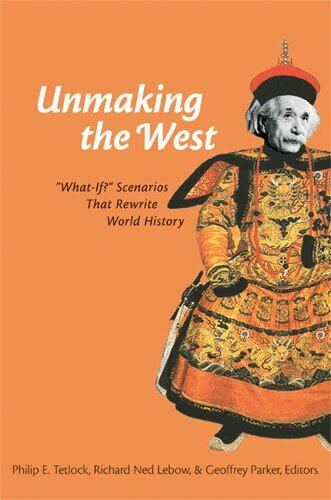
What if the Persians had won at Salamis? What if Christ had not been crucified? What if the Chinese had harnessed steam power before the West? Disparaged by some as a mere parlor game, counterfactual history is seen by others as an indispensable historical tool. Taking as their point of inquiry the debate over the inevitability of the rise of the West, the eminent scholars in Unmaking the West argue that there is no escaping counterfactual history. Whenever we make claims of cause and effect, we commit ourselves to the assumption that if key links in the causal chain were broken, history would have unfolded otherwise. Likewise, without counterfactual history we all too easily slip into the habit of hindsight bias, forgetting, as soon as we learn what happened, how unpredictable the world looked beforehand, and closing our minds to all the ways the course might have changed. This collection is thus both an exploration of alternative scenarios to world history and an exercise in testing the strengths and weaknesses of counterfactual experiments."If ever there was an argument for the usefulness of counterfactual history, this admirable, and admirably focused, collection has convincingly made it."—Robert Cowley, editor of the What If?TM series"With chapters ranging from politics to war to religion to economics and to science and technology, this is the most thematically wide-ranging collection on counterfactuality. An intelligent, cutting-edge study with important things to say."—Jonathan C. D. Clark, Department of History, University of Kansas"This volume is likely to become a standard reference in the literature on historical methodology, and could have a dramatic impact on the way future generations of historians approach disciplinary inquiry. . . . By allowing readers to share in the doubts and epiphanies that lead up to the authors' epistemological revelations, the volume allows readers to grasp the rich potential of approaching their own research from a counterfactual perspective."—Aaron Belkin, Associate Professor of Political Science, University of California, Santa BarbaraPhilip E. Tetlock is Mitchell Professor, Haas School of Business, University of California, Berkeley, and author of Expert Political Judgment: How Good Is It? How Can We Know?Richard Ned Lebow is James O. Freedman Presidential Professor of Government at Dartmouth College and author of The Tragic Vision of Politics: Ethics, Interests and Orders, winner of the Alexander L. George Award for the best book in political psychology. Geoffrey Parker is Andreas Dorpalen Professor of History at Ohio State University, a Fellow of the British Academy, and author of The Military Revolution: Military Innovation and the Rise of the West, 1500-1800, winner of two book prizes.