Philippe Blaudeau – författare
Visar alla böcker från författaren Philippe Blaudeau. Handla med fri frakt och snabb leverans.
2 produkter
2 produkter
2 147 kr
Kommande
Written by Liberatus, a Carthaginian deacon, this Breviarium is a short Latin treatise in 24 chapters dealing with Christological controversies in the East, from the preaching of Nestorius to the promulgation of Justinian's first edict against the Three Chapters (428-544). Probably composed shortly before mid 566, this narrative forms an original compendium of ecclesiastical information of great importance.Liberatus’ work is particularly notable for its unusual wealth of information. It provides knowledge that was not widely shared by his contemporaries, especially clerics or laymen in Africa. His account is nonetheless an unusual historiographical object. For Liberatus does not always consider the conciseness of his subject matter to be a primary requirement. Better still, he draws inspiration from the model of ecclesiastical histories, even quoting major documents in full (such as Zeno's Henoticon, 482) to discreetly undermine the foundations of imperial policy that aimed to condemn Theodore of Mopsuestia and certain writings by Theodoret of Cyrus and Ibas of Edessa (the so-called Three Chapters). Above all, drawing on documentation of Alexandrian and Chalcedonian origin, he offers a specific interpretation of the Cyrillian heritage and suggests a geo-ecclesiastical configuration that cannot be reduced to the vision and interests of the protagonists, even if it is the seat of Rome.
Del 55 - Millennium Studien/Millennium Studies
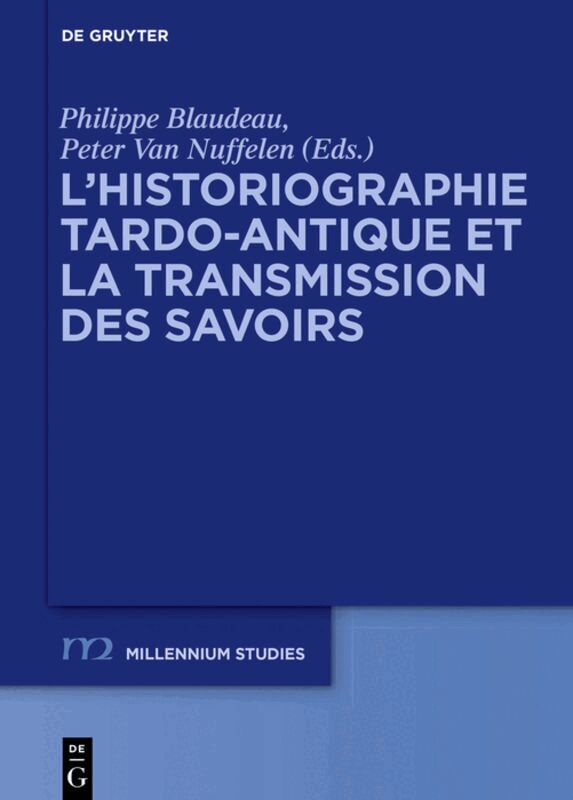
L’historiographie tardo-antique et la transmission des savoirs
Inbunden, Franska, 2015
1 982 kr
Skickas inom 5-8 vardagar
Late Antiquity witnessed enormous cultural changes, affecting all areas of intellectual life. Historiography is one of the most characteristic genres of this period and perhaps one of the most innovative ones. This volume seeks to understand how historiography both responded to the cultural changes and shaped these at the same time. Indeed, a historiographical work aims at providing its readers with experiences from the past and at interpreting these in a meaningful way and often seeks to integrate this type of knowledge into a wider body of knowledge. This theme is explored from six angles in the present volume: 1) the relationship between historiography and rhetoric; 2) the transmission of classical rhetorical culture to areas beyond the Roman Empire 3) the circulation of information, traditions and documents in the whole area of the Roman Empire and frontier areas; 4) the role played by intellectual groups (clerical and lay) in this process 5) the social, cultural, and religious variety of audiences; 6) the impact of difference in genre on the engagement with forms of knowledge.