Philippe Lacoue-Labarthe - Böcker
Visar alla böcker från författaren Philippe Lacoue-Labarthe. Handla med fri frakt och snabb leverans.
16 produkter
16 produkter
492 kr
Skickas inom 7-10 vardagar
This volume collects and translates Philippe Lacoue-Labarthe’s studies of Heidegger, written and revised between 1990 and 2002. All deal with Heidegger’s relation to politics, specifically through Heidegger’s interpretations of the poetry of HÖlderlin. Lacoue-Labarthe argues that it is through HÖlderlin that Heidegger expresses most explicitly his ideas on politics, his nationalism, and the importance of myth in his thinking, all of which point to substantial affinities with National Socialism. Lacoue-Labarthe not only examines the intellectual background--including Romanticism and "German ideology"--of Heidegger's uses and abuses of poetry, he also attempts to reestablish the vexed relationship between poetry and philosophy outside the bounds of the Heideggerian reading. He turns to Walter Benjamin and Theodor Adorno, as well as Paul Celan, arguing for the necessity of poetry as an engagement with history. While Heidegger's readings of HÖlderlin attempt to appropriate poetry for mythic and political ends, Lacoue-Labarthe insists that poetry and thought can, and must, converge in another way. Jeff Fort provides a precise translation capturing the spirit and clarity of Lacoue-Labarthe’s writing, as well as an introduction clearly situating the debates addressed in these essays.
552 kr
Skickas inom 3-6 vardagar
This book is a close reading of Jacques Lacan's seminal essay, "The Agency of the Letter in the Unconscious or Reason Since Freud, " selected for the particular light it casts on Lacan's complex relation to linguistics, psychoanalysis, and philosophy. It clarifies the way Lacan renews or transforms the psychoanalytic field, through his diversion of Saussure's theory of the sign, his radicalization of Freud's fundamental concepts, and his subversion of dominant philosophical values. The authors argue, however, that Lacan's discourse is marked by a deep ambiguity: while he invents a new "language," he nonetheless maintains the traditional metaphysical motifs of systemacity, foundation, and truth.
1 460 kr
Skickas inom 7-10 vardagar
This is a pioneering attempt to rearticulate the relationship between music and the problems of mimesis, between presentation and re-presentaion. Four "scenes" comprise the book, all four of them responses to Wagner: two by French poets (Baudelaire and Mallarme), two by German philosophers (Heidegger and Adorno).It is dificult to realize how profoundly Wagner affected the cultural and ideological sensibilities of the nineteenth century. Wagnerism rapidly spread throughout Europe, partly because of Wagner's propagandizing talent and the zeal of his adherents. But the main reason for his ascendance was the sudden appearance of what the century had desperately tried to produce since the beginnings of Romanticism - a work of art on the scale of great Greek and Christian art. At last, here it was: the secret of what Hegel called the "religion of art" rediscovered. The first two scenes of the book present a historical sequence that is punctuated by the Franco-Prussian War and the Paris Commune, in which the universal unbridling of nations and classes is prefigured. The second two register certain effects of Wagnerism that are not just ideological but make themselves felt in a new political configuration of the "national" and the "social."
356 kr
Skickas inom 7-10 vardagar
This is a pioneering attempt to rearticulate the relationship between music and the problems of mimesis, between presentation and re-presentaion. Four "scenes" comprise the book, all four of them responses to Wagner: two by French poets (Baudelaire and Mallarme), two by German philosophers (Heidegger and Adorno).It is dificult to realize how profoundly Wagner affected the cultural and ideological sensibilities of the nineteenth century. Wagnerism rapidly spread throughout Europe, partly because of Wagner's propagandizing talent and the zeal of his adherents. But the main reason for his ascendance was the sudden appearance of what the century had desperately tried to produce since the beginnings of Romanticism - a work of art on the scale of great Greek and Christian art. At last, here it was: the secret of what Hegel called the "religion of art" rediscovered. The first two scenes of the book present a historical sequence that is punctuated by the Franco-Prussian War and the Paris Commune, in which the universal unbridling of nations and classes is prefigured. The second two register certain effects of Wagnerism that are not just ideological but make themselves felt in a new political configuration of the "national" and the "social."
322 kr
Skickas inom 7-10 vardagar
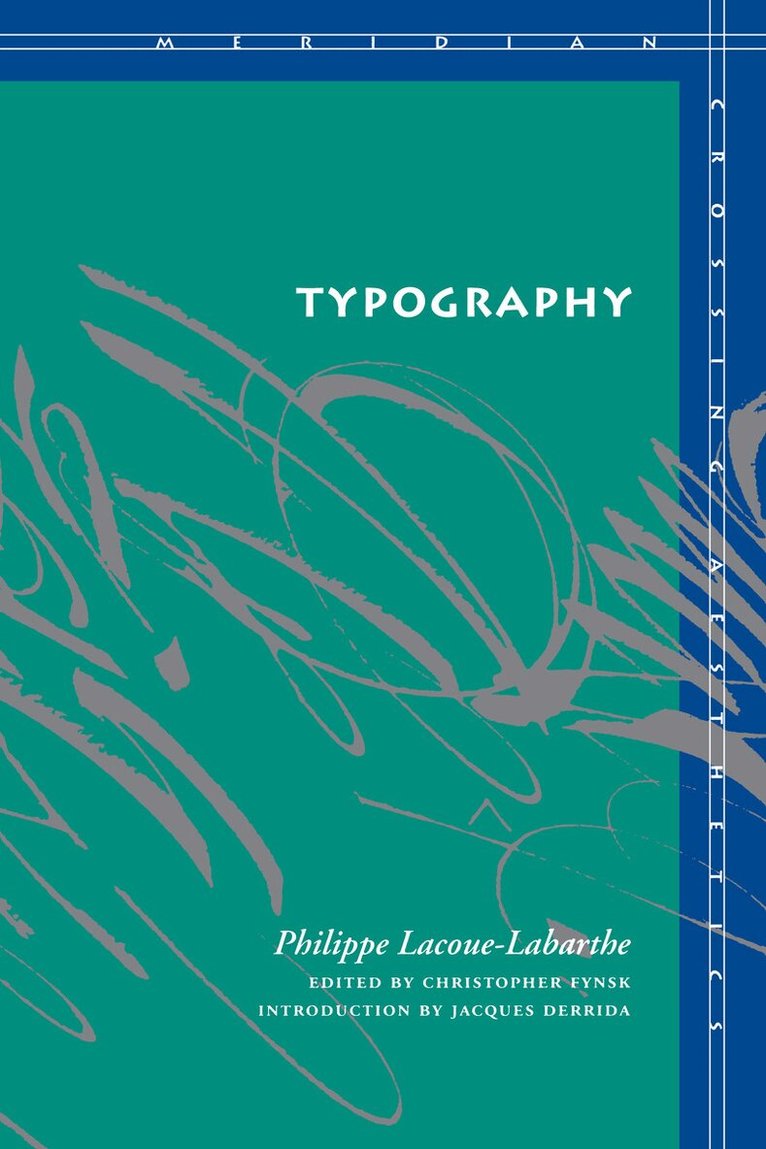
Philosopher, literary critic, translator (of Nietzsche and Benjamin), Philippe Lacoue-Labarthe is one of the leading intellectual figures in France. This volume of six essays deals with the relation between philosophy and aesthetics, particularly the role of mimesis in a metaphysics of representation.Comment [1997]"Typography is a book whose importance has not diminished since its first publication in French in 1979. On the contrary, I would say, it is only now that one can truly begin to appreciate the groundbreaking status of these essays. The points it makes, the way it approaches the questions of mimesis, fictionality, and figurality, is unique. There are no comparable books, or books that could supersede it." —Rudolphe Gasché,State University of New York, Buffalo"Lacoue-Labarthe's essays still set the standards for thinking through the problem of subjectivity without simply retreating behind insights already gained. But this book is much more than a collection of essays: it constitutes a philosophical project in its own right. Anybody interested in the problem of mimesis—whether from a psychoanalytic, platonic, or any other philosophical angle—cannot avoid an encounter with this book. Lacoue-Labarthe is a philosopher and a comparatist in the highest sense of the word, and the breadth of his knowledge and the rigor of his thought are exemplary." —Eva Geulen,New York UniversityReview"In demonstrating how mimesis has determined philosophical thought, Lacoue-Labarthe provokes us into reconsidering our understanding of history and politics. . . . Together with the introduction, these essays are essential reading for anyone interested in Heidegger, postmodernism, and the history of mimesis in philosophy and literature." —The Review of Metaphysics
295 kr
Skickas inom 7-10 vardagar
Lacoue-Labarthe's Poetry as Experience addresses the question of a lyric language that would not be the expression of subjectivity. In his analysis of the historical position of Paul Celan's poetry, Lacoue-Labarthe defines the subject as the principle that founds, organizes, and secures both cognition and action—a principle that turned, most violently during the twentieth century, into a figure not only of domination but of the extermination of everything other than itself. This thoroughly universal, abstract, and finally suicidal subject eradicates all experience, save the singularity of this experience of voiding. But what is left, as Paul Celan insisted, is a remainder to the lyric voice alone: Singbarer Rest.Lacoue-Labarthe's detailed analyses of two decisive poems by Celan, "Tübingen, Jänner" and "Todtnauberg"—the one a response to Hölderlin, the other to Heidegger—and his sustained reading of "The Meridian" present Celan's verse of singularity as the movement at and beyond the border of generalizable experience, i.e., as an experience, a traversing of a dangerous field, in which language no longer dominates anything, but rather commemorates the voiding of concepts and the collapse of the constitutive powers of the subject. For Lacoue-Labarthe, poetry after the Shoah, the poetry of bared singularity, is no longer a poetry that would correspond to the concept of the subject—or, for that matter, to the concept of poetry—but is rather the language of the decept. Only by being disappointed of the heroic language of idealistic poetry, and of the mytho-ontological tendencies of philosophy, can Celan's poetry keep open the possibility of another history, another future.
1 051 kr
Skickas inom 10-15 vardagar
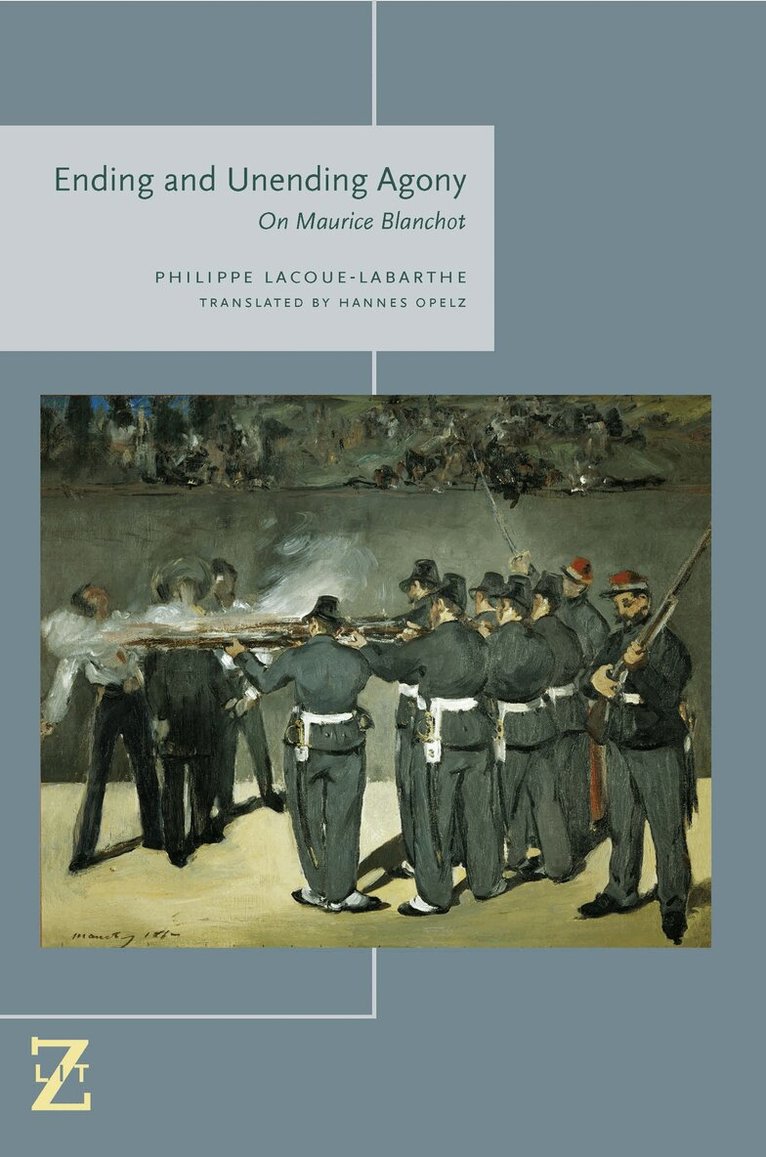
Published posthumously, Ending and Unending Agony is Philippe Lacoue-Labarthe's only book entirely devoted to the French writer and essayist Maurice Blanchot (1907–2003). The place of Blanchot in Lacoue-Labarthe's thought was both discreet and profound, involving difficult, agonizing questions about the status of literature, with vast political and ethical stakes.Together with Plato, Holderlin, Nietzsche, Benjamin, and Heidegger, Blanchot represents a decisive crossroads for Lacoue-Labarthe's central concerns. In this book, they converge on the question of literature, and in particular of literature as the question of myth—in this instance, the myth of the writer born of the autobiographical experience of death.However, the issues at stake in this encounter are not merely autobiographical; they entail a relentless struggle with processes of figuration and mythicization inherited from the age-old concept of mimesis that permeates Western literature and culture. As this volume demonstrates, the originality of Blanchot's thought lies in its problematic but obstinate deconstruction of precisely such processes.In addition to offering unique, challenging readings of Blanchot's writings, setting them among those of Montaigne, Rousseau, Freud, Winnicott, Artaud, Bataille, Lacan, Malraux, Leclaire, Derrida, and others, this book offers fresh insights into two crucial twentieth-century thinkers and a new perspective on contemporary debates in European thought, criticism, and aesthetics.
371 kr
Skickas inom 7-10 vardagar
Published posthumously, Ending and Unending Agony is Philippe Lacoue-Labarthe's only book entirely devoted to the French writer and essayist Maurice Blanchot (1907–2003). The place of Blanchot in Lacoue-Labarthe's thought was both discreet and profound, involving difficult, agonizing questions about the status of literature, with vast political and ethical stakes.Together with Plato, Holderlin, Nietzsche, Benjamin, and Heidegger, Blanchot represents a decisive crossroads for Lacoue-Labarthe's central concerns. In this book, they converge on the question of literature, and in particular of literature as the question of myth—in this instance, the myth of the writer born of the autobiographical experience of death.However, the issues at stake in this encounter are not merely autobiographical; they entail a relentless struggle with processes of figuration and mythicization inherited from the age-old concept of mimesis that permeates Western literature and culture. As this volume demonstrates, the originality of Blanchot's thought lies in its problematic but obstinate deconstruction of precisely such processes.In addition to offering unique, challenging readings of Blanchot's writings, setting them among those of Montaigne, Rousseau, Freud, Winnicott, Artaud, Bataille, Lacan, Malraux, Leclaire, Derrida, and others, this book offers fresh insights into two crucial twentieth-century thinkers and a new perspective on contemporary debates in European thought, criticism, and aesthetics.
993 kr
Skickas inom 7-10 vardagar
In February 1988, philosophers Jacques Derrida, Hans-Georg Gadamer, and Philippe Lacoue-Labarthe came together in Heidelberg before a large audience to discuss the philosophical and political implications of Martin Heidegger's thought. This event took place in the very amphitheater in which, more than fifty years earlier, Heidegger, as rector of the University of Freiburg and a member of the Nazi Party, had given a speech entitled "The University in the New Reich." Heidegger's involvement in Nazism has always been, and will remain, an indelible scandal, but what is its real relation to his work and thought? And what are the responsibilities of those who read this work, who analyze and elaborate this thought? Conversely, what is at stake in the wholesale dismissal of this important but compromised twentieth-century philosopher?In 1988, in the wake of the recent publication of Victor Farias's Heidegger and Nazism, and of the heated debates that ensued, these questions had become more pressing than ever. The reflections presented by three of the most prominent of Heidegger's readers, improvised in French and transcribed here, were an attempt to approach these questions before a broad public, but with a depth of knowledge and a complex sense of the questions at issue that have been often lacking in the press. Ranging over two days and including exchanges with one another and with the audience, the discussions pursued by these major thinkers remain highly relevant today, especially following the publication of Heidegger's already notorious "Black Notebooks," which have added another chapter to the ongoing debates over this contested figure. The present volume recalls a highly charged moment in this history, while also drawing the debate toward its most essential questions.
274 kr
Skickas inom 10-15 vardagar
In February 1988, philosophers Jacques Derrida, Hans-Georg Gadamer, and Philippe Lacoue-Labarthe came together in Heidelberg before a large audience to discuss the philosophical and political implications of Martin Heidegger's thought. This event took place in the very amphitheater in which, more than fifty years earlier, Heidegger, as rector of the University of Freiburg and a member of the Nazi Party, had given a speech entitled "The University in the New Reich." Heidegger's involvement in Nazism has always been, and will remain, an indelible scandal, but what is its real relation to his work and thought? And what are the responsibilities of those who read this work, who analyze and elaborate this thought? Conversely, what is at stake in the wholesale dismissal of this important but compromised twentieth-century philosopher?In 1988, in the wake of the recent publication of Victor Farias's Heidegger and Nazism, and of the heated debates that ensued, these questions had become more pressing than ever. The reflections presented by three of the most prominent of Heidegger's readers, improvised in French and transcribed here, were an attempt to approach these questions before a broad public, but with a depth of knowledge and a complex sense of the questions at issue that have been often lacking in the press. Ranging over two days and including exchanges with one another and with the audience, the discussions pursued by these major thinkers remain highly relevant today, especially following the publication of Heidegger's already notorious "Black Notebooks," which have added another chapter to the ongoing debates over this contested figure. The present volume recalls a highly charged moment in this history, while also drawing the debate toward its most essential questions.
355 kr
Skickas inom 11-20 vardagar
Rousseau's opposition to the theater is well known: Far from purging the passions, it serves only to exacerbate them, and to render them hypocritical. But is it possible that Rousseau's texts reveal a different conception of theatrical imitation, a more originary form of mimesis? Over and against Heidegger's dismissal of Rousseau in the 1930s, and in the wake of classic readings by Jacques Derrida and Jean Starobinski, Lacoue-Labarthe asserts the deeply philosophical importance of Rousseau as a thinker who, without formalizing it as such, established a dialectical logic that would determine the future of philosophy: an originary theatricality arising from a dialectic between "nature" and its supplements.Beginning with a reading of Rousseau's Discourse on Inequality, Lacoue-Labarthe brings out this dialectic in properly philosophical terms, revealing nothing less than a transcendental thinking of origins. For Rousseau, the origin has the form of a "scene"—that is, of theater. On this basis, Rousseau's texts on the theater, especially the Letter to d'Alembert, emerge as an incisive interrogation of Aristotle's Poetics. This can be read not in the false and conventional interpretation of this text that Rousseau had inherited, but rather in relation to its fundamental concepts, mimesis and katharsis, and in Rousseau's interpretation of Greek theater itself. If for Rousseau mimesis is originary, a transcendental structure, katharsis is in turn the basis of a dialectical movement, an Aufhebung that will translate the word itself (for, as Lacoue-Labarthe reminds us, Aufheben translates katharein). By reversing the facilities of the Platonic critique, Rousseau inaugurates what we could call the philosophical theater of the future.
950 kr
Skickas
Rousseau's opposition to the theater is well known: Far from purging the passions, it serves only to exacerbate them, and to render them hypocritical. But is it possible that Rousseau's texts reveal a different conception of theatrical imitation, a more originary form of mimesis? Over and against Heidegger's dismissal of Rousseau in the 1930s, and in the wake of classic readings by Jacques Derrida and Jean Starobinski, Lacoue-Labarthe asserts the deeply philosophical importance of Rousseau as a thinker who, without formalizing it as such, established a dialectical logic that would determine the future of philosophy: an originary theatricality arising from a dialectic between "nature" and its supplements.Beginning with a reading of Rousseau's Discourse on Inequality, Lacoue-Labarthe brings out this dialectic in properly philosophical terms, revealing nothing less than a transcendental thinking of origins. For Rousseau, the origin has the form of a "scene"—that is, of theater. On this basis, Rousseau's texts on the theater, especially the Letter to d'Alembert, emerge as an incisive interrogation of Aristotle's Poetics. This can be read not in the false and conventional interpretation of this text that Rousseau had inherited, but rather in relation to its fundamental concepts, mimesis and katharsis, and in Rousseau's interpretation of Greek theater itself. If for Rousseau mimesis is originary, a transcendental structure, katharsis is in turn the basis of a dialectical movement, an Aufhebung that will translate the word itself (for, as Lacoue-Labarthe reminds us, Aufheben translates katharein). By reversing the facilities of the Platonic critique, Rousseau inaugurates what we could call the philosophical theater of the future.
635 kr
Skickas inom 3-6 vardagar
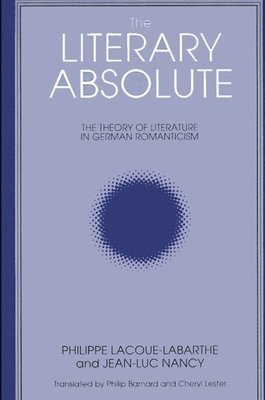
The first authoritative study of the emergence of the modern concept of literature in German romanticism.The Literary Absolute is the first authoritative study of the emergence of the modern concept of literature in German romanticism. The authors trace this concept from the philosophical crisis bequeathed by Kant to his successors, to its development by the central figures of the Athenaeum group: the Schlegel brothers, Schelling, and Novalis.This study situates the Jena romantics' "fragmentary" model of literature-a model of literature as the production of its own theory-in relation to the development of a post-Kantian conception of philosophy as the total and reflective auto-production of the thinking subject. Analyzing key texts of the period, the authors articulate the characteristics of romantic thought and at the same time show historical and systematic connections with modern literary theory. Thus, The Literary Absolute renews contemporary scholarship, showing the romantic origins of some of the leading issues in current critical theory.
409 kr
Tillfälligt slut
The first complete English translation of Lacoue-Labarthe's most innovative and original work, exploring the very origins of experience, language, desire, and mortality.Philippe Lacoue-Labarthe (1940–2007) is widely acknowledged in his native France and in the English-speaking world as one of the most important philosophers of his generation and an exceptionally rigorous reader of Heidegger, Hölderlin, Benjamin, Blanchot, and Celan. An astute thinker of the political and a far-reaching and decisive analyst of the place of theater and music in Western metaphysics, Lacoue-Labarthe also had another, clandestine passion for something called "poetry" or "literature," though he would remain deeply suspicious of these words. Phrase is his most original work, a sequence of texts both autobiographical and philosophical, written in lucid prose and in free verse over a period of more than twenty-five years.Published here in its entirety for the first time in English, Phrase is a profoundly moving meditation on the relationship between love and mortality, language and embodiment, writing and inspiration, memory and hope, loss and recompense, and music and silence. At its heart is a probing awareness of the mysterious gift of language itself, and of the perpetually elusive yet obsessive "phrase" that informs all human existence and provides the book with its lapidary title and distinctive signature. This translation also includes a postface by Jean-Christophe Bailly, one of Lacoue-Labarthe's most long-standing friends and interlocutors, and incorporates a number of translator's notes that will facilitate access to Lacoue-Labarthe's sometimes allusive writing. There is no better introduction to Lacoue-Labarthe's thought than Phrase, and no more compelling proof of the enduring significance of his thinking than this uniquely powerful text.
1 406 kr
Skickas inom 5-8 vardagar
The first complete English translation of Lacoue-Labarthe's most innovative and original work, exploring the very origins of experience, language, desire, and mortality.Philippe Lacoue-Labarthe (1940–2007) is widely acknowledged in his native France and in the English-speaking world as one of the most important philosophers of his generation and an exceptionally rigorous reader of Heidegger, Hölderlin, Benjamin, Blanchot, and Celan. An astute thinker of the political and a far-reaching and decisive analyst of the place of theater and music in Western metaphysics, Lacoue-Labarthe also had another, clandestine passion for something called "poetry" or "literature," though he would remain deeply suspicious of these words. Phrase is his most original work, a sequence of texts both autobiographical and philosophical, written in lucid prose and in free verse over a period of more than twenty-five years.Published here in its entirety for the first time in English, Phrase is a profoundly moving meditation on the relationship between love and mortality, language and embodiment, writing and inspiration, memory and hope, loss and recompense, and music and silence. At its heart is a probing awareness of the mysterious gift of language itself, and of the perpetually elusive yet obsessive "phrase" that informs all human existence and provides the book with its lapidary title and distinctive signature. This translation also includes a postface by Jean-Christophe Bailly, one of Lacoue-Labarthe's most long-standing friends and interlocutors, and incorporates a number of translator's notes that will facilitate access to Lacoue-Labarthe's sometimes allusive writing. There is no better introduction to Lacoue-Labarthe's thought than Phrase, and no more compelling proof of the enduring significance of his thinking than this uniquely powerful text.
318 kr
Skickas inom 3-6 vardagar