Pierella Paci - Böcker
Visar alla böcker från författaren Pierella Paci. Handla med fri frakt och snabb leverans.
6 produkter
6 produkter
61 kr
Tillfälligt slut
172 kr
Skickas inom 10-15 vardagar
Working Through the Crisis
Jobs and Policies in Developing Countries During the Great Recession
Häftad, Engelska, 2013
337 kr
Skickas inom 10-15 vardagar
The end of the MFA was followed by rising apparel exports, falling prices, and a reallocation of production and employment between countries. There were also significant changes within countries. The first main finding of this report is that export and employment patterns after the MFA/ATC did not necessarily match predictions. While many predicted that production would shift to low-wage countries, this book shows that only 13% of variation in export changes post-MFA can be explained by the differences in wage levels. Second, changes in exports are usually, but not always, good indicators of what happens to wages and employment within countries. This is especially important for policy because it shows that simply using exports as a metric of 'success' in terms of helping the poor is not sufficient. Third, the Book identifies the specific ways that changes in the global apparel market affected earnings. The Book shows that wage premiums change in predictable ways: rising (in most cases) in countries that were proactive in adapting to the MFA phase-out and expanded their market shares, and falling in countries that failed to respond in a timely fashion to the changing environment.The book shows that promoting 'upgrading' (defined as shifting to higher-value goods, shifting up the value chain, or 'modernizing' production techniques) seems to be necessary for sustainable competitiveness in the apparel sector but does not necessarily help the poor. Policies that support upgrading need to be complemented with targeted workforce development to make sure that the most vulnerable workers are not left behind. Having a vision for the evolution of the apparel sector that incorporates developing worker skills seems crucial. Otherwise, less-skilled workers could miss out on opportunities to gain valuable work experience in manufacturing.
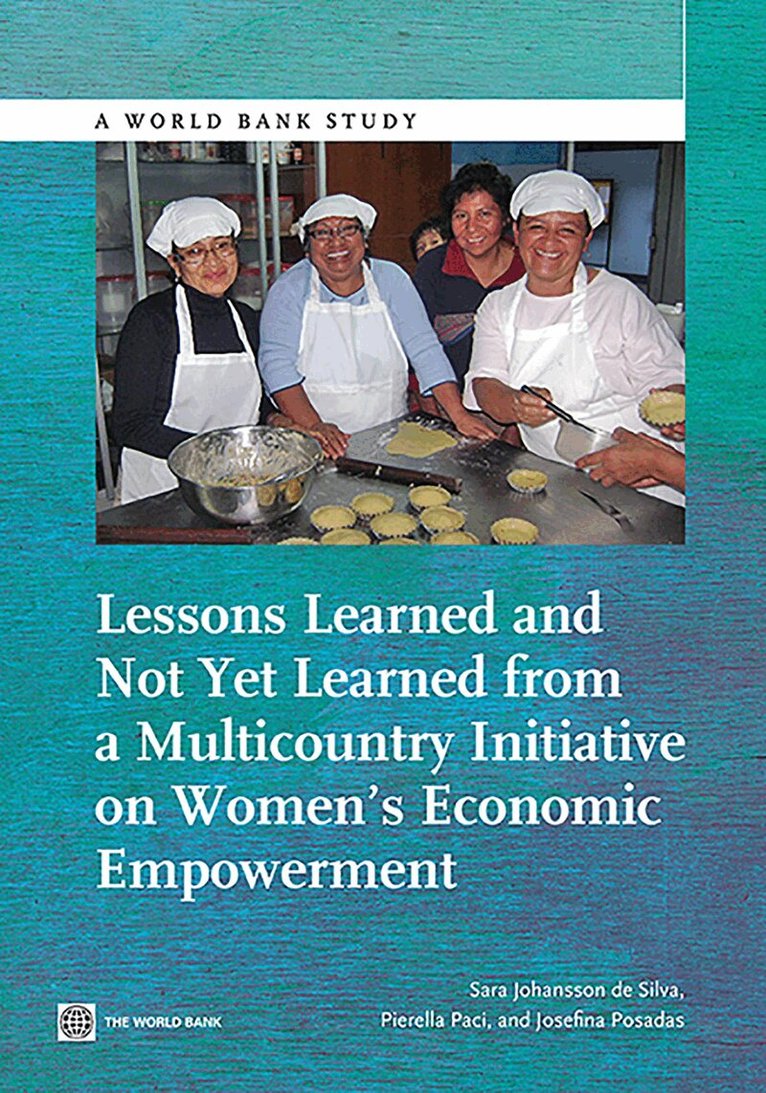
Lessons Learned and not Yet Learned from a Multicountry Initiative on Women's Economic Empowerment
Häftad, Engelska, 2014
162 kr
Skickas inom 10-15 vardagar
The Results-Based Initiatives (RBI), launched in 2007, were a pioneering attempt to provide comprehensive, coherent and rigorous evidence on effective interventions to foster the economic empowerment of women. The RBI comprised five small pilots with built-in impact evaluation designed to identify what works best in promoting better outcomes for women as entrepreneurs, wage earners or farmers, under different country contexts.The programme was an innovative experiment in an important policy area. While there is a clear rationale for policy interventions to help remove constraints to women's economic empowerment, knowledge of what interventions work best in different settings remains limited. When the RBI were conceived, rigorous evidence in this area was close to nonexistent because no systematic impact evaluations had been carried out in developing countries. However, the RBI fell short of meeting several of their ambitious objectives.This study highlights lessons from the RBI with respect to both the impact of the interventions and dos and don'ts in the design and implementation of pilots. Regarding the impact on economic opportunities, the interventions did not generally increase women's earnings, with the exception of the Peru pilot. However, women who received training generally appreciated the access to new information and felt their skills and their involvement in business associations and networks had increased.However, it would be wrong to conclude that these interventions were not effective. The lack of robust positive impact may be due to the evaluations being conducted too soon to show fully the long-term effects of the interventions, or to problems in the design, implementation, or measurement of pilot outcomes. In particular, there was a clear need of an 'early warning system' to synchronise the corrections in the interventions with the design of the impact evaluation. The RBI were overambitious regarding what could be achieved with a limited budget and a short time frame.
203 kr
Skickas inom 10-15 vardagar
Improving the returns to labour for low-paid workers is a key policy challenge, especially in low-income countries (LICs) where earnings increases are the single most important source of poverty reduction and an important engine of shared prosperity. Yet, the understanding of individual earnings dynamics remains limited. The small - but growing - body of empirical literature on the factors leading to larger and faster pay increases points to strong persistence in earnings over time. However, it remains unclear to what extent this is due to differences in individual endowments rather than to the fact that being in low-paying jobs itself undermines future earnings prospects, and to what extent determinants of earnings vary across types of activities and sectors. The knowledge gap is particularly large for LICs due to the limited availability of reliable panel data.This study uses unusually rich longitudinal data from Ghana and Tanzania to identify engines of, and barriers to, earnings and earnings mobility. It examines the relative role of individual endowments–such as gender, age, and skills–and characteristics of the job, but also focuses on the role of job switches–for example, moves into and out of self-employment. The analysis also zooms in on the drivers of transitions between low-paying and high-paying jobs and addresses questions such as whether being low paid is a transitory or permanent phenomenon, and whether it has a scarring effect on an individual's employment prospects. The extent to which earnings dynamics differ for women and young adults is also discussed in detail. Tanzania and Ghana provide a particularly relevant context in which to examine these issues and the cross-country comparison helps shed light on the institutional factors that promote labor market mobility and entrepreneurship.The audience for this report is broad: it is an important read for policy makers, academics, and development practitioners interested in reducing poverty and promoting shared prosperity in Ghana and Tanzania. However, its relevance spans well beyond the two countries analysed to include all developing countries where self-employment in small-scale activities accounts for a very large proportion of all employment.
327 kr
Skickas inom 10-15 vardagar
Gender equality is a core development objective in its own right and also smart development policy and business practice. No society can develop sustainably without giving men and women equal power to shape their own lives and contribute to their families, communities, and countries. And yet, critical gender gaps continue to exist in all countries and across multiple dimensions.The gender module of the World Bank’s ADePT software platform produces a comprehensive set of tables and graphs using household surveys to help diagnose and analyse the prevailing gender inequalities at the country level and over time. This book provides a step-by-step guide to the use of the ADePT software and an introduction to its basic economic concepts and econometric methods.The module is organised around the framework proposed by the World Development Report 2012: Gender Equality and Development . It covers gender differences in outcomes in three primary dimensions of gender equality: human capital (or endowments), economic opportunities, and voice and agency. Particular focus is given to the analysis and decomposition techniques that allow for further exploring of gender gaps in economic opportunities.