P.K. Vogt – författare
Visar alla böcker från författaren P.K. Vogt. Handla med fri frakt och snabb leverans.
10 produkter
10 produkter
Inbunden, Engelska, 2001
1 103 kr
Skickas inom 10-15 vardagar
This volume of CTMI provides a timely overview to the mechanisms and factors that mediate nuclear export of viral RNAs. It also covers the structure of nuclear pore complexes and experimental approaches to investigate nuclear export.
Häftad, Engelska, 2012
1 103 kr
Skickas inom 10-15 vardagar
In eukaryotic cells, the nuclear genome and its transcriptional apparatus is separated from the site of protein synthesis by the nuclear envelope. Thus, a constant flow of proteins and nucleic acids has to cross the nuclear envelope in both directions. This transport in and out of the nucleus is mediated by nuclear pore complexes (NPCs) and occurs in an energy and signal-dependent manner. Thus, nucleocytoplasmic translocation of macro molecules across the nuclear envelope appears to be a highly specific and regulated process. Viruses that replicate their genome in the cell nucleus are therefore forced to develop efficient ways to deal with the intracellulZlr host cell transport machinery. Historically, investigation of Polyomavirus replication allowed identification ofsequences that mediate nuclear import, which led subsequently to our detailed understanding of the cellular factors that are involved in nuclear import. Transport ofmacromolecules in the opposite direction, however, is less well understood. The investigation of retroviral gene expression in recent years pro vided the first insights into the cellular mechanisms that regulate nuclear export. In particular, the detailed dissection of the function of the human immunodeficiency virus type I (HIV-I) Rev trans-activator protein identified CRMI, as a hona fide nuclear export receptor. CRM I appears to be involved in the nucleocytoplasmic translocation of the vast majority of viral and cellular proteins that have subsequently been found to contain a Rev-type leucine-rich nuclear export signal (NES).
Del 249 - Current Topics in Microbiology and Immunology
DNA Methylation and Cancer
Häftad, Engelska, 2011
556 kr
Skickas inom 10-15 vardagar
This book is a comprehensive survey of new and exciting developments regarding the role of DNA methylation in human cancer. Issues related to the mutagenicity of 5-methylcytosine and the increase in the interaction of chemical and physical carcinogens with these residues is discussed. The book summarizes the modulation of viral gene expression and the silencing of tumor suppressor genes and illustrates mechanisms by which the methylation signal is translated into altered chromatin structure. The relationship between DNA methylation and genomic imprinting and cancer, and changes in CpG island methylation which occur in aging are discussed. Mouse model systems have played a key role in our dissection of the relationship between methylation and cancer, and these are also portrayed together with descriptions of new clinical trials in which methylation inhibitors are being used to treat leukemia, myeloid dysplastic syndromes and hemoglobinopathies.
Del 103 - Current Topics in Microbiology and Immunology
Retroviruses 1
Häftad, Engelska, 2011
1 103 kr
Skickas inom 10-15 vardagar
1. 1 Scope of the Review This review was intended initially as a reference source for those interested in the origins and fITst descriptions ofthe defective avian sarcoma viruses. Quite a few of these viruses have been characterized in the past few years and their varied nomenclature according to source, discoverer, date of isolation or biological properties could result in some con fusion among those attempting to follow the literature. Information will be included on the molecular biology of the sarcoma viruses, rather more of which is available than when the review was fITst conceived, although in this respect the review will inevitably be out of date by the time of publication. If any bias of content is introduced, this will be towards a more detailed coverage of the author's own area of interest, the gene products of the defective sarcoma viruses. Rous sarcoma virus (RSV) serves as the model for much of this work and will frequently be referred to for comparative purposes, as will the mammalian defective transforming viruses. Recent reviews provide more complete coverage of these topics (l-4a). This review is complemented by a discussion ofthe avian acute leukaemia viruses, which appears elsewhere in this volume [5]. As will be seen, concentrating primarily on the defective sarcoma viruses and comparing them to RSV can be justified in terms of their biochemical properties as well as their similar biology.
Del 107 - Current Topics in Microbiology and Immunology
Retroviruses 2
Häftad, Engelska, 2011
1 103 kr
Skickas inom 10-15 vardagar
Del 106 - Current Topics in Microbiology and Immunology
Mouse Mammary Tumor Virus
Häftad, Engelska, 2011
556 kr
Skickas inom 10-15 vardagar
Häftad, Engelska, 2011
1 103 kr
Skickas inom 10-15 vardagar
Del 115 - Current Topics in Microbiology and Immunology
Human T-Cell Leukemia Virus
Häftad, Engelska, 2011
1 103 kr
Skickas inom 10-15 vardagar
characteristic features in common with the genome of other retroviruses: long terminal repeats (L TR), and coding regions for internal proteins (gag), for re verse transcriptase (pol), and for glycosylated virion surface proteins (env) , ar ranged in the sequence gag, pol, env from the 5' to the 3' end of the genome. However, the HTL V genome also contains some specific features not shared with all other retroviruses: the LTR regions are unusually long (745 base pairs, with 298 base pairs constituting the R region), but unlike the long L TRs of mouse mammary tumor viruses, they do not contain open reading frames. A stretch of noncoding sequences separates the gag and the pol genes. Most interestingly, the HTLV genome contains a region between the 3' end of the env gene and the L TR, called the pX region, that encompasses four open reading frames. Leukemic T cells freshly obtained from patients contain the HTL V provirus but usually do not express it. However, once established in culture, these cells produce viral proteins and release type C particles. Likewise, T cells infected and transformed by HTL V in vitro synthesize virus. Such producing cell lines have been widely used in seroepidemiological surveys and continue to be of importance for detailed studies of viral proteins and nucleic acids.
Del 123 - Current Topics in Microbiology and Immunology
Retroviruses 4
Häftad, Engelska, 2011
1 103 kr
Skickas inom 10-15 vardagar
The technique of microinjection along with viral genetics and molecular biology has proven useful in the correlation of retroviral polynucleotide structure with function. The advantage of this technique is the involvement of living cells where rare activities may be observed and where properties of living cells can be assayed. Future studies involving recombinant DNA molecules and the asso- ciation of proteins with nucleic acids promise to yield additional insight into the nucleotide sequences involved in the expression of viral activities. References Anderson SM, Chen JH (1981) In vitro translation of avian myeloblastosis virus RNA. J Virol 40: 107-117 Berget SM, Moore C, Sharp PA (1977) Spliced segments of the 5' terminus of adenovirus 2 late mRNA. Proc Nat! Acad Sci USA 74:3171-3175 Bishop JM (1978) Retroviruses. Annu Rev Biochem 47:35-88 Capecchi MR (1980) High efficiency transformation by direct microinjection of DNA into cultured mammalian cells. Cell 22:479-488 Chien, Y-H, Junghans RP, Davidson W (1980) Electron microscopic analysis of the structure of RNA tumor virus nucleic acids. In: Stephenson JR (ed) Molecular biology of RNA tumor viruses.
Häftad, Engelska, 2014
1 103 kr
Skickas inom 10-15 vardagar
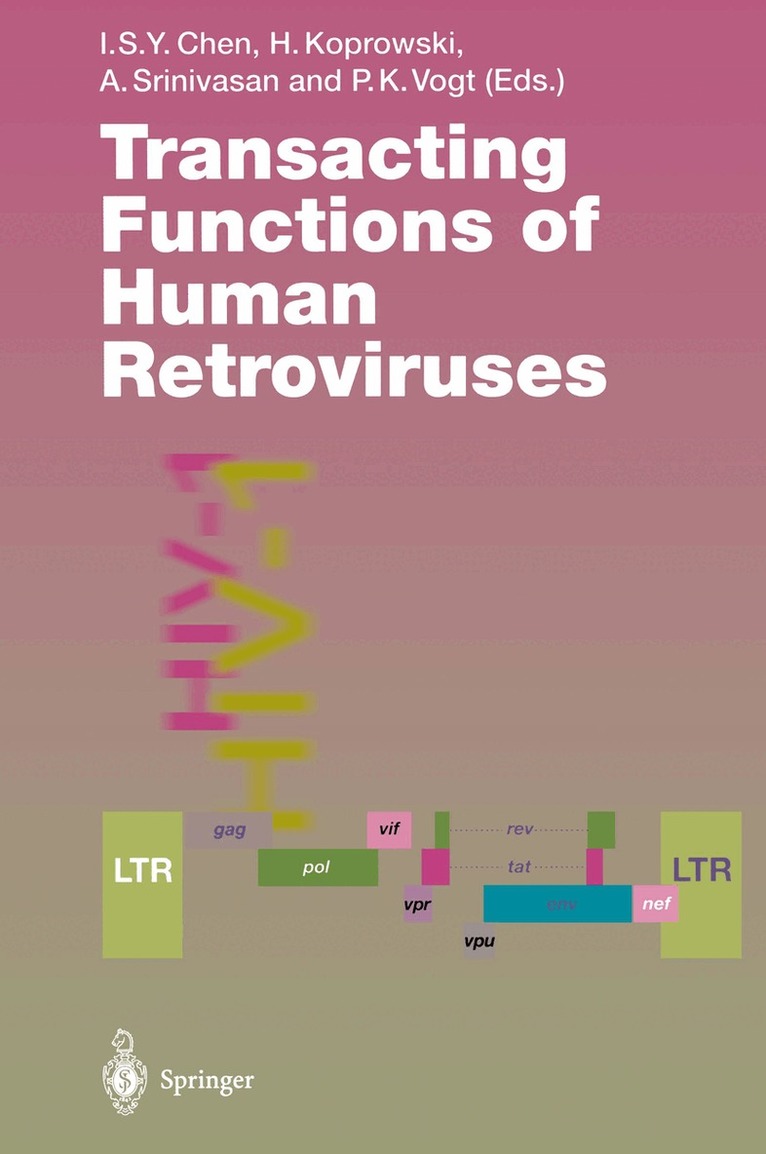
The genome of retroviruses contains three major coding regions for virion proteins, gag, pol and env. Gag encompasses information for nonglycosylated viral proteins that form the matrix, the capsid and the nucleoprotein structures. From pol derive reverse transcriptase and integrase, and env codes for the surface glycoproteins of the virion which consist of a transmembrane and a surface domain, linked by disulfide bonds. A viral protease is derived eitherfrom the gagorfrom the pol coding region, depending on the virus. Simple retroviruses contain only this elementary gag, pol, and env coding information. Once integrated, they are able to multiply efficiently, using the cellular transcriptional and replication machineries without intervention of viral transacting factors. Most oncogenic retroviruses belong in this category. Complex retroviruses, on the other hand, encode additional nonstructural proteins from multiply spliced messages. These proteins play important regulatory roles in the life cycle of the virus.They function as transacting factors that, in concert with cellular regulatory proteins, control viral gene expression and function and are essential components in the replication of complex retroviruses. To this category belong the lentiviruses, the spumaviruses and a group of oncogenic retroviruses that includes human T cell leukemia virus (HTLV) and bovine leukosis virus(BLV).