R. Cavallo - Böcker
Visar alla böcker från författaren R. Cavallo. Handla med fri frakt och snabb leverans.
5 produkter
5 produkter
1 636 kr
Skickas inom 10-15 vardagar
While general systems research has had a considerable impact on research in the social sciences, this impact has been mainly conceptual and has not served to provide the operational and methodological aids for research which are possible. In addition, many of those systems-oriented directions and results which do impact social science research have developed inde pendently and in piecemeal fashion in recent decades. The main develop ment of this book is a cohesive framework within which to integrate results of general systems research and which provides a means for the organiza tion of data and observations - and operational procedures by which to proceed - in the investigation and study of social and socio-technical systems. The book systematically develops in the first five chapters ail of the basic concepts and aspects which make up the framework, showing wherever possible the main sources of these concepts and placing them in historical perspective. The developments of the first five chapters are pulled together and integrated, in the last chapter, into a conceptual and operational general systems problem solving framework which extends the investiga tive capabilities of researchers of specific systems. The last chapter also contains an example of an overall investigation which utilizes the frame work and which proceeds from system definition through the derivation of explanatory knowledge regarding the object system and which illustrates in detail most of the concepts and elements of the framework.
1 093 kr
Skickas inom 10-15 vardagar
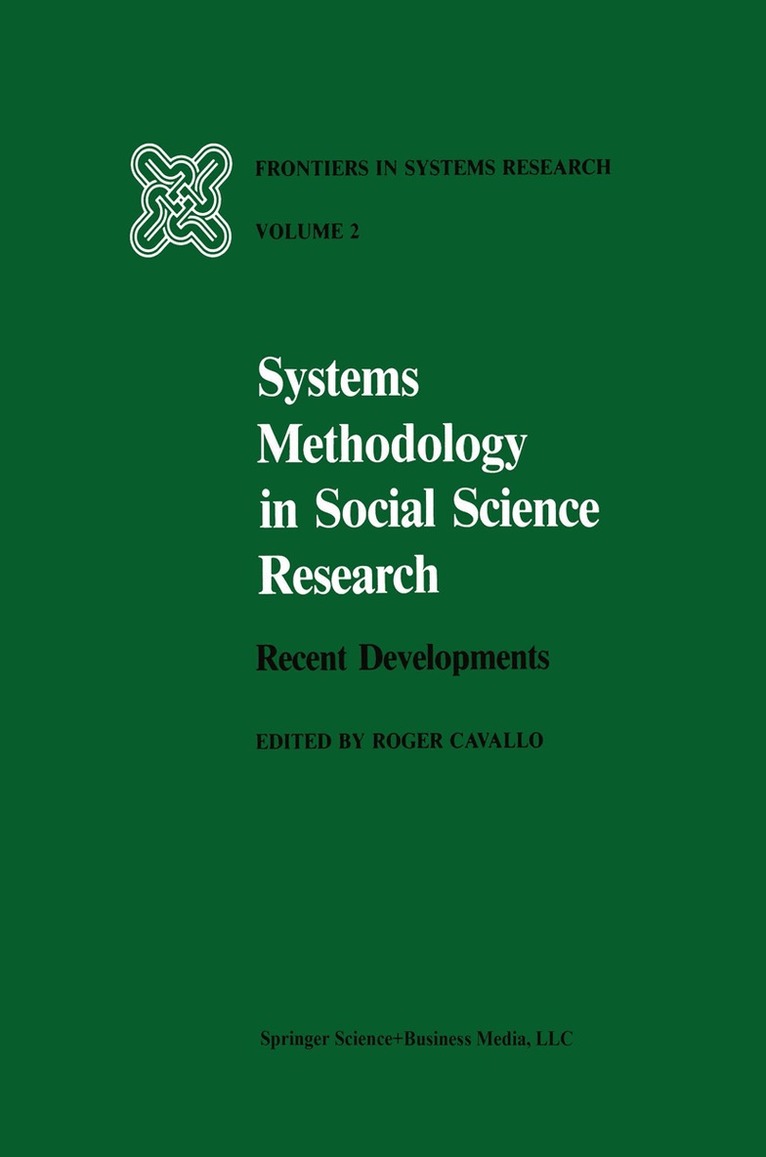
From the beginning, the systems research movement has shown a high potential for offering a conceptual framework for the understanding of social systems. Much of this potential has been realized, but a major gap remains with regard to operational investigative aids. Developments of the last ten years with a method ological orientation and emphasis seem finally to be filling this gap. The purpose of this book is to describe the most advanced of these developments and to make them available to a wider audience. The emphasis is on developments that are primarily oriented toward interaction with expertise in the social sciences and that thus hold the most promise for social systems investigation. In particu lar, attempts have been made to provide substantiation and illustration of three main points: (1) the common motivation and essential integrability that systems research provides for developments and considerations along a very broad spec trum of interests; (2) the very diverse nature of the types and forms of considera tions that may be meaningfully integrated; and (3) the operational and usable nature that developments in systems methodology represent for research in the social sciences. The book is divided into three parts with a generally increasing degree of specificity. The first part (Chapters 1, 2, and 3) deals with foundational issues associated with modeling and methodology as areas worthy of study in their ix X PREFACE own right.
1 091 kr
Skickas inom 10-15 vardagar
From the beginning, the systems research movement has shown a high potential for offering a conceptual framework for the understanding of social systems. Much of this potential has been realized, but a major gap remains with regard to operational investigative aids. Developments of the last ten years with a method ological orientation and emphasis seem finally to be filling this gap. The purpose of this book is to describe the most advanced of these developments and to make them available to a wider audience. The emphasis is on developments that are primarily oriented toward interaction with expertise in the social sciences and that thus hold the most promise for social systems investigation. In particu lar, attempts have been made to provide substantiation and illustration of three main points: (1) the common motivation and essential integrability that systems research provides for developments and considerations along a very broad spec trum of interests; (2) the very diverse nature of the types and forms of considera tions that may be meaningfully integrated; and (3) the operational and usable nature that developments in systems methodology represent for research in the social sciences. The book is divided into three parts with a generally increasing degree of specificity. The first part (Chapters 1, 2, and 3) deals with foundational issues associated with modeling and methodology as areas worthy of study in their ix X PREFACE own right.
2 096 kr
Skickas inom 10-15 vardagar
Proceedings of the CEC/IOBC Expert's Group Meeting, Pennes, France, November 1985. Forty contributions (authors are from 12 countries and two international organizations) deal with crops such as cabbages, carrots, tomatoes, potatoes, beans, and artichokes and with the particularly urgent task of red
1 632 kr
Skickas inom 10-15 vardagar
While general systems research has had a considerable impact on research in the social sciences, this impact has been mainly conceptual and has not served to provide the operational and methodological aids for research which are possible. In addition, many of those systems-oriented directions and results which do impact social science research have developed inde pendently and in piecemeal fashion in recent decades. The main develop ment of this book is a cohesive framework within which to integrate results of general systems research and which provides a means for the organiza tion of data and observations - and operational procedures by which to proceed - in the investigation and study of social and socio-technical systems. The book systematically develops in the first five chapters ail of the basic concepts and aspects which make up the framework, showing wherever possible the main sources of these concepts and placing them in historical perspective. The developments of the first five chapters are pulled together and integrated, in the last chapter, into a conceptual and operational general systems problem solving framework which extends the investiga tive capabilities of researchers of specific systems. The last chapter also contains an example of an overall investigation which utilizes the frame work and which proceeds from system definition through the derivation of explanatory knowledge regarding the object system and which illustrates in detail most of the concepts and elements of the framework.