R. David Simpson – författare
Visar alla böcker från författaren R. David Simpson. Handla med fri frakt och snabb leverans.
12 produkter
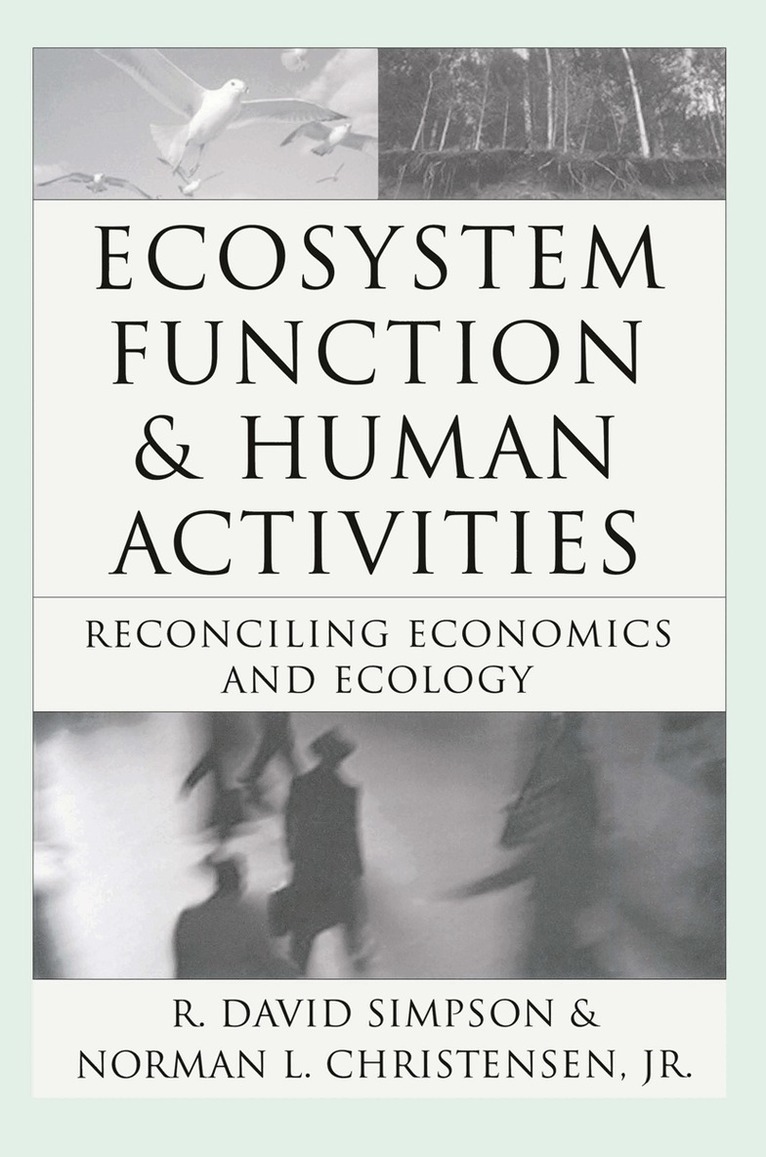
Ecosystem Function & Human Activities
Reconciling Economics and Ecology
Av R. David Simpson, Norman L. Christensen Jr.
Häftad, 1997
1094 kr
Lägg i varukorg
R. David Simpson Norman L. Christensen, Jr. Human Activity and Ecosystem Function: Reconciling Economics and Ecology Recognizing the need to improve social decision making on tradeoffs between economic growth and ecological health, the Renewable Natural Resources Foundation convened a workshop in …
Productivity in Natural Resource Industries
Improvement through Innovation
Inbunden, 1999
1527 kr
Lägg i varukorg
Several senior natural resource analysts study the role played by innovation, particularly technological innovation, in the pursuit of heightened productivity. Increasing the output of a given input improves a firm‘s bottom line, makes it more competitive internationally, and reduces the potential …
La Pared
E-bok, 2020
70 kr
Lägg i varukorg
Es el año 410 dC y las órdenes de Roma son evacuar a todos los soldados y sus familias del Muro de Adriano de Inglaterra y regresar para ayudar a defender Roma. Dos adolescentes; Cassia, la hija del Comandante y Felix, el hijo de un soldado común junto con su madre.,debe aprender las duras …
Arido Americano
E-bok, 2020
65 kr
Lägg i varukorg
Cinco personas en cinco áreas de Canadá y Estados Unidos se ven envueltas en una guerra por las necesidades estadounidenses de agua. Esta es la historia de una guerra ecológica internacional, entrelazada con la política de poder, el amor y la muerte. El agua, el recurso más valioso de la humanidad, …
A Muralha
E-bok, 2021
62 kr
Lägg i varukorg
O ano é 410 DC, as ordens são para que o exército romano e suas famílias deixem a ''Muralha de Adriano'' e retornem a Roma. A jornada de volta para casa reúne Cássia, um menino plebeu Félix e sua mãe. Juntos, eles devem sofrer e tentar voltar para casa.
Productivity in Natural Resource Industries
Improvement through Innovation
E-bok, 2014
1052 kr
Lägg i varukorg
Several senior natural resource analysts study the role played by innovation, particularly technological innovation, in the pursuit of heightened productivity. Increasing the output of a given input improves a firm‘s bottom line, makes it more competitive internationally, and reduces the …
Productivity in Natural Resource Industries
Improvement through Innovation
E-bok, 2014
1052 kr
Lägg i varukorg
Several senior natural resource analysts study the role played by innovation, particularly technological innovation, in the pursuit of heightened productivity. Increasing the output of a given input improves a firm‘s bottom line, makes it more competitive internationally, and reduces the …
Scarcity and Growth Revisited
Natural Resources and the Environment in the New Millenium
Av Robert U. Ayres, Michael A. Toman m. fl.
E-bok, 2012
981 kr
Lägg i varukorg
In this volume, a group of distinguished international scholars provides a fresh investigation of the most fundamental issues involved in our dependence on natural resources. In Scarcity and Growth (RFF, 1963) and Scarcity and Growth Reconsidered (RFF, 1979), researchers considered the long-term …
Scarcity and Growth Revisited
Natural Resources and the Environment in the New Millenium
Av Robert U. Ayres, Michael A. Toman m. fl.
E-bok, 2012
981 kr
Lägg i varukorg
In this volume, a group of distinguished international scholars provides a fresh investigation of the most fundamental issues involved in our dependence on natural resources. In Scarcity and Growth (RFF, 1963) and Scarcity and Growth Reconsidered (RFF, 1979), researchers considered the long-term …
Ecosystem Function & Human Activities
Reconciling Economics and Ecology
Av Norman L. Christensen, R. David Simpson
E-bok, 2012
1459 kr
Lägg i varukorg
R. David Simpson Norman L. Christensen, Jr. Human Activity and Ecosystem Function: Reconciling Economics and Ecology Recognizing the need to improve social decision making on tradeoffs between economic growth and ecological health, the Renewable Natural Resources Foundation convened a workshop in …
Scarcity and Growth Revisited
Natural Resources and the Environment in the New Millenium
Av R. David Simpson, Michael A. Toman m. fl.
Inbunden, 2005
2754 kr
Lägg i varukorg
In this volume, a group of distinguished international scholars provides a fresh investigation of the most fundamental issues involved in our dependence on natural resources. In Scarcity and Growth (RFF, 1963) and Scarcity and Growth Reconsidered (RFF, 1979), researchers considered the long-term …
Scarcity and Growth Revisited
Natural Resources and the Environment in the New Millenium
Av R. David Simpson, Michael A. Toman m. fl.
Häftad, 2005
811 kr
Lägg i varukorg
In this volume, a group of distinguished international scholars provides a fresh investigation of the most fundamental issues involved in our dependence on natural resources. In Scarcity and Growth (RFF, 1963) and Scarcity and Growth Reconsidered (RFF, 1979), researchers considered the long-term …